Prime Tree Care provides professional tree and shrub fertilization services throughout Chicago, helping trees overcome nutrient deficiencies, compacted clay soils, root stress, and environmental pressures. Our customized root-zone treatments improve vigor, strengthen root systems, enhance growth, and increase resilience against pests, disease, and severe weather.
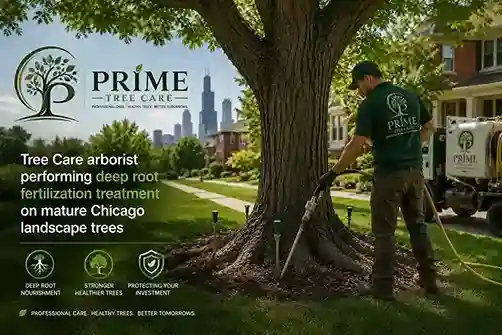
Trees growing in a natural forest rarely need fertilizer. Fallen leaves decompose into the soil every year, root systems spread freely through loose, undisturbed earth, and a healthy web of fungi and organic matter keeps nutrients cycling exactly where roots can reach them. Chicago trees don't get any of that. A parkway tree or backyard shade tree grows in a narrow soil pocket surrounded by concrete, turf, and compacted fill dirt — and every one of the natural systems that would normally feed it has been stripped away.
Instead, urban trees throughout Chicago and the surrounding suburbs contend with a specific set of stressors: dense clay soils that resist root penetration, soil compaction from decades of foot traffic and vehicles, limited root space under sidewalks and driveways, construction damage from additions, utility work, or nearby development, road salt exposure every winter, seasonal drought stress, pollution from urban air and runoff, and steady nutrient depletion from lawns that are raked, bagged, and hauled away instead of left to decompose.
Add these factors together over a tree's lifetime and the result is a slow, cumulative decline — thinning canopies, weak seasonal growth, and reduced resistance to pests and disease. Fertilization doesn't just "feed" a tree; it's a targeted correction for conditions the urban environment created in the first place. Understanding why a Chicago tree is nutrient-stressed is the first step in reversing it, which is why every fertilization program we design starts with a real diagnosis of the site, not a generic feeding schedule.
These symptoms often show up gradually, which is why many Chicago property owners don't notice the decline until it's advanced. Here's what to watch for.
Chlorotic, pale, or yellowing foliage often signals an iron, manganese, or nitrogen deficiency tied to Chicago's high-pH clay soils.
Undersized leaves compared to prior seasons usually mean the root system can't take up enough nutrients to support full growth.
A thinning crown with visible gaps is a classic early indicator of root-zone stress and declining vigor.
Noticeably shorter twig extension year over year points to a tree that's surviving, not thriving.
Leaves dropping in mid-summer, well before fall color, often reflects drought or nutrient stress rather than normal seasonal cycles.
Dead twigs and branch tips, especially in the upper canopy, indicate the tree is redirecting limited resources away from its extremities.
Ornamental and flowering species that bloom lightly or skip a season are frequently nutrient- or energy-limited.
A tree that looks the same size three years in a row isn't dormant — it's stalled.
Leaves that are sparse or undersized across the whole canopy suggest the root system isn't supporting full leaf-out.
Stressed, nutrient-deficient trees emit different chemical signals that attract more borers, aphids, and scale insects.
Exposed, girdling, or shallow roots, plus soil that stays waterlogged or rock-hard, point to compaction limiting nutrient and oxygen uptake.
Every fertilization program follows the same structured sequence, so treatment is based on your tree's actual condition — not a one-size-fits-all bag of fertilizer.
Deep root fertilization is the delivery method that makes the biggest difference for stressed, compacted, or declining Chicago trees. Here's exactly how it works and why we default to it.
Deep root fertilization injects a liquid nutrient solution directly into the soil at the depth where a tree's active feeder roots live, typically 6–12 inches below grade, rather than spreading granular fertilizer across the surface of the lawn.
Using a soil probe or injector, our arborists place nutrients on a grid pattern throughout the root zone, delivering a balanced mix of macro- and micronutrients precisely where fine feeder roots can absorb them immediately.
On Chicago's compacted clay lawns, surface-applied fertilizer is largely captured by turf grass, washes off in rain, or simply can't penetrate hardpan soil to reach a tree's roots several inches down.
Beyond nutrient delivery, the injection process itself loosens compacted soil and introduces air pockets, giving roots better access to oxygen — a critical, often-overlooked benefit on dense clay sites.
We recommend deep root fertilization for trees showing decline symptoms, trees recovering from construction or drought stress, newly transplanted trees establishing root systems, mature trees in compacted clay soils, and any tree where a soil or foliar test confirms a nutrient deficiency. It's also an effective preventive measure for high-value or historically significant trees property owners want to protect long term.
Much of Chicago and Cook County sits on dense, poorly-drained clay left behind by glacial activity. It's one of the single biggest obstacles to tree health across the region.
Clay particles are microscopically small and pack tightly together, leaving little pore space for air, water, or root growth compared to loam or sandy soils.
Foot traffic, vehicles, and construction equipment compress clay even further, squeezing out the pore space roots depend on to expand.
Clay drains slowly, which means root zones can stay saturated after rain — starving roots of oxygen even while the soil looks wet and "healthy."
Roots need oxygen to take up nutrients and water. Compacted, waterlogged clay creates a low-oxygen environment that suppresses root function even when nutrients are present.
Dense clay physically resists root penetration, often forcing root systems to stay shallow, wide, and more vulnerable to drought and wind.
We combine deep root injection with soil aeration, organic amendments, and mulching recommendations to gradually rebuild soil structure around a tree's root zone over multiple seasons.
Different deficiencies produce different symptoms. Identifying the right one is what separates an effective treatment plan from guesswork.
| Nutrient | Common Symptoms | Potential Impact |
|---|---|---|
| Nitrogen | Pale green or yellowing older leaves, thin canopy, reduced shoot growth | Slower overall growth and reduced vigor |
| Phosphorus | Dull, dark-green or purplish foliage, stunted root development | Weaker root establishment, poor stress recovery |
| Potassium | Leaf scorch, browning leaf edges, weak twig growth | Reduced drought and disease tolerance |
| Iron | Yellow leaves with dark green veins (interveinal chlorosis), common in high-pH clay | Reduced photosynthesis, thin canopy |
| Manganese | Similar interveinal yellowing, most visible on newer growth | Slowed growth, weakened new foliage |
| Magnesium | Yellowing between veins on older leaves, premature leaf drop | Reduced energy production, canopy thinning |
Left uncorrected, these deficiencies compound: leaf discoloration reduces a tree's ability to photosynthesize, which slows growth further, which in turn increases susceptibility to disease and pest pressure. Catching a deficiency early, before it cascades, is one of the biggest advantages of a proactive fertilization program.
Chicago's urban forest leans heavily on a handful of species. Each responds to fertilization a little differently.
Ash trees surviving emerald ash borer pressure or recovering after treatment benefit significantly from fertilization that supports vigor and helps them fend off secondary stress.
Mature oaks in compacted clay yards often show slow, steady decline that responds well to deep root treatment and long-term soil improvement.
Common throughout Chicago yards and parkways, maples are prone to iron chlorosis in alkaline clay soils and respond quickly to micronutrient correction.
Elms carrying the extra stress of Dutch elm disease pressure benefit from fertilization that strengthens overall vigor and resilience.
A widely planted street tree in Chicago, honey locust responds well to nitrogen and micronutrient correction after construction or drought stress.
A tough native tolerant of urban conditions, hackberry still benefits from periodic fertilization when planted in heavily compacted soil.
Flowering ornamentals like crabapple and serviceberry often show improved bloom and color with a balanced feeding program.
Arborvitae, spruce, and pine can struggle in Chicago's clay and salt-exposed sites; targeted fertilization supports winter hardiness and needle retention.
A well-executed fertilization program compounds over time. Here's what property owners can expect.
Better nutrient and oxygen access builds a deeper, more resilient root structure over successive seasons.
Trees put on healthier shoot extension and fuller canopies once deficiencies are corrected.
A well-fed root system can access and hold moisture more effectively during Chicago's dry summer stretches.
Stronger roots and wood tissue hold up better against Chicagoland's high-wind derecho events.
Well-nourished trees are less attractive to opportunistic pests and better equipped to fight off infection.
Correcting chlorosis and nutrient gaps restores rich, healthy foliage color through the growing season.
Consistent nutrition reduces the cumulative stress that shortens a tree's life in urban conditions.
Fertilization speeds recovery for trees whose roots were disturbed by nearby digging, grading, or utility work.
Fertilization is one tool among several. Here's how it compares to other services, and when each one applies.
| Condition | Fertilization | Disease Treatment | Pruning | Removal |
|---|---|---|---|---|
| Nutrient deficiency / chlorosis | ✔ Primary solution | — | — | — |
| Fungal or pest infection | Supportive | ✔ Primary solution | Sometimes helps | If untreatable |
| Structural weak points, crossing limbs | — | — | ✔ Primary solution | — |
| Dead, hazardous, or storm-damaged tree | — | — | — | ✔ Primary solution |
| Post-construction root stress | ✔ Primary solution | Supportive | Supportive | — |
Fertilization is the right call when the underlying problem is nutritional or soil-based. It's not a substitute for treating an active disease or pest infestation, correcting a structural defect, or removing a tree that's beyond recovery — which is why our evaluations always confirm the actual cause of decline before recommending a fertilization program.
Fertilization works best as part of a broader tree health strategy, not an isolated fix. We regularly pair it with:
A full diagnostic confirms whether nutrient deficiency is the primary issue, or whether disease or pests are also involved.
Removing deadwood and improving structure reduces the energy a stressed tree has to spend, letting nutrients go toward recovery.
Aeration and soil amendment work alongside fertilization to rebuild long-term soil health, not just deliver a single season's nutrients.
Support systems protect structurally weak trees while fertilization strengthens the wood and root system underneath.
Treating an active infection alongside fertilization gives a stressed tree its best chance at a full recovery.
Multi-year maintenance plans schedule fertilization on a recurring cycle matched to your tree's ongoing needs.
Every treatment plan is designed and applied by a credentialed arborist, not a seasonal lawn-care crew.
No generic feeding schedules — every program is built around your tree's species, age, and condition.
We work in Cook County's clay-heavy soil every day and build our recommendations around it specifically.
Our goal is a healthier tree years from now, not a quick surface treatment that fades by next season.
Treatment plans are grounded in actual soil and foliar diagnosis, not a one-size-fits-all product line.
If your tree doesn't need fertilization — or needs something else instead — we'll tell you that directly.
15+ years helping Chicago property owners improve tree health through proper diagnosis, soil management, root-zone improvement, and targeted fertilization programs.
Our maple's leaves had been pale and small for two summers. Prime Tree Care did deep root fertilization in the fall and the canopy filled back in beautifully by June.
They explained exactly why our clay soil was choking the roots and what deep root injection would actually fix — no upsell, just a clear plan.
Our oak was recovering from construction damage next door. The fertilization program made a visible difference within one growing season.
Trees in urban settings like Chicago often do, even though trees in a natural forest rarely need it. Compacted clay soil, limited root space, and nutrient depletion from raked lawns mean many city trees aren't getting what a forest tree would get naturally.
Most established trees benefit from fertilization every one to two years, though the right interval depends on species, age, soil condition, and whether the tree is actively recovering from stress. Newly planted or declining trees may need more frequent applications.
Deep root fertilization injects a liquid nutrient solution directly into the soil at the depth of a tree's active feeder roots, typically 6–12 inches down, so nutrients reach the roots directly instead of being captured by surface turf.
In many cases, yes — if the decline is caused by nutrient deficiency or soil stress and the tree hasn't suffered irreversible structural damage. An arborist evaluation is the only way to confirm whether fertilization is the right fix.
Cost depends on tree size, species, number of trees, and the extent of soil correction needed. Prime Tree Care provides a free, written, on-site estimate before any work is scheduled, so you know the exact price up front.
Yes, when applied correctly. Deep root fertilization is a low-impact, precise application method that's safe for mature trees and is often the best way to support their long-term health without disturbing the surrounding root system.
Fertilization supports drought recovery by strengthening root systems and improving nutrient uptake, but it works best combined with proper watering practices rather than as a standalone drought fix.
Compacted clay soil, restricted root space, construction disturbance, road salt exposure, pollution, and lawns that are raked and bagged instead of left to decompose all contribute to nutrient deficiencies in Chicago's urban trees.
Late fall and early spring are generally the most effective windows, when trees can take up nutrients ahead of active growth without the added stress of summer heat.
Yes. Shrubs face many of the same soil and compaction challenges as trees and often show similar signs of nutrient stress — including pale foliage, sparse growth, and reduced flowering — that respond well to targeted fertilization.
Prime Tree Care provides deep root fertilization, root-zone restoration, and nutrient deficiency correction across the City of Chicago and throughout Cook County's surrounding suburbs. Every community we serve shares the same core challenges: dense clay-heavy soil, an aging tree population planted decades ago in tight urban lots, and environmental stress from road salt, drought, pollution, and construction disturbance. Our treatment plans are built around these local conditions, not generic national fertilizer guidance.
Proper fertilization helps trees withstand storms, recover from stress, and thrive for decades in Chicago's challenging urban environment. Schedule a free, no-obligation evaluation with a certified arborist today.
 Prime Tree Care