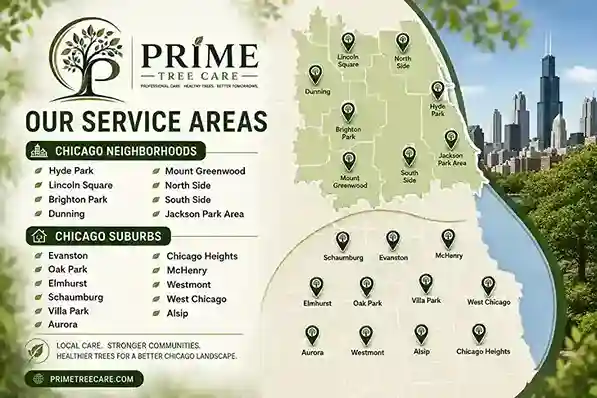
Prime Tree Care provides professional tree services throughout Chicago and surrounding suburbs including Hyde Park, Lincoln Square, Evanston, Oak Park, Schaumburg, Elmhurst, Aurora, Chicago Heights, and nearby communities. Our ISA-certified arborists help homeowners and property managers with tree removal, pruning, health inspections, storm damage response, planting, fertilization, and stump grinding tailored to Chicago's unique climate and urban forest challenges.
Tree care in Chicago is not a one-size-fits-all job. The region's dense clay soils compact easily under foot traffic and construction, restricting root growth and leaving trees more vulnerable to drought stress and storm-related failure. Layer on a long-running Emerald Ash Borer infestation, recurring Dutch Elm Disease outbreaks, and oak wilt risk in warmer months, and it becomes clear why generic "trim and remove" service isn't enough — a company needs to understand which threats are active in which part of the city, and when.
Chicago's exposure to derecho-strength straight-line winds and heavy lake-effect snow and ice loading also changes how trees should be pruned and supported. A structurally weak silver maple that survives a mild summer can fail catastrophically in a high-wind event, and heavy wet snow regularly snaps limbs that weren't properly thinned the season before.
Tree care needs also shift by geography. Dense city neighborhoods often have mature parkway trees planted decades ago, tight lot lines, and closer proximity to overhead utility lines — all of which require utility-aware pruning and coordination with the Bureau of Forestry (residents can report parkway tree issues through CHI311). Older inner-ring suburbs like Oak Park and Evanston tend to carry a similarly mature canopy with established root systems that need protecting during construction or hardscaping. Newer western suburbs such as Aurora, West Chicago, and Schaumburg, by contrast, often have younger trees that benefit most from structural training pruning and species diversification to avoid repeating the ash-monoculture mistakes of the past.
A proper tree risk assessment accounts for all of this — species, soil, sun exposure, wind corridor, proximity to structures and utility lines, and the specific regulations that apply to that property. That's the standard every Prime Tree Care evaluation is built on.
Every service below is available throughout our full Chicago and suburban coverage area, performed by ISA-certified arborists.
Emerald Ash Borer detection, canopy decline diagnosis, and disease diagnosis from certified arborists.
Learn More →Clay soil correction, root-zone improvement, and nutrient management built for Chicagoland conditions.
Learn More →Structural pruning and dormant-season scheduling, with oak wilt prevention built into our timing.
Learn More →Species diversification, ash replacement strategies, and proper site selection for long-term health.
Learn More →Hazardous tree takedowns, crane removals, and permit guidance for parkway and private trees.
Learn More →Storm damage, downed trees, and leaning trees handled with power-line safety as the top priority.
Learn More →Cabling, bracing, and wind-load reduction to prepare vulnerable trees before the next storm season.
Learn More →Full stump removal that prepares the site for replanting and restores the landscape after removal.
Learn More →Every Chicago neighborhood has its own canopy age, soil conditions, and storm exposure. Here's how we approach tree care in the areas we serve most.
Hyde Park's historic streets carry a mature, established canopy that adds significant curb appeal — and requires careful structural pruning. Lakefront weather exposure means wind and moisture stress are common considerations in our health assessments here.
View Hyde Park Tree Service →Lincoln Square's tree-lined boulevards feature mature parkway plantings that benefit from routine structural pruning. On tighter residential streets, we work carefully around close property lines and overhead utility lines.
View Lincoln Square Tree Service →In Brighton Park, tree work is often tied directly to property improvement — clearing hazardous limbs, shaping canopy for curb appeal, and preparing yards for renovation or resale.
View Brighton Park Tree Service →Dunning's mature shade trees are a neighborhood asset, but many are reaching an age where structural support or targeted pruning is needed to keep them storm-ready for Chicago's high-wind seasons.
View Dunning Tree Service →Mount Greenwood's larger residential lots often carry multiple mature trees, and recent storm activity in the area has increased demand for risk assessments and proactive cabling and bracing.
View Mount Greenwood Tree Service →The North Side's dense urban canopy sits close to power lines and pedestrian traffic, making utility-aware pruning and Bureau of Forestry coordination a routine part of parkway tree work here.
Request North Side Service →Many South Side neighborhoods have historic tree stock worth preserving. We prioritize health-first treatment plans here, reserving removal for trees that are genuinely beyond saving.
Request South Side Service →Properties near Jackson Park and Cottage Grove often border larger canopy trees and green space, which calls for careful risk assessment where private trees meet public parkland.
Request Jackson Park Area Service →From older inner-ring suburbs to newer western communities, tree conditions vary block by block. Here's what we typically see in each area.
Evanston's lakefront location and mature parkway trees mean wind exposure and established root systems are top considerations. We frequently handle structural pruning on older oaks and honey locusts here.
View Evanston Tree Service →Oak Park's historic housing stock is matched by an equally mature canopy. Root protection during renovation projects and careful pruning around older, larger trees are common requests.
View Oak Park Tree Service →Elmhurst — literally named for its elms — carries elevated Dutch Elm Disease risk, along with a strong tradition of tree-lined residential streets that benefit from consistent maintenance pruning.
Request Elmhurst Service →Schaumburg's mix of commercial corridors and residential subdivisions means we handle both commercial property tree management and typical residential removal and pruning work.
Request Schaumburg Service →Westmont's established neighborhoods have a moderate-age canopy where proactive health inspections catch early-stage EAB and disease issues before they require full removal.
Request Westmont Service →Newer developments in West Chicago benefit most from young-tree structural training and species diversification, helping avoid the ash-heavy plantings that caused widespread losses elsewhere.
Request West Chicago Service →Alsip's residential lots often include older silver maples prone to limb failure — a frequent focus of our cabling, bracing, and storm-prep recommendations in this area.
Request Alsip Service →Villa Park's dense residential blocks and close property lines call for precise, utility-aware pruning and careful removal planning around neighboring structures.
Request Villa Park Service →As one of the larger service areas we cover, Aurora spans both mature inner neighborhoods and newer subdivisions, giving us a full range of work from legacy oak preservation to new-tree planting plans.
Request Aurora Service →McHenry's more wooded, semi-rural lots often involve larger-scale land and lot clearing alongside standard residential tree maintenance.
Request McHenry Service →Chicago Heights combines older residential canopy with industrial-adjacent properties, where hazardous tree removal and clearance around structures are common priorities.
Request Chicago Heights Service →These are the issues our arborists diagnose most often across every neighborhood and suburb we serve.
This invasive beetle continues to devastate ash trees across Chicagoland. Early detection allows for treatment; advanced infestations typically require removal.
Related: Health Inspection →A fungal disease spread by bark beetles that causes rapid canopy dieback in elms, especially common in suburbs like Elmhurst with dense elm plantings.
Related: Pruning →Fast-growing but structurally weak, mature silver maples are a leading cause of storm-related limb failure throughout our service area.
Related: Support Systems →Derecho-strength winds and heavy snow loading regularly cause broken limbs, split trunks, and leaning trees across Chicago and the suburbs.
Related: Emergency Service →Mature trees in older neighborhoods frequently lift sidewalks and driveways as roots search for space in compacted soil.
Related: Root-Zone Care →Chicagoland's heavy clay soils compact easily and drain poorly, stressing root systems and limiting a tree's ability to recover from injury or drought.
Related: Fertilization →Highly contagious among oaks, oak wilt spreads through root grafts and fresh pruning wounds, making pruning timing critical in warmer months.
Related: Pruning →The same ISA-certified process, wherever you're located.
Contact us and tell us what's going on — we'll schedule an on-site visit for your neighborhood or suburb.
An ISA-certified arborist performs a full tree risk assessment, checking species, structure, and disease signs.
You receive clear, honest recommendations and a transparent estimate — no pressure, no upsells.
Our crew performs the work using modern equipment and utility-aware safety procedures.
We clear all debris and follow up to confirm you're satisfied with the result.
Every assessment and treatment plan is backed by ISA-Certified Arborist training and current best practices.
We understand how tree needs shift between city neighborhoods, older suburbs, and newer developments.
Clear, itemized estimates with no hidden fees or last-minute upsells.
Every job is covered, protecting your property and giving you peace of mind.
Storm damage doesn't wait for business hours — we offer priority dispatch when a tree becomes hazardous.
Bucket trucks, aerial lifts, crane-assisted removals, and stump grinding equipment for any job size.
We cover the greater Chicago metro area well beyond this list. Reach out and we'll confirm coverage for your address, then schedule a free, no-obligation on-site estimate with an ISA-certified arborist.
 Prime Tree Care