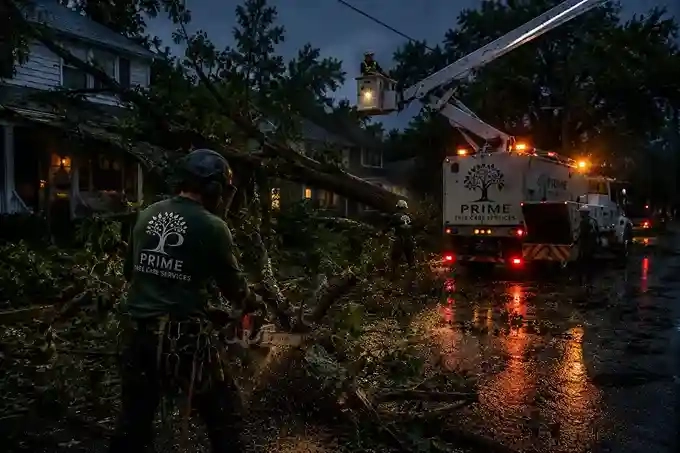
Prime Tree Care provides rapid emergency tree service throughout Chicago and surrounding suburbs. Our experienced crews respond to fallen trees, storm-damaged limbs, hazardous leaning trees, and emergencies involving structures, vehicles, and utility corridors — with safety and property protection as the first priority, every time.
Structural entry points, roof punctures, and hidden interior damage require immediate stabilization and assessment.
Garages often carry less structural reinforcement than homes, raising collapse risk under tree weight.
Weight distribution and glass hazards mean vehicles should never be approached before a crew arrives.
Emergency vehicle access and daily safety both depend on quick, controlled clearing.
A "widowmaker" limb can drop without warning and requires careful rigging to bring down safely.
A split trunk is a structural failure — the tree can come down fully with little additional force.
A new or worsening lean often signals root-plate failure underground, not just visible above-ground damage.
Always treated as energized and life-threatening until a utility company or trained crew confirms otherwise.
Lifted root plates are unstable and can shift further, even after the initial fall.
Cracking, bark separation, or visible internal decay exposed by storm stress calls for same-day evaluation.
Keep a safe distance from the entire canopy and root zone. Storm-stressed trees can continue shifting or dropping limbs well after the wind dies down.
Assume any line in contact with a tree is energized. Do not touch the tree, nearby fences, or standing water near the area.
Keep children, pets, and neighbors away. Use cones, tape, or a visible barrier if it's safe to place one from a distance.
Call 911 for downed power lines, gas leaks, trapped individuals, or any active life-safety threat.
Photograph the tree, the affected structure, and surrounding area from a safe distance for your insurance file.
Call (773) 302-8351 for 24/7 dispatch. We triage by hazard level and get a crew moving.
Report the damage to your homeowner's carrier and share our documentation and arborist report to support your claim.
Chicago's dense residential grid means mature trees frequently grow into or near overhead utility corridors, especially after high-wind events. Our crews are trained to recognize and work safely around energized power lines, and we coordinate directly with the appropriate utility provider — ComEd in most of Chicago and Cook County — before beginning any cutting or rigging near a compromised line.
This is part of standard utility vegetation management practice: line clearance work near active infrastructure follows strict protocols, restricted access zones, and coordinated shutoffs where needed. We also perform a full tree risk assessment on arrival to determine whether the hazard is isolated to the tree itself or involves compromised utility hardware, splintered poles, or transformer proximity.
Why DIY is dangerous: downed or entangled lines can be energized even if they appear inactive, ground current can travel through wet soil, bark, and standing water, and a tree under tension from a line can release suddenly when cut. If you see a tree touching a line, back away, keep others away, and call your utility provider first — then call Prime Tree Care for the tree work itself.
Your call is triaged immediately by hazard level — structure contact and power-line proximity are prioritized first.
An arborist evaluates the tree's condition, lean direction, root-plate stability, and any utility involvement on arrival.
We establish exclusion zones, coordinate with utilities if needed, and plan rigging and drop zones before any cutting begins.
Where a partial failure can be safely secured, we stabilize the tree to prevent further movement before full removal.
Sectional or crane-assisted removal, matched to the tree's size, lean, and proximity to structures.
Full cleanup of limbs, trunk sections, and wood debris, leaving the property clear and accessible.
Photo documentation and a written arborist report you can hand directly to your insurance adjuster.
We answer adjuster questions about scope of work and provide supporting detail throughout your claim.
Fast-moving, widespread straight-line windstorms capable of downing mature trees across entire neighborhoods in minutes.
Sudden downbursts push horizontally rather than rotating, snapping limbs and toppling shallow-rooted species.
Combined wind, saturated soil, and lightning strikes weaken trees that then fail hours or days later.
Ice loading adds significant weight to canopies, snapping limbs that seemed structurally sound.
Heavy, wet snow accumulation on branches is a common cause of limb failure in late-season storms.
Chicago's compacted clay soil restricts healthy root spread, making trees more prone to tipping in saturated ground.
EAB-infested ash trees become structurally unsound well before visible dieback is obvious. Learn about EAB in Chicago →
DED weakens internal wood structure, raising failure risk during wind events. Compare EAB vs. DED →
Included bark, prior improper pruning cuts, and co-dominant stems are common hidden failure points.
Proactive protection before the next storm season matters just as much as emergency response — see our storm prep & tree support systems guide.
| Factor | Emergency Removal | Scheduled Removal |
|---|---|---|
| Response time | Same day, 24/7 dispatch | Planned appointment, days to weeks out |
| Risk level | Elevated — active structural failure, storm conditions | Controlled — stable tree, planned conditions |
| Equipment needs | Often crane or rigging for unstable loads | Standard climbing or bucket-truck setup |
| Insurance involvement | Common — structure or property damage claims | Rare, typically homeowner-paid |
| Cost factors | Urgency, after-hours labor, complexity premium | Standard labor, disposal, and permit costs |
| Site conditions | Storm debris, wet ground, possible utility hazards | Clear, dry, predictable working conditions |
For non-urgent removals, see our full Tree Removal Chicago service page.
| Condition | Stabilization Possible | Removal Recommended |
|---|---|---|
| Minor lean (soft/wet soil) | Often — staking or guying | Usually not necessary |
| Storm-shifted roots | Sometimes — depends on root-plate integrity | Common if roots are torn or exposed |
| Split trunk | Rarely | Almost always |
| Structural defects (prior) | Depends on defect severity | Common if compounded by storm stress |
| Severe root failure | No | Yes — safety priority |
Where stabilization is viable, we use tree cabling and structural bracing to redistribute load and reduce future failure risk, guided by a full risk assessment of the tree's species, age, and site conditions. Learn more on our storm prep & tree support systems page.
Coverage generally applies when a tree damages your home, garage, fence, or another insured structure — not typically when it falls in open yard space.
Adjusters expect timestamped photos, a description of the event, and a professional assessment of damage and removal scope.
Most policies require reasonable steps to prevent further damage — tarping a roof or securing an area — which we can assist with on-site.
We photograph the tree, point of impact, and surrounding damage before and after removal for your claim file.
A written report describing tree condition, cause of failure, and scope of work performed, suitable for adjuster review.
We're available to answer adjuster questions directly and clarify scope, timeline, and cost breakdowns as needed.
Note on terminology: an insurance claim for a fallen branch typically follows the same documentation path as a full tree removal — photograph first, then call us for mitigation and removal.
A fallen or leaning tree threatens more than the obvious point of impact. We regularly respond to trees down on homes, across garages, through fences, blocking driveways, over pools, and onto backyard structures like sheds and decks.
A typical scenario: a mature parkway tree splits during a straight-line wind event and drops a major limb across a driveway and part of a garage roof. Our crew secures the area, stabilizes the remaining canopy, removes the limb in controlled sections, and clears debris the same visit — with photo documentation ready for your insurer.
Property managers and HOA boards carry public-safety liability the moment a hazardous tree is identified. We respond to apartment communities, office buildings, retail centers, schools, municipal properties, and HOA-managed grounds throughout Chicago and the suburbs.
For multi-unit and public-facing properties, we prioritize rapid hazard mitigation to limit liability exposure, then coordinate scheduling and reporting with property management or municipal contacts.
| Emergency Situation | Typical Cost Range |
|---|---|
| Fallen limb removal | $150 – $600 |
| Small emergency removal (under 30ft) | $500 – $1,500 |
| Medium emergency removal (30–60ft) | $1,500 – $4,000 |
| Large hazardous removal (60ft+ / mature hardwood) | $4,000 – $8,000+ |
| Crane-assisted emergency removal | $6,000 – $10,000+ |
What affects the final price:
For non-emergency pricing, see our full Tree Removal Cost Guide, and read why the cheapest tree quote is risky before hiring any crew during a storm surge.
Emergency dispatch every day of the year, including nights, weekends, and holidays.
Every emergency assessment is led by a credentialed arborist, not a subcontracted day crew.
Deep, repeated experience with Chicago's derecho and straight-line wind events.
Crane and rigging capacity for the large, tight-access, or structure-entangled jobs a smaller crew can't safely handle.
Trained protocols for utility proximity, structural risk, and unstable trees.
Photo evidence and written reports built for adjuster review from day one.
James leads Prime Tree Care's emergency response division and specializes in hazardous tree removals, storm-damage mitigation, structural stabilization, cabling systems, and safe operations around structures and utility corridors. His team responds throughout Chicago during severe weather events, helping protect people, property, and critical infrastructure.
Call Prime Tree Care's 24/7 emergency line immediately. If the tree has damaged your roof, windows, or utility connections, also contact your insurance carrier, and call 911 if there's an active safety threat like a gas leak or downed power line. Our crews assess structural risk on arrival and begin safe stabilization and removal.
A tree that has visibly shifted or developed a new lean after wind activity, with lifted soil or cracked roots at its base, should be treated as an emergency and assessed the same day, even if full removal isn't ultimately necessary.
Treat it as energized and dangerous. Stay back at least the tree's height, don't touch the tree or anything connected to it, and call your utility provider before calling us for the tree work.
We dispatch throughout Chicago and the suburbs around the clock. Response time depends on storm volume and location, but most calls are triaged and a crew is en route within hours, with life-safety hazards prioritized first.
Most homeowner policies cover emergency removal when a tree damages a covered structure. A tree falling in open yard space without hitting anything is often not covered. We provide documentation to support your claim either way.
In most cases, yes — once our crew completes a hazard assessment, controlled removal and debris clearing typically happen the same visit, provided site access, weather, and utility clearance allow it.
Stay indoors, away from windows facing large trees, and don't go outside to inspect damage until conditions are safe. Call for emergency service once the storm has passed.
Minor limb loss or a slight lean is often correctable with pruning, cabling, or bracing. A split trunk or major root failure is typically not salvageable and should be removed for safety.
Typically $150–$600 for a fallen limb, $800–$2,500 for a small to medium emergency removal, and $3,500–$10,000+ for a large, crane-assisted removal, depending on accessibility and utility involvement.
Yes — Prime Tree Care provides around-the-clock emergency tree response, including nights, weekends, and holidays, throughout Chicago and the surrounding suburbs.
Chicago's mature urban tree canopy, dense residential neighborhoods, and aging utility infrastructure combine to create real derecho and straight-line wind risk each storm season. We respond throughout the city and suburbs, including:
For the latest local storm damage patterns and event-specific updates, see our living Chicago Derecho & Storm Damage guide.
When a tree emergency threatens your home, business, family, or property, rapid professional response can reduce damage, improve safety, and help begin the recovery process immediately.
 Prime Tree Care Chicago Arborists