Home/ Services/ Tree Health Inspection & Treatment
Prime Tree Care provides ISA-certified tree health inspections throughout Chicago, helping homeowners identify Emerald Ash Borer infestations, canopy decline, disease issues, structural concerns, and environmental stress before trees become hazardous or treatment options disappear.
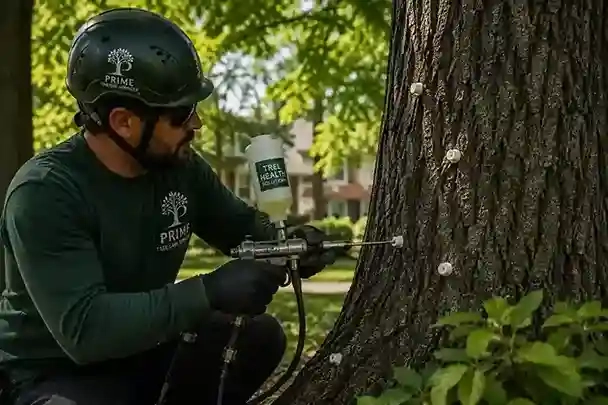
Chicago's urban forest is under more pressure than most homeowners realize. Emerald Ash Borer (EAB) has moved through nearly every neighborhood in the city and suburbs, quietly killing ash trees from the inside out long before visible symptoms appear. Dutch Elm Disease continues to threaten the region's remaining American elms, and pockets of Oak Wilt show up wherever oaks are pruned or wounded during the growing season. Add in the structural weaknesses common to Silver Maples — a species planted heavily across Chicago decades ago — and the risk of sudden limb failure is real on almost every block.
It isn't only pests and disease. Chicago's heavy clay soil compacts easily and drains poorly, restricting root growth and starving trees of oxygen. Construction projects, sidewalk replacements, and utility work regularly damage root systems without anyone noticing until the canopy starts to thin a season or two later. Winter road salt splashes onto parkway trees and leaches into soil near driveways, while Chicagoland's increasingly frequent high-wind storms add mechanical stress that a weakened tree may not survive.
Most of these problems are diagnosable years before they become an emergency — but only if someone is looking for them. A certified arborist trained to recognize early-stage decline can often set a tree on a treatment path that costs a fraction of removal, preserves property value and shade coverage, and avoids the safety risk of a tree failing unexpectedly. Waiting until a tree looks obviously sick usually means the window for treatment has already closed.
If you're noticing any of the following, it's worth having a certified arborist take a closer look before the situation worsens.
Branches with no leaves during the growing season often signal disease, root damage, or advanced pest activity.
A canopy that looks sparse compared to previous years is one of the earliest visible signs of decline.
Leaves falling well before autumn usually point to drought stress, root problems, or vascular disease.
Yellowing, browning, or unusual mottling can indicate nutrient deficiency, soil issues, or infection.
Vertical cracks or peeling bark can expose internal decay and are a common precursor to canker disease.
Mushrooms or conks at the base or trunk are a strong indicator of internal root or wood decay.
A new or worsening lean can mean root failure and is often an urgent safety concern.
Increased woodpecker feeding often means the tree already hosts a significant insect infestation, including EAB.
Small D-shaped holes in the bark are the signature sign of Emerald Ash Borer.
Construction, trenching, or grade changes near the root zone can compromise stability and nutrient uptake.
Broken limbs, split unions, or exposed wood after a storm need evaluation for infection risk and structural integrity.
Hollow sections or soft, crumbling wood reduce a tree's structural strength and raise failure risk.
Every inspection follows the same structured, six-part process so nothing gets missed — from the canopy down to the root flare.
We start with a full walk-around to establish the baseline picture before moving into detail.
The canopy tells us how the tree is functioning right now and how it has changed over recent seasons.
The trunk is examined closely for structural and pest-related warning signs.
Root health is frequently the real cause behind canopy problems homeowners notice above ground.
We check for the specific pests and pathogens most common to Chicago's tree population.
You'll receive a written report with clear next steps — treatment, monitoring, pruning, or removal — along with the reasoning behind each recommendation and honest cost expectations for every path forward.
Emerald Ash Borer (EAB) is a metallic-green invasive beetle whose larvae tunnel through the inner bark of ash trees, cutting off the flow of water and nutrients. Since arriving in the Chicago area, EAB has devastated the region's ash population — historically one of the most heavily planted street and residential trees in the city. Left undetected, EAB can kill a mature ash tree within two to four years of infestation.
Whether an ash tree can be saved comes down to how much canopy has already been lost and how structurally sound the tree remains. Here's how we generally advise homeowners:
| Condition | Treatment Recommended | Removal Recommended |
|---|---|---|
| Canopy loss under 30% | Yes — strong candidate | — |
| Canopy loss 30–50% | Often, case-by-case | Consider if declining fast |
| Canopy loss over 50% | — | Yes — treatment unlikely to succeed |
| Trunk decay or structural defects | — | Yes — safety priority |
| Near home, driveway, or power line | Lower risk tolerance advised | Often recommended sooner |
We also weigh treatment cost against the tree's long-term value — shade coverage, property value, and the years it would take a replacement tree to reach the same size — before making a recommendation. Given Chicago's extensive EAB history, we've evaluated thousands of ash trees across the region and know how quickly this decision window can close.
Beyond EAB, our arborists regularly diagnose and treat these diseases across Chicago-area properties.
Symptoms: Wilting, yellowing leaves in a single branch or section, followed by rapid canopy dieback.
Treatment: Preventive fungicide injections for high-value elms; prompt removal of infected trees to stop beetle-borne spread.
Symptoms: Leaves bronzing from the edges inward, sudden wilting in red oaks especially, rapid crown loss.
Treatment: Root graft disruption, fungicide injection for high-value oaks, and strict avoidance of pruning during active transmission season.
Symptoms: Irregular brown blotches on leaves, premature leaf drop, twig dieback in wet springs.
Treatment: Sanitation pruning, canopy thinning for airflow, and fungicide in severe or recurring cases.
Symptoms: Leaf margins browning while the interior stays green, worsening yearly, slow canopy decline.
Treatment: No cure exists; we focus on stress reduction, monitoring, and extending the tree's usable lifespan.
Symptoms: Thinning canopy, mushroom growth at the base, soft or crumbling wood near the root flare.
Treatment: Soil and drainage correction where possible; removal recommended once structural stability is compromised.
Symptoms: Sunken, discolored patches on bark or branches, oozing sap, localized dieback.
Treatment: Pruning out affected wood, improving tree vigor, and monitoring for spread to healthy tissue.
What canopy decline means: Instead of a sudden event, decline develops over one or more growing seasons as smaller leaves, sparse foliage, and dead twigs accumulate. Because the symptoms show up in the canopy, homeowners often assume the problem is "in the leaves" — but the canopy is usually the last part of the tree to show a problem that started elsewhere.
Common causes include drought stress from Chicago's variable rainfall, soil compaction in high-traffic yards, root damage from construction or trenching, grade changes near the root flare, active disease, and insect pressure such as EAB. Often more than one factor is at work simultaneously.
Why early detection matters: A tree that's caught in early-stage decline usually responds well to soil correction, fertilization, or targeted treatment. Once decline reaches 50% or more of the canopy, recovery becomes far less likely and removal often becomes the safer, more cost-effective option.
A homeowner in Elmhurst noticed thinning at the top of a mature oak after a driveway repaving. Root damage from the construction was the cause — soil decompaction and fertilization brought the canopy back over two seasons.
A Chicago Northwest Side resident assumed drought was behind a thinning ash canopy. Inspection revealed early-stage EAB — treatment was started in time to save the tree.
A Schaumburg property owner delayed a canopy inspection for two years. By the time we were called, decline had passed 60% and removal was the only safe path forward.
Not every unhealthy tree is dangerous, and not every dangerous tree looks unhealthy. A formal risk assessment evaluates the specific factors that determine whether a tree is a safety liability.
We identify the specific defects that could lead to failure — not just general "poor health."
Cracks, included bark, cavities, and co-dominant stems are evaluated for failure potential.
We assess the likelihood of whole-tree failure versus limb failure, and the timeline involved.
Trees are evaluated against Chicagoland's high-wind derecho and straight-line wind risk specifically.
Proximity to power lines factors into both risk rating and recommended mitigation approach.
We document findings clearly for homeowners, HOAs, and property managers concerned about liability exposure.
Our risk assessments support Tree Risk Assessment documentation, Utility Vegetation Management coordination, and general property protection planning for both residential and commercial clients across Chicagoland.
| Tree Species | Common Problems | Typical Recommendation |
|---|---|---|
| Ash | Emerald Ash Borer | Insecticide treatment if canopy loss is under 30%; removal beyond that |
| Elm | Dutch Elm Disease | Preventive fungicide injection for high-value trees; rapid removal if infected |
| Oak | Oak Wilt, root compaction | Avoid pruning in growing season; root graft disruption if wilt is confirmed nearby |
| Silver Maple | Weak wood, limb failure, decay | Structural pruning, cabling, or removal depending on defect severity |
| Norway Maple | Girdling roots, verticillium wilt | Root collar excavation and monitoring; selective pruning |
| Honey Locust | Canker disease, webworm | Sanitation pruning and canopy monitoring |
| Hackberry | Nipple gall, witches' broom | Generally cosmetic; monitoring recommended, treatment rarely needed |
| Kentucky Coffeetree | Minor pest pressure, transplant stress | Soil and fertilization support during establishment years |
Every inspection ends with a written recommendation. Depending on what we find, that plan may include one or more of the following.
Trunk injections or soil-applied insecticide for EAB and other boring pests.
Fungicide injection, sanitation pruning, and root graft disruption where applicable.
Soil-specific nutrient plans built for Chicago's heavy clay conditions. Learn more →
Decompaction, aeration, and drainage correction to restore root function.
Targeted cuts that reduce failure risk and improve long-term form. Learn more →
Support systems for weak unions and mature trees ahead of storm season. Learn more →
Scheduled follow-up inspections for trees in early-stage treatment or watch status.
When treatment is no longer viable, safe removal to eliminate the hazard. Learn more →
Every inspection is led by a credentialed arborist, not a rotating crew of estimators.
We diagnose against the pests, diseases, and soil conditions actually present in this region.
We recommend treatment when it makes sense — and tell you plainly when it doesn't.
Findings are based on observable evidence, not guesswork or upsell incentives.
You receive a clear written report documenting findings and next steps.
Our goal is keeping healthy trees on your property for decades, not maximizing removal jobs.
15+ years diagnosing and treating trees across Chicago's Northwest Side, specializing in Emerald Ash Borer management, disease diagnosis, and tree risk assessments.
Based in Hickory Hills, Prime Tree Care provides tree health inspections and treatment planning across the City of Chicago and surrounding Cook County suburbs — accounting for the urban tree stress, clay-heavy soil, aging tree populations, and EAB impacts specific to this region.
Early diagnosis often prevents expensive removals and helps preserve valuable mature trees. Get a free, no-obligation inspection from an ISA-certified arborist.
 Prime Tree Care