Prime Tree Care provides safe, professional tree removal services throughout Chicago for hazardous, dead, storm-damaged, and structurally compromised trees. Our ISA-certified arborists perform everything from routine removals to complex crane-assisted projects near homes, businesses, and utility corridors — while helping property owners navigate local permit requirements and safety concerns.
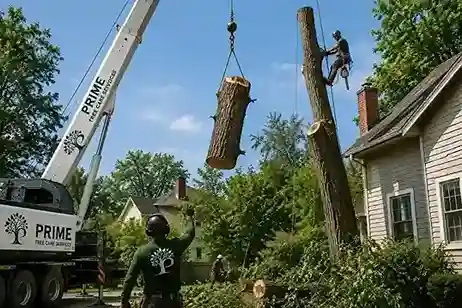
Removal is always the last recommendation, not the first. Every job Prime Tree Care evaluates starts with an on-site inspection by an ISA-certified arborist to determine whether a tree can be treated, pruned, or supported — and only moves to removal when the tree presents a genuine safety or structural risk that can't be corrected.
Chicago's mature tree canopy, clay-heavy soil, and increasingly severe storm seasons combine to create specific failure patterns our crews see repeatedly. Dead trees lose the structural integrity that living wood provides, and once a tree is fully dead, limb and trunk failure becomes a matter of when, not if. Advanced decay — often invisible from the outside — hollows out a trunk or major limb from within, and by the time fungal conks or soft, spongy wood are visible at the base, the tree may already be unsafe to climb.
Structural failure shows up as included bark, co-dominant stems splitting apart, or a canopy that has grown unevenly heavy on one side. Storm damage from Chicago's derechos, straight-line winds, and ice events can snap major limbs or crack a trunk in ways that aren't repairable. A severe lean that has developed suddenly, especially paired with lifted soil or exposed roots, often signals root failure — the tree's anchoring system giving way, which puts it at real risk of a full uproot in the next high-wind event.
Utility conflicts arise when a tree's canopy or root system grows into overhead lines or underground infrastructure, creating both a safety hazard and a maintenance conflict that a utility company will eventually force a resolution on. And irreversible disease — Dutch elm disease in mature elms or late-stage emerald ash borer infestation in ash trees, for example — reaches a point where treatment can no longer save the tree and removal protects the surrounding, still-healthy trees on the property.
In every one of these cases, our approach is the same: inspect first, treat and prune where it's genuinely possible, and only recommend removal when it's the responsible, safety-driven decision. If you're unsure which category your tree falls into, our tree health inspection and treatment service is the right starting point before any removal is scheduled.
These are the warning signs our arborists look for first during any hazard evaluation. If your tree shows one or more of these signs, it's worth scheduling an inspection before the next storm.
Dead branches lose flexibility and can fail without warning, even in light wind.
Hollowing reduces the wood available to bear the tree's own weight and wind load.
Conks and mushrooms at the root flare often indicate internal decay already underway.
Vertical or horizontal cracks can signal the trunk is under stress and close to failure.
Co-dominant trunks with included bark are prone to splitting apart under weight or wind.
Soil heaving or cracking near the base suggests the root system is losing its grip.
A new or worsening lean, especially after a storm, is one of the clearest uproot risks.
Thinning or dying foliage starting at the crown often points to root or vascular stress.
Broken limbs, stripped bark, or a cracked leader from a recent storm need prompt review.
A tree that has already dropped limbs is statistically more likely to drop more.
Strike damage can kill cambium tissue and destabilize a tree even without visible scarring.
Open cavities in the trunk or major limbs reduce structural strength at that point.
Every removal, from a single backyard tree to a complex crane-assisted project, follows the same structured process to keep your property and our crew safe.
When a tree comes down or splits without warning, waiting isn't an option. Prime Tree Care runs emergency crews around the clock across Chicago and the suburbs for storm-related tree failures.
Cracked leaders, stripped canopies, and compromised trunks after high-wind events.
Controlled, careful removal when a tree has already fallen onto a roof or structure.
Full uproots blocking driveways, yards, or access points get cleared safely and fast.
Trunks that have split under load are unstable and require immediate stabilization or removal.
"Widowmakers" caught in the canopy are removed before they fall on their own.
Trees down on or near power lines are coordinated with the utility before crews approach.
Chicagoland has seen a documented rise in high-wind derecho events, sudden downbursts, and straight-line wind damage in recent storm seasons — see our dedicated guide on Chicago derecho storm damage to trees for what to expect and how to prepare before the next event.
Some trees simply can't be removed safely with climbing and rigging alone. When a tree is too large, too close to a structure, or positioned in a tight-access yard, a crane becomes the safest and most efficient option.
Cranes are typically necessary for large mature trees with heavy limb sections, properties with limited access for a bucket truck, and trees growing directly over a house, garage, or power line where controlled, section-by-section lowering is the only safe method. The safety advantage is significant: instead of a climber cutting and dropping sections through the canopy, the crane lifts each piece cleanly away from the work zone, which also means faster project completion and dramatically reduced risk of property damage to roofs, fences, gardens, and neighboring structures.
Our crews are trained on crane rental coordination, bucket truck operation, and aerial lift access, and we select the right equipment for each job rather than defaulting to the cheapest option for a removal that genuinely calls for more capability.
| Removal Method | Best For | Safety Level | Typical Complexity |
|---|---|---|---|
| Traditional Removal | Smaller trees, open yards | Good | Low–Moderate |
| Crane-Assisted Removal | Large trees, tight access, near structures | Highest | High |
| Aerial Lift Removal | Mid-size trees with drivable access | Very Good | Moderate |
Removing a tree that's growing close to your house, garage, fence, or the utility company's power lines is where DIY attempts and unlicensed crews cause the most damage — and the most injuries.
Plywood, padding, and ground protection mats shield roofs, siding, driveways, and landscaping before any cutting starts.
Trees growing into a utility corridor are handled in coordination with vegetation management standards for that line.
Contact with an energized line — directly or through a wet branch or rigging rope — can be fatal. This work is never DIY-safe.
Ropes, blocks, and friction devices control the speed and direction of every cut section before it's lowered.
Sections are lowered piece by piece to a precise landing zone instead of dropped free-fall.
When a line needs to be de-energized or a utility crew needs to be present, we handle that coordination directly.
A tree that looks straightforward from the ground can have hidden decay, tension in a leaning trunk, or a branch resting against a line that isn't visible from below. Untrained removal attempts near structures and power lines are one of the leading causes of serious property damage and injury in residential tree work — it's why every near-structure and near-line job on our crews is led by a certified arborist, not a general labor crew.
Short answer: it depends on who owns the tree. Private trees on your own property generally do not require a City of Chicago permit to remove. Parkway trees — planted in the strip between the sidewalk and the street — are owned by the City and require going through the Bureau of Forestry rather than a private contractor alone.
Private trees anywhere on your own lot are your responsibility to maintain, insure, and remove as needed, though some suburbs outside Chicago proper apply their own diameter-based permit thresholds, so it's worth checking local ordinance before a large removal. Parkway trees fall under the Bureau of Forestry, the City department responsible for planting, maintaining, and removing trees in the public right-of-way. Requests for parkway tree inspection or removal typically go through CHI311, Chicago's non-emergency service request system, rather than a direct permit application.
City-owned trees on park land or other public property follow a similar path through the relevant city department, and easements and right-of-way issues can complicate removal when a tree sits near a shared property line, utility easement, or drainage easement — situations where Prime Tree Care can help document the tree's condition and location before any removal request is filed.
| Tree Location | Owner | Removal Authority |
|---|---|---|
| Private Property | Homeowner | Homeowner / Licensed Contractor |
| Parkway (Between Sidewalk & Street) | City of Chicago | Bureau of Forestry via CHI311 |
| City Park or Public Land | City of Chicago | Relevant City Department |
| Shared Property Line / Easement | Shared or Disputed | Documentation & Agreement Required |
For a full breakdown, see our dedicated guides: Do I Need a Permit to Remove a Tree in Chicago? and Parkway Trees vs. Private Trees in Chicago. If a tree dispute involves a neighboring property, our guide on Chicago tree law and neighbor disputes covers the legal basics.
Tree removal cost in Chicago is driven primarily by tree size, but access, proximity to structures or power lines, and disposal needs all move the final price.
| Tree Size | Typical Cost Range |
|---|---|
| Small Trees (under 12 ft) | $300 – $800 |
| Medium Trees (20–40 ft) | $1,500 – $3,000 |
| Large Trees (50+ ft) | $6,000 – $9,000+ |
Beyond size, several variables shift a quote up or down: height and diameter both affect how much rigging and cutting time a removal requires; access determines whether equipment can reach the tree directly or whether hand-carrying debris adds labor time; crane needs add specialized equipment cost but often reduce overall project time and risk; power lines require extra caution, sometimes utility coordination, and specialized rigging; disposal costs depend on wood volume and whether it's hauled away or left as firewood; and stump grinding is priced separately from the removal itself.
For a full cost breakdown by scenario, see our dedicated Tree Removal Cost in Chicago guide, and if you're also grinding the stump, check Stump Grinding Cost in Chicago.
Removal is irreversible, so our arborists always check whether a less invasive option can resolve the problem first.
Targeted treatment for emerald ash borer, Dutch elm disease, and fungal infections can save a tree caught early.
Removing weak, crossing, or overextended limbs reduces failure risk without removing the tree.
Support systems reinforce weak unions in mature or high-value trees, especially before storm season.
Correcting nutrient deficiencies common in Chicago's clay soil can restore a stressed tree's vigor.
Aeration and soil correction address compacted, poorly draining root zones before decline becomes irreversible.
| Condition | Save Tree | Remove Tree |
|---|---|---|
| Early-stage disease or pest infestation | Likely | Not yet |
| Minor structural defect, otherwise healthy | Likely | Not yet |
| Hollow trunk with major decay | Unlikely | Recommended |
| Severe, worsening lean with root movement | Unlikely | Recommended |
| Fully dead or irreversibly diseased | No | Recommended |
Explore our related services: Tree Health Inspection & Treatment, Tree Trimming & Pruning, Tree & Shrub Fertilization, and Storm Prep & Tree Support Systems.
Certain species dominate Chicago's residential canopy — and certain species fail in predictable, well-documented ways.
| Species | Common Removal Reason |
|---|---|
| Ash | Emerald ash borer infestation and canopy collapse |
| Silver Maple | Weak wood and frequent limb failure in storms |
| Elm | Dutch elm disease |
| Cottonwood | Rapid growth, brittle wood, large limb drop |
| Box Elder | Prone to decay and multi-stem structural weakness |
| Norway Maple | Shallow root systems and included bark defects |
| Willow | Brittle wood and frequent storm-related breakage |
Emerald ash borer has moved through nearly every Chicago neighborhood, killing ash trees from the canopy down over one to several seasons. Dutch elm disease continues to affect the city's remaining mature elms, spreading through root grafts and bark beetles. Silver maple failure patterns are especially common on older properties, where fast, weak growth from decades ago is now reaching the point of structural failure. Learn more in our dedicated guides: Emerald Ash Borer in Chicago, Dutch Elm Disease in Chicago, and Silver Maple Problems in Chicago.
Whether homeowner's insurance covers a tree removal usually depends on what the tree damaged, not just that it fell.
When a fallen tree or storm damage impacts a covered structure — your house, garage, fence, or shed — homeowner insurance typically covers removal and repair, minus your deductible. A tree that falls in the yard without damaging a structure is handled less consistently across policies, so it's worth reviewing your specific coverage. Documentation matters immediately after any storm event: photos of the tree, the damage, and the surrounding property from multiple angles support a faster, cleaner claim.
An arborist report documenting the tree's condition, likely cause of failure, and removal scope can strengthen a claim, especially for larger losses. Where a fallen tree creates an ongoing hazard — blocking an entrance, resting against a structure, or leaning toward a second target — emergency mitigation removal is often covered even before a full claim is finalized, since insurers generally expect reasonable steps to prevent further damage. Liability considerations also come into play when a tree falls onto a neighboring property; in most cases, each property owner's own insurance covers the damage on their side of the line, regardless of whose tree caused it, though the specifics can vary.
If you're filing an insurance claim (fallen branch) or a full tree loss, our crews can provide the documentation and tree risk assessment your adjuster will likely request.
Every evaluation and removal is led by a credentialed arborist, not a rotating labor crew.
Full crane, bucket truck, and aerial lift capability for large or tight-access removals.
24/7 storm response across Chicago and the surrounding suburbs, every day of the year.
Verified coverage protects your property, your neighbors', and our crews on every job.
Trained and equipped to work safely near energized power lines and structures.
Right-sized equipment selected for each job — never an undersized crew to cut cost.
Ground protection, rigging, and controlled lowering keep your landscaping and structures intact.
We know Chicago's parkway-tree rules and suburb-specific requirements before your project starts.
10 years of experience leading hazardous tree removals, crane-assisted projects, storm response operations, and complex removals near structures and energized power lines throughout Chicago.
Straight answers to the questions Chicago property owners ask us most about tree removal.
Costs typically range from $300–$800 for small trees, $1,500–$3,000 for medium trees, and $6,000–$9,000+ for large trees, depending on height, diameter, access, crane needs, and disposal.
Private trees on your own property generally don't require a city permit. Parkway trees are owned by the City of Chicago and go through the Bureau of Forestry via CHI311.
A parkway tree grows in the strip between the sidewalk and the street and is owned and maintained by the City of Chicago's Bureau of Forestry, not the adjacent homeowner.
Yes. Prime Tree Care provides 24/7 emergency response for storm damage, fallen limbs, and trees threatening a structure across Chicago and the suburbs.
Yes, with specialized rigging and, when necessary, coordination with the utility company. This work should never be attempted without trained, insured crews.
A crane lifts and lowers cut sections of a large tree in a controlled way, reducing property damage risk and often making removal faster and safer than climbing alone.
Often, when the tree damages a covered structure. Coverage for a tree that falls without hitting a structure varies by policy — documentation and an arborist report help support a claim.
Watch for large dead limbs, a hollow trunk, fungal growth at the base, deep cracks, significant lean, root movement, or canopy dieback — any of these warrants an arborist inspection.
Trimming is usually less expensive, but a tree with irreversible decay or major structural failure is a poor candidate for pruning — removal becomes the safer long-term option.
Yes. An ISA-certified arborist evaluates species, structural integrity, decay, and root condition to determine whether treatment or removal is the right path.
Prime Tree Care removes hazardous, dead, and storm-damaged trees across the City of Chicago and the surrounding suburbs, based out of our Hickory Hills location.
Chicago's mature tree population, exposure to high-wind storm events, and dense, older neighborhoods each create distinct removal challenges. Urban lots often mean tight access and close proximity to structures, driveways, and power lines, which is why crane and aerial-lift capability matters as much in the city as it does in the suburbs. Neighborhood-specific tree challenges — heavy ash mortality on the Northwest Side, aging silver maples in older bungalow neighborhoods, and storm-exposed mature canopy throughout Cook County — shape how our crews plan every job. See our full service area coverage for a complete list of communities we serve.
Whether you're dealing with a storm-damaged tree, advanced decay, or a hazardous tree threatening your property, Prime Tree Care provides safe, professional removal solutions throughout Chicago.
 Prime Tree Care Chicago Arborists