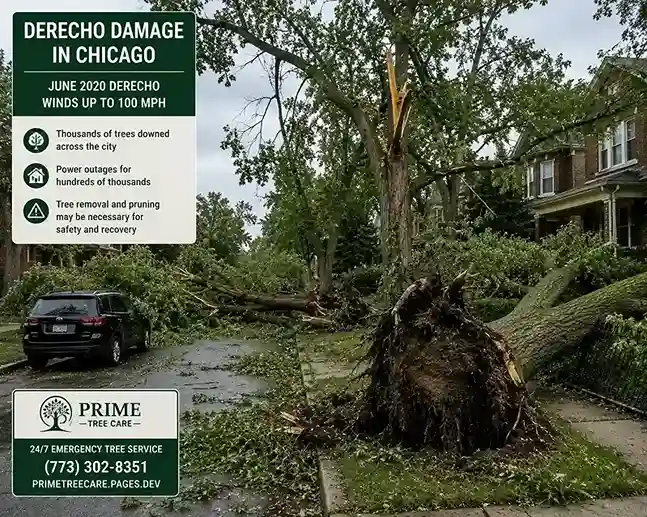
Chicago's recent derecho and severe thunderstorm events have caused widespread tree damage, including uprooted trees, major limb failures, canopy loss, power-line conflicts, and property damage. While some storm-damaged trees can be preserved through pruning and support systems, others require immediate removal due to structural instability or safety risks. Recent 2026 storms generated widespread wind damage and tree emergencies across Chicago and surrounding communities.
If you've lived in Chicagoland through 2026, you've likely seen it firsthand: a line of storms rolls through, and within twenty minutes your block has downed limbs, a leaning tree, or a full canopy sprawled across a driveway. This isn't ordinary bad weather. The Chicago area has experienced a genuine run of high-impact wind events this year, and each one offers real, documented lessons about why urban trees fail and what homeowners can do about it. This guide is built to be updated after every significant storm, so it stays the most current, most locally grounded resource on Chicago storm damage trees available anywhere online.
What Is a Derecho?
A derecho is a widespread, long-lived line of thunderstorms that produces a swath of particularly damaging straight-line winds — specifically, wind gusts of at least 58 mph sustained along most of the storm's path, with several well-separated gusts of 75 mph or greater, spanning an area at least 250 miles long. The defining feature is right there in the name: straight-line winds. Unlike a tornado, where wind rotates around a narrow, funnel-shaped path, a derecho pushes wind forward in essentially one direction across a very wide area, which is exactly why damage from a derecho tends to be so widespread rather than confined to a narrow track.
That said, derechos and tornadoes aren't mutually exclusive. A derecho is a parent storm system, and it's common for a derecho to spawn one or more embedded tornadoes along its path, as happened during both of Chicago's major 2026 derecho events. How derechos damage trees comes down to sustained, one-directional wind loading across a huge geographic footprint — instead of one or two trees failing in an isolated pocket, a derecho can knock down trees across dozens of neighborhoods and suburbs simultaneously, which is exactly why derecho recovery periods strain tree service capacity so much more than typical storm damage.
According to the National Weather Service, a June 2026 event in northern Illinois was officially classified as a derecho, with a line of thunderstorms producing widespread wind gusts of 80–85 mph across much of the region.
2026 Chicago Storm Timeline (Living Update Section)
This table is maintained as a running record of significant wind and storm events affecting Chicago-area trees in 2026. It is updated after every major storm.
| Date | Event | Reported Tree Damage |
|---|---|---|
| June 10, 2026 | Derecho — gusts to 80–85 mph, 2 EF-0 tornadoes | Uprooted trees and widespread limb failures from Lincoln Park to Beverly, Hyde Park, Lincoln Square, South Shore, Portage Park, Oak Park, and Evanston; wind gusts exceeded 70 mph across parts of the city |
| July 27, 2026 | Severe thunderstorms & tornadoes | Power outages, downed lines, and tree-removal emergencies reported across multiple Cook County municipalities, including the City of Chicago; a county-wide damage assessment survey was opened with IEMA-OHS |
| August 11, 2026 | Powerful morning derecho — 70 to 100+ mph winds, 8 tornadoes | Extensive uprooted and snapped trees across DuPage County forest preserves and south/southwest Chicago neighborhoods, from Brighton Park and Garfield Ridge to Chatham, Roseland, and Woodlawn |
June 2026 Derecho
The June 10th derecho produced its most damaging winds during the afternoon, with a fast-moving line of storms generating gusts of 80–85 mph across much of northern Illinois and two brief EF-0 tornadoes confirmed near Maple Park and in the Palos Heights–Alsip area. Within Chicago proper, the National Weather Service documented tree damage reports across a striking range of community areas in a single afternoon: extensive uprooted oaks in Lincoln Park, a large uprooted tree and multiple broken limbs in Beverly, widespread branch failures in Morgan Park, Lincoln Square, Uptown, and Edgewater, and reported branch damage in South Shore, Washington Heights, Auburn Gresham, and South Lawndale. A peak wind gust of 73 mph was recorded near Hyde Park, and gusts near Midway Airport reached 72 mph. Suburbs including Naperville, Bolingbrook, Plainfield, Homer Glen, Palatine, Arlington Heights, and Barrington all reported multiple trees and power lines down the same afternoon.
July 2026 Severe Storms
Severe thunderstorms and tornadoes on July 27th prompted Cook County's Department of Emergency Management and Regional Security, working alongside the City of Chicago's Office of Emergency Management and Communications, to open a formal damage assessment survey. Multiple municipalities across the county, including the City of Chicago, experienced power outages, downed power lines, tree-removal emergencies, debris, and localized flooding. The county partnered with the Illinois Emergency Management Agency to compile damage data and evaluate options for additional resident assistance.
August 2026 Derecho
The August 11th derecho was the most severe of the three events, producing widespread 70 to locally 100+ mph straight-line winds and eight confirmed tornadoes ranging from EF-0 to EF-2 across the region, with a peak gust of 99 mph recorded at Gary/Chicago International Airport. Extensive tree damage was documented in DuPage County's Blackwell, Herrick Lake, and Danada forest preserves, where trees ranging from 1 to 3 feet in diameter were snapped or uprooted. Within Chicago, community-area tree damage reports were especially concentrated across the south and southwest side, spanning Auburn Gresham, Beverly, Washington Heights, Roseland, Chatham, Avalon Park, Calumet Heights, South Chicago, Woodlawn, Brighton Park, Garfield Ridge, Gage Park, and Chicago Lawn, along with the north and northwest side communities of Norwood Park, Jefferson Park, Portage Park, and Albany Park.
Why Trees Fail During Chicago Storms
No single factor explains why one tree survives a derecho untouched while its neighbor ends up on a roof. It's almost always a combination of the following:
Saturated Soils
Heavy rainfall ahead of or during a storm saturates soil and reduces the friction holding root systems in place, which is a major reason so many derecho reports describe trees uprooted with an intact root ball rather than snapped at the trunk — the whole root plate simply lifted out of loosened, waterlogged ground.
Straight-Line Wind Loads
A large, full canopy functions like a sail. The more leaf surface area and branch density a tree carries, the more force a sustained straight-line wind event transfers into the trunk and root system, which is why late-summer storms — when canopies are at their fullest — tend to produce disproportionate tree damage compared to the same wind speeds in early spring.
Structural Defects
Included bark (where two branches grow so close together that bark gets pinched into the union instead of forming solid wood), co-dominant stems (two roughly equal trunks competing instead of one dominant leader), and generally weak branch unions are all structural time bombs that a strong wind event will reliably expose.
Disease Damage
Trees weakened by Emerald Ash Borer, Dutch Elm Disease, or internal decay have compromised wood strength long before a storm arrives — a healthy-looking ash with hidden EAB galleries beneath the bark can snap in conditions a genuinely healthy tree would shrug off.
Species-Specific Weaknesses
Some species are simply more storm-prone by nature. Silver Maple is notorious for weak, brittle wood and included bark at branch unions. Bradford Pear has a well-documented tendency toward structural failure as it matures. Overgrown, EAB-weakened ash trees round out the list of species that consistently overrepresent in Chicago storm damage reports.
The Most Common Storm Damage We See After High-Wind Events
Broken Limbs
The most frequent damage type — ranging from small twigs to major limbs several inches in diameter torn loose by wind.
Split Trunks
Often occurs at a co-dominant stem union, splitting a tree into two failing halves under wind load.
Uprooted Trees
Common in saturated soil conditions, where the entire root plate lifts rather than the trunk snapping.
Hanging Branches
Partially broken limbs left dangling in the canopy — a serious, easy-to-miss hazard known as a "widowmaker."
Trees Leaning Toward Homes
A newly leaning tree after a storm signals active root or structural failure and needs prompt evaluation.
Parkway Tree Failures
City-owned trees between the sidewalk and street frequently fail during derechos, adding permitting complexity to cleanup.
Trees Entangled in Utility Lines
Among the most dangerous outcomes — treat any tree touching a line as energized until a utility crew confirms otherwise.
Energized power line hazards deserve special emphasis: multiple 2026 storm reports across Chicagoland involved trees and power lines down together, and utility vegetation management crews, not general tree services, are responsible for anything in direct contact with live lines.
Which Chicago Trees Are Most Vulnerable During Derechos?
| Species | Typical Storm Weakness |
|---|---|
| Silver Maple | Weak, brittle wood and included bark at branch unions |
| Ash (EAB-affected) | Internal decay from Emerald Ash Borer galleries weakens wood strength |
| Bradford Pear | Structural failure at tight branch unions as the tree matures |
| Siberian Elm | Prone to limb breakage under wind and ice loading |
| Norway Maple | Dense canopy loading increases wind-sail effect |
None of these species are automatically doomed — but if you own one of these trees, more frequent inspection and proactive structural pruning are genuinely worth the investment ahead of storm season.
Can a Storm-Damaged Tree Be Saved?
This is the question we get most often in the days after a major wind event, and the honest answer is: it depends on what exactly failed.
Usually Salvageable
- Minor limb loss confined to a small portion of the canopy
- Isolated damage that hasn't compromised the main trunk
- A healthy, intact trunk with no major splitting
- A strong, undisturbed root system with no lean or soil heaving
Often Requires Removal
- A major trunk split, especially through a co-dominant union
- Root plate lifting or visible soil heaving around the base
- A significant new lean that wasn't present before the storm
- Extensive internal decay revealed by the failure
- Direct involvement with power lines
An ISA-certified arborist should perform a formal tree risk assessment before either decision is finalized — the difference between "this will heal fine" and "this is a falling hazard waiting to happen" is often not visible without a trained inspection of the trunk, root flare, and remaining branch structure.
Storm Damage Warning Signs Homeowners Should Never Ignore
Fresh Lean
Any new lean that wasn't there before the storm is a red flag for root failure.
Soil Heaving
Cracked or lifted soil around the base indicates the root plate has already started to shift.
Cracks in Trunk
Vertical cracks, especially wide ones, suggest the trunk's structural integrity is compromised.
Hanging Limbs
Partially broken branches caught in the canopy can fall without warning.
Root Exposure
Roots pulled partially out of the ground signal an unstable anchoring system.
Large Canopy Imbalance
A tree that lost most of its canopy on one side is now unevenly weighted and at higher risk.
How Tree Cabling and Bracing Reduces Storm Damage Risk
Structural support systems are one of the most effective proactive tools against future storm damage on an otherwise valuable, healthy tree.
Structural Cabling
Steel cables installed high in the canopy connect major limbs or co-dominant stems, restricting how far they can move independently under wind load and reducing the chance of a split at a weak union.
Dynamic Support Systems
Modern synthetic rope-based systems allow slightly more natural movement than rigid steel cabling while still limiting catastrophic separation — often preferred for trees where some flexibility is beneficial to long-term health.
Rod Bracing
Threaded steel rods installed through a trunk or major limb union provide rigid support for trees with a confirmed split or severe structural weakness, typically used alongside cabling rather than as a standalone fix.
Proactive Risk Reduction
It's worth being direct here: cabling and bracing reduce failure risk, they don't eliminate it. In an extreme event like a derecho with locally 100 mph gusts, no support system guarantees a tree won't fail — but for the much more common range of severe thunderstorm winds Chicago sees several times a summer, a properly engineered support system meaningfully lowers the odds of losing a mature, high-value tree.
Why Structural Pruning Matters Before Storm Season
Structural pruning is the single highest-leverage thing most Chicago property owners can do ahead of storm season, and it's dramatically cheaper than emergency removal after a failure. Weight reduction on overextended limbs lowers the leverage wind can exert on a weak union. Deadwood removal eliminates already-compromised material that's guaranteed to fail in the next significant wind event. Canopy balancing corrects lopsided growth patterns that concentrate wind stress unevenly. Wind penetration improvements — selectively thinning overly dense canopy — let wind pass through a tree rather than load against it like a solid sail. Dormant-season pruning, done in late winter while a tree is leafless and less stressed, is typically the ideal window for major structural corrections ahead of the following spring and summer storm season.
Emergency Storm Damage?
If a tree has fallen on a structure, is touching power lines, or is blocking a roadway, treat it as an active hazard. Call Prime Tree Care's 24/7 emergency line at (773) 302-8351 or contact emergency services if anyone is at risk.
What To Do Immediately After a Tree Falls
Stay Clear
Keep yourself, family, and pets away from the tree, especially any hanging or partially attached limbs.
Assume Power Lines Are Energized
Treat any wire in contact with the tree as live, even if power appears out in the area.
Document Damage
Take clear photos from multiple angles before anything is moved, for insurance purposes.
Contact Emergency Services
Call 911 if the situation involves an energized line, blocked road, or immediate safety risk.
Schedule an Arborist Inspection
Have a certified arborist assess remaining structural risk before deciding on removal or preservation.
This sequence is consistent with Illinois forestry storm-damage guidance: stay clear of hazards first, avoid do-it-yourself cleanup near power lines or structural damage, and bring in a professional evaluation before making removal decisions on a tree that isn't a full, obvious loss.
Chicago Neighborhoods Frequently Impacted by Tree Damage
Storm reports across 2026's major events show a recurring pattern: certain Chicago community areas and suburbs turn up again and again in tree damage documentation, whether due to mature canopy age, tree density, or storm track tendencies. Hyde Park, Lincoln Square, South Shore, Beverly, Morgan Park, Woodlawn, Chatham, and Roseland all sustained significant, separately documented tree damage across the June and August derecho events, alongside Oak Park, Evanston, and Mount Greenwood in the broader metro area. This pattern reflects both the region's substantial legacy canopy — much of it planted decades ago — and the reality that Chicago's densest tree cover tends to concentrate in exactly the older, established neighborhoods that recur in these reports.
What Recent Storms Teach Us About Chicago's Urban Forest
Three major wind events in three consecutive months is not typical, and it's worth stepping back to ask what that pattern says about the region's tree canopy more broadly. Aging canopy across many Chicago neighborhoods means a larger share of trees are now old enough to carry the structural defects — co-dominant stems, included bark, internal decay — that storms reliably expose. EAB losses have already thinned and weakened the ash population that once made up a significant share of the urban forest, leaving fewer, more vulnerable specimens standing into an active storm season. Climate resilience planning is increasingly part of the conversation as severe wind events appear to be occurring with greater frequency. The need for diversification — never concentrating replanting in one species — and preventive maintenance — structural pruning and inspection before storms hit rather than cleanup after — are the two most actionable lessons from this year's storm seasons for any Chicago property owner managing mature trees.
Prime Tree Care's Storm Preparedness Approach
Rather than waiting for the next call after a storm, our approach is built around getting ahead of it:
- 01
Tree Risk Assessments
Documented, ISA-based evaluations that identify structural weaknesses before they become storm failures.
- 02
Cabling & Bracing
Proactive support systems for high-value trees with identifiable structural concerns.
- 03
Structural Pruning
Weight reduction, deadwood removal, and canopy balancing timed to dormant season.
- 04
Emergency Response Planning
24/7 availability when a storm does cause damage, with prioritized response for active hazards.
- 05
Species Diversification
Replacement planting guidance that avoids recreating the single-species vulnerabilities of the past.
Being proactive rather than reactive is the difference between a tree that survives the next derecho and one that doesn't.
Frequently Asked Questions
What is a derecho?
A derecho is a widespread, long-lived line of thunderstorms that produces a swath of damaging straight-line winds — specifically, gusts of at least 58 mph along most of its path with several well-separated gusts of 75 mph or greater — over an area at least 250 miles long. Unlike a tornado, a derecho's damage comes from wind blowing in one general direction rather than a rotating funnel, though derechos can also spawn embedded tornadoes.
Why do trees fall during Chicago storms?
Trees fail during Chicago storms due to a combination of factors: saturated soils that weaken root anchorage after heavy rainfall, large canopies acting as wind sails under straight-line wind loads, structural defects like included bark and co-dominant stems, disease and pest damage from Emerald Ash Borer, Dutch Elm Disease, or internal decay, and species-specific weaknesses in trees like Silver Maple and Bradford Pear that have inherently weak wood.
Can a leaning tree be saved?
It depends on the cause and severity of the lean. A tree with a long-standing, gradual lean and no soil heaving may be structurally stable and require only monitoring. A tree with a fresh lean, visible soil heaving, or exposed roots on the opposite side is showing signs of active root failure and should be evaluated by a certified arborist immediately, since it may be at high risk of falling.
Should I remove a storm-damaged tree immediately?
Not always. Trees with minor limb loss, isolated damage, a healthy trunk, and a strong root system are often salvageable through corrective pruning. Trees with a major trunk split, lifted root plate, significant new lean, extensive decay, or involvement with power lines typically require prompt removal due to safety risk. A tree risk assessment from an ISA-certified arborist is the best way to make this determination.
What should I do if a tree falls on my house?
Stay clear of the area, keep everyone away from the tree and any exposed wiring, and assume any wires involved are energized even if they appear inactive. Document the damage with photos for your insurance claim, contact emergency services if there is a safety risk or gas line involvement, and schedule a professional arborist inspection before attempting any cleanup near the structure yourself.
Can a tree touching a power line be trimmed?
Trees in direct contact with power lines should not be trimmed by homeowners or general tree crews — this work falls under utility vegetation management and typically must be handled by the utility company or a specially trained line-clearance crew. Treat any tree touching a line as energized and dangerous, and contact your utility provider immediately to report it.
How much does emergency tree removal cost in Chicago?
Emergency tree removal costs in Chicago typically range from several hundred dollars for a smaller tree or limb to several thousand dollars for a large, mature tree involving structural damage, tight access, or crane assistance. Emergency and after-hours response can carry a premium over standard scheduled removal. A free, on-site estimate provides an exact cost for your specific situation.
Do cabling systems prevent trees from falling?
Cabling and bracing systems reduce — but do not eliminate — the risk of limb or trunk failure by redistributing structural load across weak branch unions or co-dominant stems. They are a proactive risk-reduction tool for otherwise healthy, high-value trees with a specific structural weakness, not a guarantee against failure in extreme wind events like a derecho.
Which tree species fail most often during storms?
Silver Maple, Bradford Pear, Siberian Elm, and Norway Maple are among the species that fail most often during Chicago storms due to inherently weak wood, poor branch attachment angles, or dense canopy structure that catches more wind. Ash trees weakened by Emerald Ash Borer decline are also disproportionately represented in storm damage reports.
When should trees be inspected before storm season?
Trees should ideally be inspected in early spring, before Chicago's peak severe thunderstorm season ramps up, and again in early fall ahead of winter ice and snow loading. Any tree with known structural concerns, recent construction nearby, or storm damage from a prior event should be inspected sooner rather than waiting for the next scheduled check.
Prime Tree Care Arborist Insight
"What stood out most about this year's storms wasn't any single event — it was how many trees that failed had a visible structural issue we could have flagged months earlier. A co-dominant stem, a lean that had been there for years, deadwood nobody got around to removing. Storm damage isn't always random bad luck; a surprising amount of it is predictable if someone actually looks." — David Kowalski, ISA Certified Arborist
Storm Update Log
A dated record of updates to this page, maintained after every major Chicago-area storm event.
Added full details on the August 11, 2026 derecho, including the storm species vulnerability table and updated FAQ entries on emergency response.
Added the July 27, 2026 severe thunderstorm and tornado event, including Cook County's damage assessment survey process.
Initial publication following the June 10, 2026 derecho, including neighborhood-level tree damage documentation across Chicago.