 Prime Tree Care Chicago Arborists
Why Are Silver Maples So Common Throughout Chicago?
If you own a large, fast-shading maple in an older Chicago neighborhood or inner-ring suburb, there's a good chance it's a silver maple. Few species explain their own prevalence as clearly as this one does — it was planted because it worked, at least in the short term.
Fast Growth & Quick Shade
Silver maples can add two to three feet of height per year under good conditions, reaching a usable shade canopy far faster than slower-growing native hardwoods like oak or hickory. For a homeowner in the 1950s wanting shade over a new patio within a decade instead of a generation, that was a compelling trade-off.
Post-War Neighborhood Development & Suburban Expansion
Chicago's rapid post-war housing boom created enormous demand for landscape trees that could establish quickly on newly graded lots with limited topsoil. Silver maple tolerated compacted, disturbed soil better than many alternatives and was widely available and inexpensive from nurseries supplying the era's booming subdivisions.
Historic Planting Trends
Historical Chicago-area urban forestry records show silver maple became one of the most heavily planted street and yard trees across many communities during this development period — a pattern echoed in cities throughout the Midwest. Decades later, that legacy planting is exactly why so many mature silver maples across Chicago are now reaching the age where their structural weaknesses become a real, tangible concern.
What Is a Silver Maple?
Before discussing risk, it helps to know exactly what you're looking at. Silver maple (Acer saccharinum) is native to Illinois and much of the eastern United States, typically found naturally along floodplains and riverbanks — which explains its tolerance for wet soil and its notoriously aggressive root system.
| Scientific Name | Acer saccharinum |
| Typical Height | 50–75+ feet |
| Growth Rate | Fast (up to 2–3 ft/year) |
| Native Status | Native to Illinois |
| Common Use | Shade tree, parkway tree |
| Leaf Identification | Deeply lobed leaves, silvery-white underside |
| Major Concern | Weak wood and storm damage |
Identification features: Silver maple leaves have five deep, sharply toothed lobes and a distinctive silvery-white underside that flashes visibly in wind — hence the name. Bark on younger trees is smooth and gray, becoming shaggy and furrowed with age. You'll commonly find silver maples as parkway trees along older residential streets, in backyards of homes built between the 1950s and 1980s, and along low-lying areas near creeks and drainage corridors throughout Chicagoland.
The Biggest Problem — Weak Wood
Weak wood is the single characteristic that drives nearly every other concern on this list. Understanding why it happens makes every other section of this guide easier to interpret.
Why Fast Growth Creates Weak Wood
Trees allocate a finite amount of energy between growing tall and building dense, strong wood fiber. Silver maples are genetically wired to prioritize speed — rapid vertical and lateral growth comes at the direct expense of wood density. The result is a tree that reaches an impressive size quickly, but with wood that's noticeably more porous and less able to resist mechanical stress than slower-growing species like oak or hickory.
Brittle Branch Structure & Load Resistance Issues
This lower wood density translates directly into brittle branch structure. Large-diameter limbs that would flex and absorb energy in a stronger-wooded species are more prone to snapping outright in silver maple, particularly at existing defect points like old pruning wounds, cavities, or branch unions.
Failure Under Wind Stress & Ice Loads
Utility vegetation management crews and municipal forestry departments across the Midwest consistently identify silver maple as a species prone to breakage specifically because of this combination of rapid growth and weak wood. Under straight-line wind stress, heavy limbs catch more wind resistance than their wood strength can handle. Under ice loads, the added weight on already porous wood is often enough to trigger failure that a stronger species would have absorbed without damage.
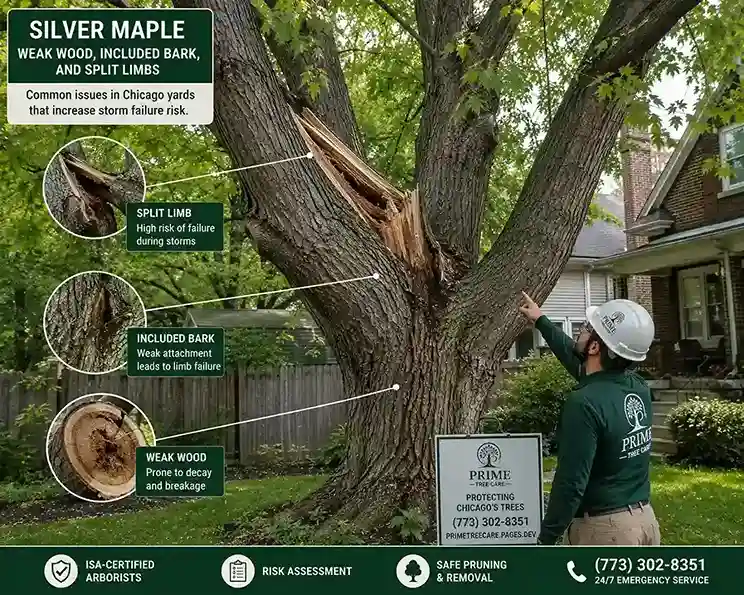
In our tree risk assessments across Chicago, silver maple limb failures are rarely random — they almost always trace back to a visible, identifiable defect: an included bark union, an old wound that never closed properly, or a section of hidden decay. That's actually good news for homeowners, because it means most silver maple risk is detectable well before failure, if someone trained to look for it takes the time to look.
Included Bark and Why Silver Maples Split
If weak wood is the material problem, included bark is the structural problem — and the two combine to create the species' most dangerous failure mode: mid-limb or trunk splitting.
Codominant Stems & Included Bark Crotches
Silver maples very commonly develop codominant stems — two or more main trunks or major limbs of roughly equal size competing for dominance instead of one tree growing from a single central leader. Where these stems meet, bark can become trapped inside the union instead of growing around it smoothly. This "included bark" prevents the wood from fusing into a genuinely strong connection; instead of interlocking wood grain, you get a seam of compressed bark tissue with a fraction of the structural strength.
Structural Weakness, Mid-Limb Failure & Trunk Splitting
These included bark unions are frequently invisible from the ground, hidden inside a V-shaped crotch that looks unremarkable until it fails. Utility vegetation management studies consistently identify included bark crotches as a leading reason silver maples fail catastrophically — not a slow branch snap, but a sudden vertical split down through the trunk or a major limb, often during or immediately after a storm. This is the failure mode homeowners describe as "the tree just split in half," and it's almost always traceable to a codominant union that had been developing for years or decades.
Why Silver Maples Suffer So Much Storm Damage in Chicago
Chicago's climate delivers nearly every storm condition capable of exploiting a silver maple's structural weaknesses, often within the same calendar year.
Thunderstorms & Straight-Line Winds
Frequent spring and summer storms test large, full canopies against sudden gusts, the exact load type weak wood handles poorly.
Derechos
Fast-moving, widespread straight-line wind events can flatten entire sections of exposed canopy in a single pass.
Wet, Heavy Snow
Chicago's late-season wet snow adds substantial dead weight to branches still holding foliage or dense growth.
Ice Storms
Ice coating adds uniform weight across the entire canopy simultaneously — the load type Illinois Extension repeatedly flags as most damaging to silver maple.
Heavy Canopy Weight
Mature, unpruned silver maples carry dense, top-heavy canopies that amplify leverage on already weak branch unions.
Repeated Exposure
Decades of cumulative storm exposure compound existing defects, meaning older trees carry more risk with each passing storm season.
Illinois Extension repeatedly identifies silver maple among the species most susceptible to storm and ice damage in the region — not as an isolated opinion, but as a pattern observed consistently across municipal and university forestry data throughout the Midwest.
The Real Cost of Ignoring a Mature Silver Maple
Deferred maintenance on a large silver maple rarely stays cost-neutral. The risk compounds quietly until a storm converts it into an expensive, sometimes dangerous, emergency.
- Falling limbs: The most common and most costly failure mode, capable of striking structures, vehicles, or people without warning.
- Roof damage: Large limb strikes routinely cause five-figure roof and structural repair bills.
- Vehicle damage: Driveways and street parking beneath mature silver maples are a recurring source of storm-season insurance claims.
- Sidewalk damage: Aggressive surface roots heave concrete, creating trip hazards and municipal liability concerns.
- Utility conflicts: Fast upward and outward growth frequently brings canopy into contact with overhead lines, triggering utility vegetation management pruning that can leave a tree lopsided and more vulnerable.
- Emergency removal costs: Storm-damaged, split trees almost always cost significantly more to remove on an emergency basis than the same tree would have cost to manage proactively.
Risk Progression by Tree Condition
| Tree Condition | Risk Level |
|---|---|
| Young & Regularly Pruned | Low |
| Mature With Minor Defects | Moderate |
| Included Bark Present | High |
| Large Dead Limbs | Very High |
| Active Splitting | Critical |
A tree in the "critical" category — one that is actively splitting or has a visible crack propagating through a major union — should be treated as an emergency. Don't wait for the next storm to test it further; contact an emergency tree service right away.
Why Arborists Frequently Recommend Structural Pruning
Structural pruning is the most cost-effective, least invasive tool for managing silver maple risk before it escalates — which is exactly why it's the first recommendation most certified arborists make for a moderately defective tree.
- Weight reduction: Selectively shortening long, heavy limbs reduces the leverage acting on weak branch unions.
- Defect mitigation: Removing deadwood and correcting minor structural issues before they worsen.
- Load redistribution: Rebalancing an uneven canopy so wind and snow load doesn't concentrate on the weakest points.
- Storm preparation: Thinning excess density lets wind pass through the canopy instead of catching it like a sail.
- Long-term preservation: Consistent structural pruning over years can meaningfully extend a silver maple's safe lifespan.
Illinois Extension notes that regular, professional pruning is among the most effective preventative measures available for storm-prone species like silver maple — far more effective, and far less expensive, than reactive storm cleanup. Learn more about our approach on the tree trimming & pruning service page.
When Tree Cabling and Bracing Makes Sense
Pruning alone can't always correct an existing structural defect — that's where cabling and bracing come in.
Split Leaders & Codominant Stems
A steel or synthetic cable installed high in the canopy between codominant stems physically limits how far they can move independently in wind, reducing the strain on an included bark union without requiring removal of either stem.
High-Value Shade Trees & Historic Trees
For a mature silver maple that provides significant shade value, screening, or has sentimental or historic significance to a property, cabling and bracing can be the difference between years of continued safe use and premature removal.
Preservation vs. Removal
Support systems don't make a defect disappear, but they can meaningfully extend the safe, usable lifespan of a structurally compromised tree — buying years of enjoyment while managing the underlying risk responsibly. Our storm prep & tree support systems service covers cabling and bracing installation and inspection.
Silver Maple Root Problems
Silver maple's floodplain origins gave it an aggressive, opportunistic root system — a trait that serves it well in the wild and creates recurring headaches in a residential yard.
Surface Roots
Large roots frequently grow at or near grade, making mowing difficult and creating tripping hazards across the lawn.
Sidewalk Damage
Expanding roots are a leading cause of heaved, cracked concrete along older parkways and driveways.
Sewer Line Concerns
Roots seek out moisture aggressively and can infiltrate aging clay sewer laterals common throughout older Chicago neighborhoods.
Lawn Disruption
Dense surface root mats compete with turf grass for water and nutrients, leaving thin, patchy lawn areas beneath the canopy.
Foundation Concerns
Trees planted too close to a structure can, over decades, contribute to soil movement issues near shallow foundations.
Root Management Options
Root barriers, selective root pruning, and careful placement of new plantings can reduce — though rarely eliminate — these conflicts.
Both Illinois Extension and the Morton Arboretum note silver maple's aggressive root system as one of its defining, and most homeowner-relevant, characteristics.
Common Diseases and Secondary Problems
Structural defects are usually the dominant concern with silver maple, but disease and physiological stress can compound the risk picture.
- Verticillium wilt: A soil-borne fungal disease that can cause sudden branch dieback and, in severe cases, tree death.
- Anthracnose: A common leaf fungus causing early leaf drop and cosmetic canopy thinning, particularly in wet spring conditions.
- Chlorosis: Yellowing between leaf veins, often linked to soil pH imbalances affecting nutrient uptake.
- Root rot: Fungal decay in root systems, frequently linked to poor drainage or repeated soil compaction.
- Wood decay: Internal decay fungi exploiting old wounds and pruning cuts, often invisible until a cavity or hollow sound is detected.
In our experience, structural defects — not disease — are the far greater safety concern in most Chicago silver maples. Disease matters for long-term tree health, but included bark unions and weak wood are what actually cause sudden, dangerous failures.
How to Inspect a Silver Maple for Warning Signs
A homeowner inspection can't replace a certified arborist's evaluation, but knowing what to look for helps you decide when to call one.
- ✓Cracks anywhere on the trunk or major limbs
- ✓Splits, even small or partial ones
- ✓Hanging limbs caught in the canopy
- ✓Bark inclusions at branch unions (V-shaped, tight crotches)
- ✓Cavities or hollow sounds when tapped
- ✓Leaning that's new or worsening
- ✓Dead canopy sections or sparse regrowth
- ✓Fungal growth at the base or on the trunk
If you notice any of these signs — especially cracks, splits, or fungal growth — it's time to contact a certified arborist for a tree health inspection rather than waiting for the next storm to answer the question for you.
Should You Remove a Silver Maple?
This is rarely a simple yes-or-no decision, and a good arborist will walk through the trade-offs with you rather than defaulting to removal.
When Preservation Makes Sense
Good overall health, defects that are manageable with pruning or cabling, and high landscape or shade value all favor keeping the tree with an active management plan.
When Removal Is Often Better
Extensive internal decay, repeated limb failures, severe or active splitting, high-value targets nearby (home, driveway, power lines), and advanced structural instability all shift the balance toward removal.
If removal is the right call, our tree removal team can handle even large, structurally compromised silver maples safely, including rigging and crane-assisted work when site conditions require it.
Why Silver Maples Continue to Fail After Storms
One of the more frustrating patterns homeowners describe is a silver maple that keeps losing limbs, storm after storm, even after previous cleanup. There are a few consistent reasons for this.
- Hidden internal decay: Decay fungi can hollow out significant portions of a limb or trunk while the exterior still looks intact.
- Repeated limb loss: Each failure often exposes a fresh wound that becomes the next entry point for decay, creating a compounding cycle.
- Poor compartmentalization: Silver maple is comparatively slow to wall off, or "compartmentalize," decay and damage compared to stronger-wooded species, allowing problems to spread internally.
- Stress accumulation: Drought years, construction damage, and repeated storm exposure all add up over a tree's lifetime, lowering its overall resilience threshold.
Even experienced arborists frequently note that mature silver maples tend toward recurring limb failure simply because of these species characteristics — it's not bad luck, it's a predictable pattern rooted in how the tree is built.
Better Tree Choices for Future Planting
If you're removing a silver maple — or simply planning ahead for when you eventually will — Chicago has several strong, storm-resilient alternatives that avoid most of silver maple's structural downsides.
Swamp White Oak
Strong wood, excellent storm resistance, and good tolerance for Chicago's variable soil moisture.
Bur Oak
Exceptionally long-lived and structurally sound, well suited to open residential lots.
Kentucky Coffeetree
A tough, underused native with strong branch structure and few major pest or disease concerns.
Hackberry
Fast-establishing and resilient, with better structural integrity than silver maple.
Disease-Resistant Elm Cultivars
Modern Dutch Elm Disease-resistant cultivars offer the classic elm form without the historic disease vulnerability.
Species diversification is also a citywide resilience strategy, not just a personal landscaping choice — a canopy dominated by one species is far more vulnerable to a single pest, disease, or storm pattern wiping out a large share of the tree cover on a block at once. Our tree planting & transplanting team can help you choose and place the right replacement species for your site.
Chicago Homeowner Guide to Managing Mature Silver Maples
If you're keeping your silver maple rather than removing it, here's a practical, ongoing action plan.
- Annual inspectionHave a certified arborist inspect the tree at least once a year, and always after a major storm.
- Structural pruningSchedule proactive pruning on a regular cycle to manage weight and correct developing defects early.
- Cabling assessmentIf codominant stems or included bark are present, discuss whether cabling is appropriate now, before a failure forces the decision.
- Storm season preparationBefore Chicago's peak spring and summer storm months, confirm the canopy has been recently evaluated and cleared of deadwood.
- Emergency response planningKnow who to call — and keep that number handy — before a storm turns a known defect into an active emergency.
- Long-term decision frameworkRevisit the preservation-vs-removal question every few years as the tree ages, rather than treating it as a one-time decision.
If you have a mature silver maple and are concerned about storm damage, splitting limbs, or long-term safety, Prime Tree Care can provide a professional tree risk assessment and help you determine whether pruning, cabling, or removal is the most appropriate next step.
What Chicago Property Owners Should Know About Silver Maples
Pulling the threads of this guide together, here's the short version for Chicago-area property owners specifically.
- Parkway trees: Many mature silver maples growing between the sidewalk and street are managed under city or municipal forestry jurisdiction — check before assuming a tree is fully your responsibility.
- Utility conflicts: Silver maple's fast, upright growth frequently brings canopy into contact with overhead utility lines, prompting utility vegetation management pruning that can affect the tree's overall structure.
- Storm exposure: Chicago's storm patterns — spring thunderstorms, occasional derechos, wet snow, and ice — hit nearly every weakness silver maple has, making proactive management more valuable here than in milder climates.
- Older neighborhood canopies: Communities built during the post-war boom often have a disproportionate share of aging silver maples reaching peak risk age simultaneously.
- Species diversity goals: Chicago's modern urban forestry approach favors a more diverse canopy mix, partly in response to lessons learned from past over-reliance on single species like silver maple and American elm.
- Preventive maintenance: Regular inspection and pruning remain the most cost-effective way to keep an existing silver maple safe for as long as reasonably possible.
Frequently Asked Questions
Why do silver maple branches break so easily?
Silver maples prioritize fast growth over wood density, producing comparatively porous, brittle wood. Combined with a tendency toward codominant stems and included bark unions, this makes branch failure more common than in slower-growing, stronger-wooded species.
Are silver maples dangerous?
Not inherently, but mature silver maples with structural defects — included bark, large dead limbs, or active cracks — do carry meaningfully elevated risk, especially near structures, driveways, or areas where people spend time. A tree risk assessment can determine your specific tree's risk level.
How long do silver maples live?
Silver maples typically live 80 to 130 years, though structural problems and storm damage often shorten their practical, safe lifespan well before natural old age becomes the limiting factor.
Should I remove a mature silver maple?
It depends on the tree's specific condition. Good health with manageable defects often favors preservation through pruning or cabling; extensive decay, repeated failures, or severe splitting typically favor removal. A certified arborist's assessment is the best way to decide.
Can pruning make a silver maple safer?
Yes. Structural pruning reduces weight on vulnerable limbs, removes deadwood, and redistributes canopy load, meaningfully lowering storm failure risk when done on a regular basis by a qualified arborist.
Do silver maples survive Chicago storms?
Often, yes — but with damage. Silver maples frequently survive individual storms while sustaining limb loss, and repeated storm exposure over years tends to compound existing structural weaknesses.
Why are silver maples so common in Chicago?
They were widely planted during Chicago's post-war development boom because of their fast growth and quick shade, becoming one of the most common street and yard trees across many established neighborhoods and suburbs.
Are silver maple roots invasive?
Silver maple roots are notably aggressive and often grow near the surface, commonly causing sidewalk heaving, lawn disruption, and occasional sewer line conflicts, particularly in older neighborhoods with aging infrastructure.
Can cabling save a splitting silver maple?
Cabling can help manage the risk from codominant stems or included bark unions before a full split occurs, but a tree that is already actively splitting usually needs an in-person arborist evaluation to determine whether cabling is still a safe option or whether removal is now necessary.
What trees are better than silver maple?
Swamp white oak, bur oak, Kentucky coffeetree, hackberry, and disease-resistant elm cultivars all offer stronger wood and better structural integrity than silver maple, making them better choices for new plantings in Chicago.