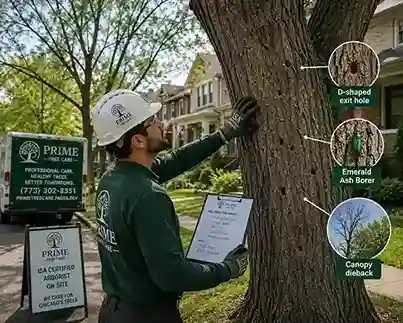
Dutch Elm Disease affects elm trees. Emerald Ash Borer affects ash trees. DED is a fungal disease spread by elm bark beetles and root grafts. EAB is an invasive wood-boring insect. Both can kill a mature tree within a few years, but because the causes are completely different, correct identification is essential before deciding whether to treat or remove a declining tree.
If you're standing in your yard looking at a tree with thinning leaves, dying branches, or bark that looks wrong, it's natural to assume the worst — and it's just as natural to assume every declining shade tree in Chicago is suffering from the same problem. It isn't. Dutch Elm Disease (DED) and Emerald Ash Borer (EAB) are two of the most destructive tree health threats Chicagoland has faced in the last century, and homeowners regularly confuse them because both produce canopy dieback and both frequently end in tree death. But they attack completely different species, spread through completely different mechanisms, and call for completely different decisions. This guide walks through exactly how to tell them apart, what an ISA-certified arborist looks for during a tree risk assessment, and what your realistic options are once you know which problem you're dealing with.
The Short Answer — DED and EAB Are Not the Same Problem
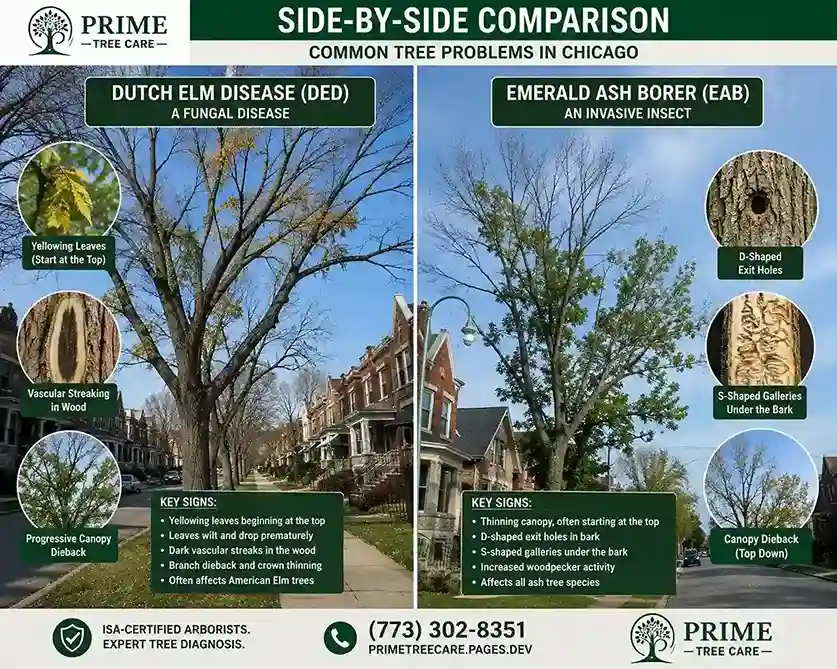
Before going deeper, here's the comparison in its simplest form. DED is caused by a fungus, Ophiostoma novo-ulmi, that clogs an elm's vascular system. EAB is caused by an invasive insect, Agrilus planipennis, whose larvae tunnel beneath ash bark and cut off the tree's ability to move water and nutrients. Different organism, different tree species, different spread pattern, different treatment path.
| Feature | Dutch Elm Disease | Emerald Ash Borer |
|---|---|---|
| Affected Tree | Elm | Ash |
| Cause | Fungus | Insect |
| Scientific Name | Ophiostoma novo-ulmi | Agrilus planipennis |
| Spread By | Elm bark beetles & root grafts | Adult beetles (flight) |
| Typical Outcome | Often fatal | Almost always fatal if untreated |
| Early Symptom | Flagging branches | Canopy thinning |
| Visible Sign | Wilted, discolored branches | D-shaped exit holes |
DED spreads primarily through elm bark beetles that carry fungal spores from an infected tree to a healthy one as they feed, and through root grafts — natural underground connections that form between the root systems of neighboring elms of the same species. EAB, by contrast, spreads when adult beetles emerge from an infested ash, fly to nearby ash trees, and lay eggs in bark crevices; the larvae that hatch are what actually kill the tree by feeding beneath the bark.
Why Chicago Homeowners Frequently Confuse the Two
The confusion is understandable, and it's worth explaining why rather than just asserting they're different.
- Both cause canopy dieback. Whether the cause is a fungus or an insect, a stressed tree loses leaves and thins out in visually similar ways from a distance.
- Both kill mature trees. Homeowners who lost one tree to either problem often assume any subsequent tree death in the neighborhood is "the same thing" happening again.
- Both have changed Chicago's urban forest. Entire tree-lined streets have been reshaped by each pest and disease in different eras, so both are part of the region's shared tree-loss history.
- Both often require removal. Once either problem reaches an advanced stage, removal frequently becomes the safest option, which reinforces the perception that they're interchangeable.
- Symptoms can look similar from the ground. Thinning leaves and dead branches at 30 feet up don't announce their cause; you generally need a closer inspection of bark, exit holes, or branch patterns to tell them apart.
Chicago's history with these two problems also overlaps in the public memory. DED reached the Chicago area by the 1960s and, over the following decades, wiped out the American Elm as the region's dominant street tree. EAB was first identified in the Midwest in the early 2000s and became established in Illinois within several years, going on to kill millions of ash trees across the state — including the ash trees that many communities had planted specifically to replace the elms lost to DED a generation earlier.
Understanding Dutch Elm Disease
Dutch Elm Disease is caused by the fungus Ophiostoma novo-ulmi, which infects a tree's xylem — the vascular tissue responsible for moving water up from the roots to the canopy. As the fungus spreads, the tree responds by producing gum-like compounds that clog its own vascular tissue in an attempt to wall off the infection, which ironically accelerates the tree's decline by cutting off water flow to healthy branches.
How elm bark beetles spread it: Elm bark beetles breed in the bark of dead or dying elm wood, picking up fungal spores in the process. When adult beetles emerge and fly to feed on the twigs of healthy elms, they introduce the fungus into the new tree's vascular system through their feeding wounds.
Root graft transmission: Elms planted close together — as they frequently were along historic Chicago parkways — often develop root grafts, natural fusions between the root systems of neighboring trees. If one elm becomes infected, the fungus can move directly into a neighboring elm's roots through this underground connection, bypassing the beetle entirely. This is one of the fastest ways DED spreads through a block of parkway elms.
Why American elms are vulnerable: The American elm has almost no natural resistance to Ophiostoma novo-ulmi, which is part of why the disease was able to spread so extensively once introduced. Some elm species and modern disease-resistant cultivars fare significantly better.
Chicago's historic elm losses: Chicago was once famous for elm-lined boulevards that formed a dense, cathedral-like canopy over residential streets. DED fundamentally altered that landscape over the mid-to-late 20th century, and the small number of legacy elms that survive today in neighborhoods throughout the city represent a fraction of what once stood.
Understanding Emerald Ash Borer
Emerald Ash Borer is an invasive, metallic-green beetle native to Asia that attacks only true ash trees in the genus Fraxinus. Unlike DED, which is a disease, EAB is a direct physical infestation.
How larvae kill trees: Adult EAB beetles lay eggs in bark crevices. Once hatched, the larvae tunnel into the phloem and outer sapwood, feeding in S-shaped galleries that girdle the tree's ability to move water and nutrients — the insect equivalent of what the DED fungus does to an elm's vascular system, just through mechanical destruction rather than fungal blockage.
Why ash trees are vulnerable: North American ash species evolved with no natural defense against EAB, which is part of why infestations progress so aggressively and why nearly all untreated ash trees eventually die.
Chicago's ash tree losses: Ash was widely planted throughout Chicagoland in the decades following the DED-driven elm losses, in part because it was fast-growing, tolerant of urban stress, and, at the time, considered relatively pest-free. That widespread single-species planting is exactly what made EAB's arrival so devastating — the region had once again concentrated its canopy in one vulnerable species.
Why untreated trees rarely survive: Once EAB populations establish inside a tree, larval feeding accelerates year over year. Untreated ash trees generally die within two to four years of initial infestation, and by the time canopy thinning becomes obvious from the ground, the infestation is often already well advanced.
Which Trees Are at Risk?
Elm Species Susceptible to DED
- American Elm — highly susceptible, with essentially no natural resistance to the fungus.
- Slippery Elm — also susceptible, though somewhat less commonly planted as a landscape tree.
- Other elm species — susceptibility varies significantly; some Asian elm species and modern disease-resistant American elm cultivars developed through selective breeding show meaningfully better resistance.
If you have an older, large elm on your property, it is very likely a straight American elm rather than a resistant cultivar, since disease-resistant varieties have only become widely available in more recent decades.
Ash Species Susceptible to EAB
- Green Ash — one of the most commonly planted ash species in the Chicago area and highly vulnerable.
- White Ash — also widely planted and equally susceptible.
- Black Ash — less common in urban plantings but still vulnerable.
Nearly all native North American ash species are vulnerable to EAB; there is no meaningfully resistant native ash comparable to the disease-resistant elm cultivars now available.
Symptoms of Dutch Elm Disease
DED symptoms typically begin in one part of the canopy and spread outward as the fungus moves through the vascular system.
Flagging Branches
One or several branches suddenly wilt and turn brown while the rest of the canopy still looks healthy — usually the very first visible sign.
Yellowing Leaves
Leaves on affected branches yellow and curl before turning brown, often faster than typical seasonal color change.
Sudden Wilting
Unlike drought stress, DED wilting can appear rapidly, sometimes within just a few weeks during peak growing season.
Brown Sapwood Streaking
Peeling back bark on an affected branch often reveals brown or reddish-brown streaking in the outer sapwood.
Progressive Canopy Decline
Symptoms typically spread from one section of canopy to the whole tree over one to several growing seasons.
DED symptom checklist: isolated branch wilting that appears suddenly · yellow-to-brown leaf discoloration on otherwise healthy-looking branches · brown streaking visible under peeled bark · symptoms starting high in the canopy and progressing downward · symptoms worsening within weeks rather than months.
Symptoms of Emerald Ash Borer
EAB symptoms tend to build more gradually at first, then accelerate as larval populations increase inside the tree.
Canopy Thinning
Progressive dieback starting at the top of the canopy and working downward over one to several seasons.
Bark Splitting
Vertical splits in the bark, often revealing the S-shaped larval galleries underneath.
Epicormic Sprouts
Clusters of small shoots sprouting from the trunk or major limbs — a stressed tree's attempt to compensate for canopy loss.
Woodpecker Activity
Increased woodpecker feeding damage as birds dig for larvae beneath the bark, sometimes stripping large bark patches.
D-Shaped Exit Holes
Small, distinctly flat-sided exit holes left by emerging adult beetles — the single most diagnostic EAB symptom.
Crown Dieback
Advanced infestations show significant portions of the upper crown dead or bare, even in the growing season.
EAB symptom checklist: thinning that starts at the very top of the canopy · small D-shaped exit holes in the bark, roughly 1/8 inch across · S-shaped tunneling visible under peeled bark · unusual woodpecker damage · epicormic sprouting along the trunk · bark splitting over larval galleries. The D-shaped exit hole and S-shaped gallery are the two symptoms arborists rely on most heavily, since they aren't produced by any other common Chicago tree pest.
Side-by-Side Symptom Comparison Table
| Symptom | DED | EAB |
|---|---|---|
| Flagging Branches | ✓ | Rare |
| D-Shaped Exit Holes | No | ✓ |
| Woodpecker Damage | Sometimes | Common |
| Root Graft Spread | ✓ | No |
| Bark Splitting | Possible | Common |
| Crown Dieback | ✓ | ✓ |
| Epicormic Sprouts | Rare | Common |
| Sudden Wilt | ✓ | Rare |
How Arborists Diagnose DED vs EAB
A proper diagnosis rarely relies on a single symptom. Here's the general sequence an ISA-certified arborist works through during an on-site evaluation:
- 01
Tree Species Identification
Since DED only affects elms and EAB only affects ash, confirming the species immediately rules one of the two out.
- 02
Canopy Evaluation
The pattern of dieback — isolated flagging branches versus top-down thinning — offers an early clue before any closer inspection.
- 03
Bark Inspection
Checking for splitting, woodpecker damage, and the texture of the outer bark layer.
- 04
Exit Hole Inspection
Looking specifically for the flat-sided D-shaped holes unique to EAB.
- 05
Sapwood Examination
Peeling back a small section of bark to check for DED's characteristic brown streaking or EAB's S-shaped galleries.
- 06
Risk Assessment
Evaluating structural safety alongside the diagnosis, since a badly compromised tree may need prompt removal regardless of cause.
- 07
Laboratory Confirmation When Necessary
In ambiguous cases, a sapwood sample can be sent for lab confirmation of the DED fungus.
Can Either Tree Be Saved?
Dutch Elm Disease
Early intervention gives an elm its best chance — fungicide treatment is far more effective when only a small portion of the canopy shows symptoms. Fungicide options typically involve trunk injection of systemic fungicides on a preventive or early-treatment schedule. Root graft management — severing root graft connections between a diseased elm and its healthy neighbors — can help prevent underground spread to adjacent trees even if the infected tree itself can't be saved. Removal decisions become necessary once symptoms have progressed through a large portion of the canopy, since treatment success drops sharply at that stage.
Emerald Ash Borer
Trunk injection treatments with systemic insecticides are the primary tool for saving an EAB-infested ash, most effective when canopy dieback is still under roughly 30–50%. Preventive programs — treating a healthy, high-value ash before infestation ever takes hold — offer the best long-term odds in areas with known EAB pressure. Long-term monitoring is essential even after successful treatment, since EAB protection generally requires repeat treatments on a multi-year cycle rather than a single application. Removal decisions become the responsible choice once a tree has lost the majority of its canopy, both because treatment success drops and because dead ash wood becomes structurally unsafe quickly.
Across both problems, treatment tends to be most successful when the tree is otherwise in good structural condition and the infection or infestation is caught early — which is exactly why annual inspection matters more than most homeowners assume.
Treat or Remove? Decision Framework
An arborist weighs several factors together rather than applying a single rule:
| Factor | Favors Treatment | Favors Removal |
|---|---|---|
| Tree Condition | Early-stage symptoms, limited canopy loss | Advanced dieback, majority of canopy affected |
| Structural Integrity | Sound trunk and major limbs | Visible decay, cracks, or weak unions |
| Size | Manageable, healthy root system | Very large tree with declining root support |
| Landscape Value | Mature shade or historic/legacy significance | Lower landscape value or already a safety concern |
| Cost Comparison | Ongoing treatment cheaper than removal + replacement | Removal comparable to years of repeated treatment |
| Risk Exposure | Low risk to structures or people if treatment fails | Tree near a home, driveway, or high-traffic area |
Why Both Problems Changed Chicago's Urban Forest
Chicago and the broader region have experienced significant, back-to-back losses from both DED and EAB, and the pattern between them tells an important story about urban forestry. Historic elm losses from DED eliminated the region's dominant street tree by the late 20th century. Ash tree decline from EAB then devastated the very species many communities had leaned on as an elm replacement. The lesson that emerged from watching this happen twice is species diversification: no single species should ever again make up a large share of a neighborhood's canopy, because any pest or disease that targets that species can then take out the whole area's tree cover in one pass. Current planting strategies throughout Chicagoland now generally follow diversity guidelines limiting any one species, genus, or family to a small percentage of new plantings in a given area.
Common Misdiagnoses Homeowners Make
- Maple vs. Ash — homeowners sometimes assume a declining maple has EAB simply because a neighboring ash died from it; maples aren't affected by EAB at all.
- Elm vs. Ash — the two species are sometimes confused at a glance, especially from a distance, leading to the wrong pest or disease being assumed.
- Drought Stress vs. Disease — a hot, dry summer can cause canopy thinning that looks similar to early DED or EAB symptoms but resolves with adequate watering.
- Construction Damage vs. Pest Activity — root disturbance from nearby digging can cause canopy decline that has nothing to do with either DED or EAB.
- Storm Damage vs. Decline — broken limbs from wind are sometimes mistaken for disease-related dieback rather than mechanical damage.
What Should You Plant Instead?
Whether you've lost an elm to DED or an ash to EAB, the replacement decision matters as much as the removal itself. Diversified, well-adapted species for Chicago conditions include:
- Bur Oak — slow-growing but exceptionally long-lived and tolerant of Chicago's clay soil.
- Swamp White Oak — strong shade value and good tolerance for heavier, wetter soils.
- Hackberry — fast-establishing and highly tolerant of urban stress.
- Kentucky Coffeetree — outstanding urban tolerance with no serious pest or disease pressure.
- Disease-Resistant Elm Cultivars — modern breeding has produced elm varieties with meaningfully improved DED resistance, for homeowners who specifically want an elm's classic form back.
Overreliance on a single species is exactly what turned both DED and EAB into region-wide catastrophes rather than isolated tree losses — spreading new plantings across multiple genera and families is the single best protection against a repeat.
Prime Tree Care Arborist Insight
"The single biggest mistake we see is homeowners guessing based on what happened to a neighbor's tree instead of getting the actual species and symptoms confirmed. DED and EAB call for genuinely different treatment plans, and starting with the wrong assumption wastes both time and money on a tree that might still be saveable — or delays removal on one that's already a safety risk." — David Kowalski, ISA Certified Arborist
What Chicago Property Owners Should Know
Parkway trees — those growing in the strip between the sidewalk and street — are owned and managed by the Chicago Bureau of Forestry, not by the adjacent homeowner. If you suspect DED or EAB in a parkway tree, reporting it to the city is the appropriate first step alongside your own arborist consultation. Private trees on your own lot are your responsibility to monitor, treat, or remove.
Urban tree diversity throughout Chicago's neighborhoods varies block by block, which means your risk exposure to either problem depends heavily on what's already growing near your property — a yard full of legacy elms carries different risk than one with young, diverse plantings. Risk management means treating both DED and EAB as ongoing monitoring priorities rather than one-time concerns, especially for property owners with mature trees. Tree inspection timing matters too: symptoms are often easiest to spot during peak growing season (roughly May through August) when a healthy tree should have full, uniform canopy density to compare against.
Frequently Asked Questions
What is the difference between Dutch Elm Disease and Emerald Ash Borer?
Dutch Elm Disease (DED) is a fungal disease, caused by Ophiostoma novo-ulmi, that affects elm trees and spreads through elm bark beetles and root grafts between neighboring elms. Emerald Ash Borer (EAB) is an invasive wood-boring insect, Agrilus planipennis, that attacks only true ash (Fraxinus) species. They affect entirely different tree genera, spread through entirely different mechanisms, and require different treatment and management approaches.
How do I know if my tree is an elm or an ash?
Elm leaves are asymmetrical at the base (one side extends further down the stem than the other) with double-toothed edges, while ash trees have compound leaves made up of 5 to 9 leaflets arranged opposite each other along a central stem. Elm bark is typically deeply furrowed with a diamond or ladder-like pattern, while ash bark has a distinctive tight, diamond-shaped ridge pattern. If you're unsure, a certified arborist can identify the species in minutes during an on-site inspection.
What are D-shaped exit holes?
D-shaped exit holes are small, roughly 1/8-inch openings in ash tree bark left behind when adult Emerald Ash Borer beetles emerge from beneath the bark. The flat side of the "D" shape is a distinctive diagnostic sign of EAB infestation and is not produced by Dutch Elm Disease or by native wood-boring insects, which typically leave round exit holes.
Can Dutch Elm Disease spread underground?
Yes. In addition to spreading above ground through elm bark beetles carrying fungal spores from tree to tree, Dutch Elm Disease can spread underground through root grafts, natural connections that form between the root systems of nearby elms of the same species. This is why a single infected elm can quickly spread the disease to healthy elms planted close together along a parkway or property line.
Can Emerald Ash Borer be treated?
Yes, in many cases. Ash trees caught in the early-to-moderate stages of EAB infestation, generally with less than 30–50% canopy dieback, often respond well to systemic trunk injection treatments repeated on a regular schedule. Trees with advanced decline are much less likely to recover and are typically better candidates for removal, since dead and dying ash wood becomes structurally unsafe within a year or two of tree death.
Is Dutch Elm Disease curable?
Dutch Elm Disease is not truly curable once a tree is significantly infected, but early intervention with fungicide injections can sometimes stop or slow the disease in a tree that has only recently shown symptoms on a single branch. Once the fungus has spread through a large portion of the vascular system, treatment success drops sharply and removal is usually the safer, more realistic recommendation.
Which is more destructive in Chicago?
Both have been devastating in different eras. Dutch Elm Disease reshaped Chicago's urban forest in the mid-20th century, wiping out the American Elm as the region's dominant street tree. Emerald Ash Borer has caused comparable devastation more recently, killing the majority of untreated ash trees across Chicagoland since its arrival in Illinois. In terms of sheer number of trees lost in a short period, EAB's local impact has been faster and more concentrated.
Should I remove a tree immediately?
Not necessarily. Immediate removal is warranted for trees that are dead, structurally unsafe, or posing an active hazard to people or property. For trees showing early symptoms of either DED or EAB, a tree risk assessment from a certified arborist can determine whether treatment is a realistic option before defaulting to removal.
How fast do infected trees die?
Dutch Elm Disease can kill a mature elm within a single growing season in severe cases, though some trees decline gradually over two to three years. Untreated ash trees infested with Emerald Ash Borer typically die within two to four years of initial infestation, with canopy decline accelerating rapidly once EAB populations build up inside the tree.
Can nearby trees become infected?
Yes, for both problems, though through different pathways. Dutch Elm Disease spreads to nearby elms through elm bark beetles carrying fungal spores and through underground root grafts between elms of the same species. Emerald Ash Borer spreads when adult beetles fly to nearby ash trees to lay eggs, and infestations often move through a neighborhood's ash population over several years once established locally.