Prime Tree Care provides tree trimming, tree removal, emergency tree service, tree health inspections, cabling & bracing, tree planting, and stump grinding throughout Chicago. Our ISA-certified arborists combine hands-on Chicago storm preparedness experience with deep knowledge of parkway trees, Emerald Ash Borer, and the mature urban canopy found across the city's historic neighborhoods.
Our headquarters sits at 8811 W 87th St in Hickory Hills, about 18–22 miles southwest of downtown Chicago (the Loop), putting most city neighborhoods within a 25–45 minute dispatch depending on route and traffic on I-55, I-90/94, or Cicero Ave.
A wetter stretch is moving through this week, with rain chances climbing toward the weekend — the kind of saturated-soil pattern that raises root-plate movement risk on already-leaning trees.
Hickory Hills to downtown Chicago via I-55 N or the Stevenson Expressway, with most North, South, and West Side neighborhoods reachable within a similar range.
Straight-line winds and derecho-type events peak in summer; heavy wet snow and ice loading are the leading winter risk, typically December through February.
Generic tree-service descriptions don't hold up in a city with century-old parkway trees, strict public-vs-private ownership rules, and some of the most volatile storm swings in the Midwest. Here's what actually shapes tree care decisions in Chicago.
Chicago's historic neighborhoods — Hyde Park, Lincoln Square, Beverly, and dozens of others — carry a canopy shaped by decades of dense residential development. Many parkway and yard trees are 60, 80, even over 100 years old, planted when lots were platted in the early 1900s. That mature canopy is a defining feature of these neighborhoods' character, but it also means an aging tree population that needs proactive risk management rather than reactive removal. Managing that aging canopy well means regular inspection, structural pruning to extend safe lifespan, and honest evaluation of which trees are candidates for preservation versus removal.
This is the single most common point of confusion we hear from Chicago homeowners. A parkway tree is planted in the strip of land between the sidewalk and the street. Despite sitting directly in front of a private home, parkway trees are owned and maintained by the City of Chicago's Bureau of Forestry — not the adjacent property owner. Homeowners cannot legally prune, treat, or remove a parkway tree on their own; requests for inspection, pruning, or removal go through the city, typically initiated via 311 or CHI311, Chicago's non-emergency service request system. Private trees — anything on your own lot outside the parkway strip — are entirely the homeowner's responsibility to maintain, insure, and remove as needed. For the complete breakdown with examples by neighborhood, see our dedicated guide: Parkway Trees vs. Private Trees in Chicago.
Few U.S. cities put trees through the range of stress Chicago's weather delivers across a single year. Winter ice accumulation adds significant weight to limbs, especially on trees already weakened by decay, and ice storms are a leading cause of large-limb failure between December and February. Spring storms bring the season's first heavy wind and rain after a dormant winter, catching trees at a vulnerable transition point. Summer thunderstorms and straight-line winds — sustained, non-rotating wind events that can exceed 60-70 mph — are Chicago's most common cause of sudden, catastrophic limb and trunk failure, and the region has seen an increasing number of derecho-type events in recent storm seasons, which combine hurricane-force gusts with widespread canopy damage over a large area. Drought stress in dry summer stretches weakens root systems and makes trees more vulnerable to the next wind event, creating a compounding risk pattern our arborists watch for year to year. For the full picture on Chicago's increasingly severe wind events, see Chicago Derecho Storm Damage to Trees.
Four issues account for the large majority of disease- and pest-related tree loss across the city.
Emerald Ash Borer (EAB) has killed a large share of Chicago's ash tree population since its arrival in the region. Watch for D-shaped exit holes in the bark, thin or yellowing canopy starting at the crown, and vertical bark splitting. The critical decision point is treatment vs. removal: trees caught with less than roughly 30% canopy loss often respond well to systemic insecticide treatment, while trees past that threshold are usually better candidates for removal before they become a structural hazard.
Emerald Ash Borer in Chicago →Dutch Elm Disease continues to affect Chicago's remaining mature elms, spread by elm bark beetles and through connected root systems between nearby trees. Symptoms include sudden wilting and yellowing of leaves on individual branches — "flagging" — often starting in the upper canopy in early summer. Management includes root-graft disruption between nearby elms, sanitation pruning, and in some cases preventative fungicide injection for high-value trees.
Dutch Elm Disease in Chicago →Silver maple failure is one of the most frequently discussed tree problems in Chicago homeowner forums, and for good reason — the species' fast growth produces notably weak wood. Large limb loss during summer storms is common even on otherwise healthy-looking silver maples, and older specimens with included bark at major limb unions are especially prone to sudden, large-scale failure.
Silver Maple Problems in Chicago →Oak wilt spreads both through root grafts between nearby oaks and via sap beetles attracted to fresh pruning wounds — which is why pruning timing matters so much for this species. Oaks should not be pruned between roughly April and July, when beetle activity peaks; dormant-season pruning in late fall through winter carries far lower disease-spread risk.
Oak Wilt, Dutch Elm & Dormant Pruning Season →Every service below is performed or supervised by an ISA-certified arborist, from a routine inspection to a full crane-assisted removal.
Tree risk assessment, EAB and Dutch elm monitoring, canopy decline diagnosis, and root stress evaluation to catch problems before they become removals.
Learn more →Targeted nutrient programs correcting the deficiencies common in Chicago's compacted, clay-heavy urban soil.
Learn more →Structural pruning, utility clearance pruning, deadwood removal, and dormant-season timing for oak- and elm-safe cuts.
Learn more →Species selection and planting suited to Chicago's soil and climate, including replacement planting after EAB-related removals.
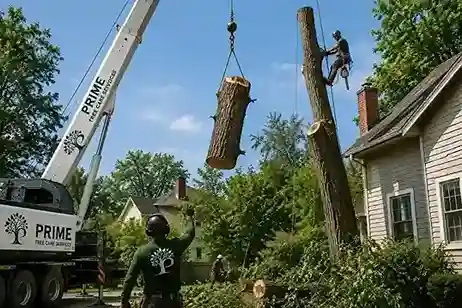
Learn more →Hazardous, dead, and storm-damaged tree removal, from routine jobs to complex crane-assisted removals near structures.
Learn more →24/7 response for downed limbs, split trunks, and trees on structures after severe weather, anywhere in the city.
Learn more →Tree cabling, structural bracing, and preventative inspection to reduce wind-load risk before the next storm season.
Learn more →Hazard removal and landscape restoration to prepare the site for replanting, sod, or hardscaping.
Schedule an Arborist Inspection and we'll walk you through the right next step for your tree.
Removal cost is one of the most searched tree-care topics in the city, and the honest answer is: it depends primarily on size, with several variables shifting the total up or down.
| Tree Size | Typical Range |
|---|---|
| Under 12" | $300 – $800 |
| Medium Trees | $1,500 – $3,000 |
| Large Mature Trees | $3,500 – $6,000 |
| Large Oaks | $6,000 – $9,000+ |
Beyond size, the variables that move a quote are consistent citywide: diameter and height determine cutting and rigging time; crane requirement adds equipment cost but often reduces overall risk and project time on large or tightly positioned trees; access limitations — common on narrow North Side lots or alley-access South Side properties — can add labor time; power line proximity requires extra caution and sometimes utility coordination; disposal depends on total wood volume; and stump grinding is quoted separately from the removal itself. For a complete cost breakdown by scenario, see our dedicated Tree Removal Cost in Chicago guide.
These are the indicators an ISA-certified arborist checks first during a tree risk assessment — often following the ISA's TRAQ (Tree Risk Assessment Qualification) framework for evaluating likelihood of failure against nearby targets.
Brittle limbs with no live growth can fail without warning, even in light wind.
A new or worsening lean often signals root failure and elevated uproot risk.
Lifted soil, cut roots from construction, or exposed roots weaken anchoring.
Fungal conks at the root flare are a strong visible indicator of internal decay.
Peeling or split bark exposes the tree to decay organisms and pests.
A tree that has already dropped limbs is statistically likely to drop more.
Sparse foliage relative to neighboring trees often points to root or disease stress.
Limbs growing into power or service lines need professional, coordinated attention.
Cracking in major structural limbs signals the union is close to failure.
Every part of Chicago has its own canopy character, lot layout, and risk pattern. Here's how our approach shifts neighborhood to neighborhood.
Historic canopy trees near the University of Chicago and the Museum of Science and Industry define this neighborhood — many decades-old oaks and elms require careful, preservation-first management.
Hyde Park Tree Service →Boulevard trees along Lincoln Avenue and the neighborhood's residential side streets require careful parkway pruning coordination with the Bureau of Forestry.
Lincoln Square Tree Service →A mix of older residential blocks and ongoing property improvement projects makes canopy management and stump removal common requests here.
Brighton Park Tree Service →Mature shade trees on larger Northwest Side lots make storm preparedness — cabling, bracing, and pre-season inspection — a priority for Dunning homeowners.
Dunning Tree Service →Larger Southwest Side lots and a heavier mature-tree density than much of the city make storm-damage prevention a recurring focus.
Mount Greenwood Tree Service →Lakeview, Lincoln Park, Uptown, Ravenswood, and neighboring communities combine dense urban canopy with heavy utility line conflicts along tight alleys.
North Side Tree Service →Historic tree preservation is central to South Side neighborhood character, from Bronzeville's boulevards to Beverly's mature ravine-lined streets.
South Side Tree Service →Large canopy tree management near Jackson Park and the Obama Presidential Center construction area requires close coordination around root zones and access.
Cottage Grove Tree Service →Don't see your neighborhood listed? Prime Tree Care serves all of Chicago and the surrounding suburbs — see our full service area coverage.
Chicago homeowner discussions on Reddit, Quora, and local Facebook groups return to the same advice again and again: verify insurance, verify certifications, verify the arborist's credentials before hiring anyone. Here's what that looks like with us.
Every job is led by an arborist who has passed the International Society of Arboriculture's certification exam — not a general labor crew.
We evaluate structural risk formally, using TRAQ-informed methodology, rather than guessing from the ground.
Removal is always the last recommendation after treatment and structural pruning have been genuinely ruled out.
Years of hands-on experience with the city's specific ordinance, species mix, and neighborhood-by-neighborhood canopy challenges.
Trained and equipped for safe work near energized power lines, with direct utility coordination when needed.
Cabling, bracing, and pre-season inspection programs designed around Chicago's specific wind and ice risk calendar.
Before hiring any tree company in Chicago, homeowners should verify active liability insurance, confirm ISA arborist certification for whoever is evaluating or supervising the job, and ask directly about crew experience with the specific issue — parkway coordination, utility proximity, or crane-scale removal. Prime Tree Care provides documentation for all three on request.
The same structured process applies whether the job is a single inspection or a full crane-assisted removal.
An ISA-certified arborist evaluates the tree on-site, in person.
Species-specific risk factors — oak wilt, EAB, Dutch elm — are identified early.
Structural condition, decay, lean, and proximity to targets are formally evaluated.
A clear recommendation, with reasoning, and equipment plan — aerial lift, bucket truck, or crane removal as needed.
Rigging systems, utility vegetation management coordination, and property protection throughout.
Full site cleanup plus written documentation useful for insurance or city requests.
Tree removal typically costs $300–$800 for trees under 12 feet, $1,500–$3,000 for medium trees, $3,500–$6,000 for large mature trees, and $6,000–$9,000+ for large oaks and other oversized trees requiring a crane. Diameter, height, access, crane needs, power line proximity, disposal, and stump grinding all affect the final price.
Private trees on your own property generally do not require a City of Chicago permit to remove. Parkway trees are owned by the city and are handled through the Bureau of Forestry, typically initiated via CHI311, rather than a private removal permit.
A parkway tree is a tree planted in the strip of land between the sidewalk and the street. In Chicago, these trees are owned and maintained by the Bureau of Forestry, not the adjacent homeowner, even though the tree sits directly in front of a private residence.
Most mature Chicago trees benefit from a professional inspection every 2–3 years, with annual checks for older trees, trees near structures, or storm-prone species like silver maple. Trees showing warning signs should be inspected immediately.
Silver maple, cottonwood, and willow are among the most storm-prone species in Chicago due to fast growth and weaker wood. Ash trees weakened by Emerald Ash Borer and elms affected by Dutch Elm Disease are also more prone to failure since disease damage compromises structural integrity before visible collapse.
Emerald Ash Borer (EAB) is an invasive beetle that has killed a large share of Chicago's ash population. Larvae tunnel under the bark and disrupt water and nutrient flow, causing canopy thinning, D-shaped exit holes, and eventual death if untreated.
Trimming is preferable whenever a tree is structurally sound and the problem can be corrected with pruning. Removal becomes the right call when a tree has irreversible decay, major structural failure, or disease that has progressed too far for treatment.
An ISA-certified arborist has passed the International Society of Arboriculture's exam covering tree biology, risk assessment, pruning standards, and safe work practices, and applies that training to diagnose and treat, prune, or remove trees safely.
In most cases, each property owner is responsible for damage on their own property regardless of whose tree caused it, and homeowner insurance typically covers removal when a tree damages a covered structure. Liability can shift if the tree owner had documented prior notice of a hazard.
Late winter through early spring, while trees are dormant, is generally best for structural pruning. Oaks should avoid pruning between roughly April and July to reduce oak wilt risk, and elms should avoid peak bark beetle season to limit Dutch Elm Disease transmission.
Michael brings hands-on urban forestry experience across nearly every Chicago neighborhood, from century-old canopy management in Hyde Park and Beverly to dense utility-line coordination on the North Side. His background includes storm-damage assessment following the region's major wind events, tree preservation planning aimed at extending the safe lifespan of mature parkway and yard trees, and neighborhood-specific experience with the species issues — EAB, Dutch elm, oak wilt — that define tree risk block by block across the city.
See the full Chicagoland service area list, including surrounding suburbs like Evanston, Oak Park, Elmhurst, Schaumburg, and Aurora.
From a routine inspection to emergency storm response, Prime Tree Care brings ISA-certified expertise and real Chicago-specific knowledge to every job, in every neighborhood.
 Prime Tree Care Chicago Arborists