ISA-Certified Arborists Protecting Hyde Park's Historic Tree Canopy
Prime Tree Care provides ISA-certified tree service throughout Hyde Park — from the mature oaks lining streets near the University of Chicago and the Midway Plaisance to the historic canopy bordering Jackson Park and the Wooded Island. Our arborists handle everything from Emerald Ash Borer treatment and elm preservation to storm-damaged tree removal along Hyde Park's lakefront-exposed blocks, with a preservation-first approach built for this neighborhood's historic residential properties.
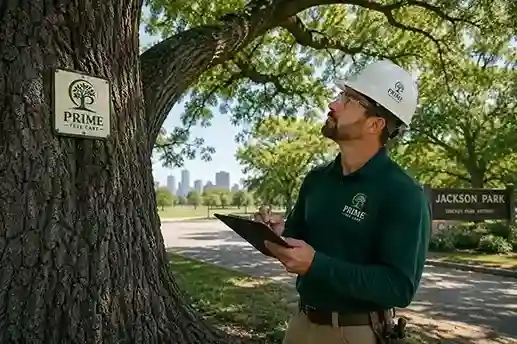
Hyde Park carries one of the stronger neighborhood canopy profiles in Chicago, with tree cover estimated around 27% — well above many South Side neighborhoods, though with real room for additional canopy growth on underplanted blocks. That canopy isn't incidental: it's the product of over a century of deliberate landscape planning tied to Jackson Park, the Midway Plaisance, and the University of Chicago campus, and it requires a different level of care than a typical residential tree.
Jackson Park spans more than 500 acres along Lake Michigan and is one of Chicago's most significant urban parks, shaped by Frederick Law Olmsted's landscape design legacy. Its large mature tree populations — including the plantings around the Wooded Island — set the tone for canopy expectations throughout Hyde Park. Properties near the park often carry legacy trees that deserve a preservation-first evaluation before removal is ever considered.
The Midway Plaisance's tree-lined corridor is part of Hyde Park's historic landscape design, and its mature shade trees are a defining visual feature of the neighborhood. Trees along and near the Midway typically need long-term structural pruning rather than reactive removal, given their contribution to the streetscape.
The University of Chicago's historic campus trees and the surrounding residential blocks call for preservation-minded management. Homeowners near campus are often dealing with dense urban canopy on smaller lots, where root protection, careful pruning, and thoughtful removal planning matter more than on a typical suburban property.
Given Hyde Park's historic canopy, we default to health and preservation options — treatment, structural pruning, cabling — before recommending removal, reserving removal for trees that are genuinely hazardous or beyond recovery.
Years of working Hyde Park's blocks have shown a consistent pattern of issues tied to this neighborhood's species mix, soil, and lakefront exposure.
Hyde Park's ash population — like much of Chicago's broader urban forest, including Jackson Park — has been significantly impacted by EAB-related losses over the past decade. For ash trees still standing, the decision comes down to timing: early-stage infestations can often be treated and preserved, while trees with significant canopy dieback are usually better replaced. We evaluate each ash tree individually and build a canopy replacement strategy — often diversifying species — when removal is the right call.
Read our full Emerald Ash Borer guide →Hyde Park still has notable historic elm populations worth protecting. We monitor these trees closely for early wilting and canopy flagging, since early intervention — pruning infected limbs and, when appropriate, fungicide treatment — is far more effective than treating an advanced infection.
Read our full Dutch Elm Disease guide →Silver maples throughout Hyde Park's residential blocks commonly develop weak branch unions as they mature, making them vulnerable to both wind and ice loading. We look for co-dominant stems and included bark early, so cabling or structural pruning can reduce failure risk before a storm forces the issue.
See Storm Prep & Support Systems →Hyde Park's position along Lake Michigan means straight-line wind events, heavy snow loads, and occasional derecho-style storms hit harder here than in more inland neighborhoods. We regularly respond to downed limbs and leaning trees along the lakefront-exposed blocks east of the neighborhood core.
See Emergency Tree Service →Many of Hyde Park's large mature oaks were planted alongside the neighborhood's historic homes decades ago and are now reaching the age where long-term structural pruning becomes essential for risk reduction — rather than waiting until a defect becomes a hazard.
See Tree Trimming & Pruning →EAB diagnosis, canopy assessments, and disease identification from ISA-certified arborists.
Learn More →Structural and dormant-season pruning, with oak wilt awareness built into scheduling.
Learn More →Hazardous tree removal, confined-space removals, and crane-assisted takedowns for tight Hyde Park lots.
Learn More →Downed limbs, leaning trees, and storm response across Hyde Park and the South Side.
Learn More →Species diversification and ash replacement planning suited to Hyde Park's canopy goals.
Learn More →Root-zone improvement and clay soil management for stressed urban trees.
Learn More →Cabling, bracing, and risk mitigation for weak-limbed trees before storm season.
Learn More →Hyde Park's canopy is more diverse than many Chicago neighborhoods — here's what we see most often, and what each species typically needs.
| Species | Benefits | Typical Issues | Maintenance Needs |
|---|---|---|---|
| Red Oak | Fast growth, strong canopy, fall color | Oak wilt susceptibility | Prune only outside Apr–Oct |
| White Oak | Long lifespan, storm-resistant structure | Slow to recover from wounds | Careful would-management pruning |
| Bur Oak | Highly durable, drought and wind tolerant | Large canopy needs space | Periodic structural pruning |
| American Elm | Iconic vase-shaped canopy, historic value | Dutch Elm Disease risk | Monitoring, early intervention |
| Hackberry | Tough, adaptable to urban soils | Witches' broom, minor pests | Routine pruning |
| Kentucky Coffeetree | EAB-resistant, strong urban performer | Slow establishment | Light structural training when young |
| Honey Locust | Light shade, tolerant of compacted soil | Thorns on wild varieties, pod litter | Annual light pruning |
| Ash | Legacy shade trees | Emerald Ash Borer | Treatment evaluation or removal |
| London Plane Tree | Urban-tolerant, distinctive bark | Anthracnose in wet springs | Structural pruning, monitoring |
| Maple (various) | Shade, fall color | Silver maple weak branch unions | Cabling/bracing on mature trees |
Hyde Park's built environment creates removal challenges you won't find in newer suburbs.
Century-old homes sit close to mature trees, requiring precise rigging to avoid roofs, porches, and masonry.
Narrow side yards and small lots limit equipment access, often calling for confined-space removal techniques.
Many Hyde Park properties are only reachable via narrow alleys, which shapes how we stage equipment and debris removal.
Alley-facing garages sit directly beneath canopy in many cases, requiring careful sectional dismantling instead of felling.
Given Hyde Park's historic canopy value, we default to preservation options before recommending removal wherever possible.
Overhead lines throughout the neighborhood require utility-aware pruning and, at times, coordination with utility crews.
Public parkway trees fall under the Bureau of Forestry, distinct from private trees, and often require a 311 request or permit before work begins.
Understanding the difference between private trees and public parkway trees matters in Hyde Park more than in most neighborhoods, given how many blocks have mature parkway plantings right at the curb. Private trees on your own lot are your responsibility and decision to make; parkway trees are technically city property and require coordination with the Bureau of Forestry, even if the tree is directly in front of your home. We help identify which category a given tree falls into before recommending next steps. Learn more in our parkway vs. private tree guide.
We review your Hyde Park property, access constraints, and any nearby parkway trees before scheduling.
An ISA-certified arborist evaluates species, structural defects, and root management needs on-site.
We formally assess risk level, factoring in proximity to structures and utility vegetation management concerns.
You get a clear, written recommendation and transparent estimate — no pressure to over-remove healthy trees.
Work is performed with confined-space techniques and utility-aware safety procedures suited to Hyde Park's lot sizes.
We clear all debris and discuss a long-term care plan for your remaining canopy.
Every recommendation is backed by ISA-Certified Arborist training and current urban forestry practices.
We default to preservation-first recommendations for Hyde Park's historically significant canopy.
Years of hands-on work throughout Hyde Park and the South Side inform every assessment we make.
Every job is fully covered, protecting your historic property and landscaping.
24/7 priority dispatch for storm damage along Hyde Park's lakefront-exposed blocks.
Bucket trucks, aerial lifts, crane removals, and stump grinders sized for Hyde Park's tight lots.
Whether it's a mature oak near Jackson Park, an ash tree showing EAB damage, or storm damage after a lakefront wind event, our ISA-certified arborists are ready to help. Free estimates, 24/7 emergency dispatch.
 Prime Tree Care