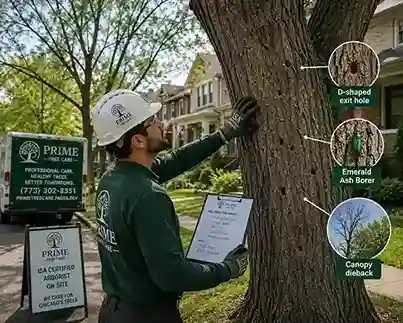
Emerald Ash Borer (EAB) is an invasive Asian beetle that has killed the large majority of untreated ash trees across the Chicago region since it arrived. Its larvae feed beneath the bark and cut off a tree's ability to move water and nutrients. Healthy, mildly infested ash trees can often be saved with professional trunk injection treatment. Trees with advanced canopy dieback, structural decay, or more than half their crown already dead are usually better candidates for removal before they become a safety hazard.
Emerald Ash Borer, scientifically named Agrilus planipennis, is a small, metallic green beetle native to Asia. It was first detected in the United States in Michigan in 2002, almost certainly arriving in wood packing material from overseas cargo shipments. As an invasive species with no natural predators in North America, it spread rapidly through the Midwest and reached the Chicago region within a few years.
EAB kills trees from the inside out. Adult beetles lay eggs in bark crevices, and the larvae that hatch tunnel beneath the bark to feed on the cambium layer, the thin band of living tissue responsible for moving water and nutrients between the roots and the canopy. As larvae feed, they carve winding, S-shaped galleries that girdle the trunk and branches. Once enough of this tissue is destroyed, the tree can no longer transport water upward or sugars downward, and it starves.
Ash trees are especially vulnerable because North American ash species evolved without any exposure to this pest, and they have no natural chemical or structural defenses against it. Nearly every native ash species, green ash, white ash, and black ash alike, is susceptible.
| Fact | Details |
|---|---|
| Scientific Name | Agrilus planipennis |
| Native Region | Asia |
| First U.S. Detection | Michigan, 2002 |
| Host Species | Ash trees (green, white, black) |
| Primary Damage | Larvae feeding beneath the bark, cutting off water and nutrient flow |
Chicago's EAB crisis has roots that go back decades before the beetle ever arrived. After Dutch Elm Disease wiped out most of the region's American elms in the mid-20th century, cities and homeowners across the Chicago area replanted heavily with ash trees. Ash grew fast, tolerated urban stress well, and filled in bare parkways quickly, so it became one of the most common replacement species planted along Chicago's streets and in residential yards.
That popularity is exactly what made the EAB outbreak so severe. A pest that targets ash specifically found an enormous, densely planted host population waiting for it across public tree inventories, parkway trees, and residential landscapes throughout the metro area. Urban forestry departments were managing tree populations that, in some neighborhoods, were 20 percent or more ash, a concentration that let the beetle spread rapidly from tree to tree with little natural interruption.
The impact on Chicago's urban canopy has been substantial. Entire blocks of parkway trees have been lost in some neighborhoods, and the loss of mature shade trees has affected property values, energy costs, and stormwater management in the areas hit hardest.
The City of Chicago's Bureau of Forestry has run a large-scale ash tree management program since EAB was confirmed in the region, combining preventive treatment of healthy, high-value trees with removal of trees too far into decline to save. This dual approach reflects a simple reality: treating every ash tree in the city is not practical, but removing every ash tree immediately is not necessary either.
Public tree inventories let the city track which parkway trees are ash, prioritize treatment for large, structurally sound specimens in good locations, and schedule removal for trees already showing significant dieback. Healthy, high-value ash trees, particularly large, mature specimens providing significant shade and canopy cover, are generally strong candidates for the city's ongoing treatment cycle. Trees with more than 30 to 50 percent canopy loss are typically moved toward the removal side of the program instead.
Private property owners face the same basic decision on a smaller scale, and the same logic applies: a healthy or mildly infested ash tree is usually worth evaluating for treatment, while a severely declining one is usually better addressed through planned removal before it becomes a safety issue.
Before you can evaluate EAB risk, you need to confirm the tree in question is actually an ash. Several Chicago-area species get mistaken for ash, so a quick identification check is worth doing before you assume the worst.
Seasonal identification is easiest in late spring and summer, when leaves and seed clusters are fully developed. In winter, bark pattern and opposite branch structure are the most reliable clues.
Early EAB infestation is subtle, and homeowners often mistake it for ordinary drought stress. Catching it at this stage gives you the most treatment options.
Once an infestation progresses, the signs become much more visible and much harder to reverse.
A homeowner's visual inspection is a useful starting point, but a confirmed diagnosis and treatment recommendation should come from an ISA-certified arborist. Our process typically includes a full visual inspection of the trunk, bark, and canopy; confirming the tree's species; a close look for exit holes and bark damage; a canopy assessment to estimate what percentage of the crown is already affected; and, where appropriate, a full tree risk assessment covering structural stability, not just insect activity.
That combination determines treatment viability. A tree with 10 percent canopy loss and no structural defects is a very different case than one with 60 percent dieback and visible trunk decay, even if both show D-shaped exit holes. ISA certification matters here because it reflects standardized training in exactly this kind of tree health and risk evaluation, not just tree removal experience.
Often, yes, but it depends heavily on how far the infestation has progressed. Healthy trees with no visible symptoms respond very well to preventive treatment. Trees with mild infestation and limited canopy thinning also generally respond well. Moderate infestation, meaning noticeable canopy loss but a still-largely-intact crown, is possible to treat but requires an honest conversation about the odds. Severely declining trees, generally those with more than half the canopy already dead, respond poorly to treatment even when it's attempted. Trees that are already dead cannot be treated at all and should be evaluated for removal.
| Tree Condition | Treatment Potential |
|---|---|
| Healthy | Excellent |
| Mild Infestation | Good |
| Moderate Infestation | Possible |
| Severe Decline | Often Poor |
| Dead Tree | Not Recoverable |
This is the decision every ash tree owner in Chicago eventually faces, and it deserves more thought than a quick guess. The right call depends on tree size, current condition, location relative to structures and power lines, structural risk, the tree's contribution to property value, long-term treatment cost versus one-time removal cost, and how much landscape value the tree provides in shade, privacy, or character.
If you're unsure which category your tree falls into, that uncertainty is itself a good reason to schedule a professional evaluation rather than guessing either direction.
Trunk injection is the most commonly recommended professional treatment for EAB. A systemic insecticide, most often one containing emamectin benzoate, is injected directly into the trunk's vascular tissue, where the tree's own water transport system carries it up into the canopy. Because the chemical moves through the same tissue EAB larvae feed on, it kills larvae feeding beneath the bark from the inside out, rather than relying on an external spray that has to reach the beetles directly.
Treatment typically runs on a cycle rather than a single application. Depending on the product and the tree's condition, most Chicago-area ash trees are re-treated every one to three years to maintain protection, since the insecticide's effectiveness fades over time. Preventive treatment, started before significant infestation, generally produces the best long-term outcomes and the most predictable treatment cycle. An arborist will typically recommend a monitoring schedule alongside treatment, checking canopy condition and exit hole activity at each visit to confirm the tree is responding well.
Treatment cost scales primarily with trunk diameter, since larger trees require more insecticide to reach full canopy coverage.
| Tree Size | Typical Treatment Range |
|---|---|
| Small | $200 to $500 |
| Medium | $400 to $900 |
| Large Mature Ash | $800 to $2,000+ |
What affects the price: trunk diameter, accessibility, the specific treatment product used, how frequently retreatment is needed, and the tree's overall condition going into treatment. Keep in mind this is typically a recurring cost every one to three years, not a single payment, which matters when comparing it against a one-time removal cost.
Removal cost depends on a different set of factors than treatment: overall tree height, whether crane access is required, how tight the work site is, proximity to utility lines, and disposal logistics for the wood and debris.
| Ash Tree Size | Typical Removal Range |
|---|---|
| Small (under 12 in. trunk) | $300 to $800 |
| Medium (20 to 40 ft. tall) | $1,500 to $3,000 |
| Large (50 ft.+ mature specimen) | $3,500 to $9,000+ |
For a full breakdown of what drives Chicago tree removal pricing across all species, including crane requirements and disposal fees, see our complete tree removal cost guide for Chicago.
Putting off a treat-or-remove decision rarely saves money, and it often costs significantly more. A dead ash tree becomes dangerous quickly, since EAB-killed wood dries out and becomes brittle within a year or two, well before the tree visibly appears hazardous from the ground.
Dead ash trees are also considerably harder and more expensive to remove safely. Brittle wood is unpredictable during a rigging or crane operation, which raises both the difficulty and the cost of the job compared to removing the same tree while it was still alive and structurally sound. Add in the increased risk of structural failure, particularly during wind events, and the odds of storm-related property damage or an unplanned emergency removal go up substantially the longer a dead ash tree is left standing.
Before assuming EAB is the issue, it's worth confirming species. Several common Chicago trees share superficial similarities with ash.
| Comparison | Key Difference |
|---|---|
| Ash vs. Elm | Elm has alternate (staggered) leaves and asymmetrical leaf bases; ash has opposite leaves and branching. |
| Ash vs. Maple | Maple has simple, single-blade leaves; ash has compound leaves with 5 to 9 leaflets per stem. |
| Ash vs. Honey Locust | Honey locust has much finer, feathery compound leaves and thorny bark on younger growth. |
| Ash vs. Boxelder | Boxelder, a type of maple, has 3 to 5 leaflets and greener, smoother bark than mature ash. |
If you're not confident in the identification, our tree health inspection service includes species confirmation as a standard first step.
If your ash tree does need to come out, replanting with a more resilient, diversified species helps avoid a repeat of the exact situation that made EAB so damaging in the first place: too many of one species planted too densely. A genuinely diversified urban canopy is far more resistant to the next invasive pest or disease, whatever it turns out to be.
Strong Chicago-area alternatives include bur oak and swamp white oak, both long-lived, storm-tolerant natives well suited to clay soils; Kentucky coffeetree, a tough, underused native with few pest problems; hackberry, a resilient, adaptable shade tree; and disease-resistant elm cultivars bred specifically to resist Dutch Elm Disease while restoring some of the classic elm canopy shape Chicago lost decades ago.
For a full walkthrough of species selection, planting timing, and diversification strategy, see our dedicated guide on what to plant instead of ash in Chicago, or ask about our tree planting and transplanting service.
An EAB-weakened ash tree is a storm risk well before it looks dangerous. Larval tunneling compromises the wood's structural integrity from the inside, which means limb failure can happen in fairly ordinary wind, not just during a major event. Hidden decay behind intact-looking bark is one of the most common reasons an apparently stable ash tree fails during a Chicago derecho or severe thunderstorm.
This is a big part of why emergency ash removals spike after major wind events. A tree that had been quietly declining for a season or two finally gives way under storm-level wind loading, often with far less warning than a healthy tree would show. Addressing a declining ash tree proactively, on a planned schedule, is consistently safer and less expensive than waiting for a storm to force the issue.
If you have an ash tree on your property today, a few practical points matter more than general EAB background. First, confirm whether the tree is on the parkway or private property. Parkway trees are owned and managed by the City of Chicago's Bureau of Forestry, and any treatment or removal decision on those goes through the city rather than a private contractor working alone. Private property ash trees are entirely your responsibility, and the treat-or-remove decision is yours to make.
Second, Chicago's urban canopy recovery from EAB is an ongoing, multi-decade project, and species diversification is central to it. If removal is the right call for your tree, replanting with a different species helps the broader neighborhood canopy, not just your own yard.
Third, long-term tree planning beats reactive tree care every time. An annual or biennial health check on any remaining ash trees, paired with a clear treat-or-remove plan before a tree reaches advanced decline, consistently costs less and produces safer outcomes than waiting for a crisis.
Our ISA-certified arborists have evaluated and treated ash trees across Chicago's parkways and residential landscapes for years, from routine tree risk assessments to full treatment planning and species identification. That hands-on experience means we can usually tell within a single site visit whether a tree is a strong treatment candidate or better suited for planned removal, and we'll always walk you through the reasoning rather than just handing you a recommendation.
Canopy thinning at the top of the tree, early or excessive leaf loss, and generally reduced vigor are usually the first visible signs, often appearing before any exit holes are noticeable.
Individual trees can be protected with ongoing systemic insecticide treatment, but EAB itself cannot be eliminated from a region once established. Treatment manages infestation in specific trees rather than eradicating the pest.
Typical Chicago-area treatment ranges from $200 for a small tree to $2,000 or more for a large mature ash, with retreatment usually needed every one to three years.
Healthy or mildly infested trees are generally strong candidates for treatment. Trees with more than roughly half the canopy already lost, or with visible structural decay, are usually better addressed through planned removal.
Significant canopy thinning, extensive deadwood, D-shaped exit holes, bark splitting, and heavy woodpecker activity together indicate a tree in serious decline rather than early-stage stress.
D-shaped exit holes are where adult Emerald Ash Borer beetles have chewed their way out from beneath the bark after completing larval development, and they are one of the clearest confirmations of active infestation.
Yes. Dead ash wood becomes brittle within a year or two and is prone to sudden limb or trunk failure, particularly during wind events, which is why prompt removal of dead ash trees matters for safety.
Bur oak, swamp white oak, Kentucky coffeetree, hackberry, and disease-resistant elm cultivars are all strong, resilient alternatives well suited to Chicago's soil and climate conditions.
Yes. The City of Chicago's Bureau of Forestry continues to treat healthy, high-value parkway ash trees as part of its ongoing urban forestry management program, while removing trees too far into decline to save.
Untreated, most ash trees decline and die within two to four years of visible infestation, though the exact timeline varies with tree size, health, and how early the infestation was caught.
Prime Tree Care can provide a professional arborist evaluation, identify signs of Emerald Ash Borer activity, and help you make an informed treatment-versus-removal decision, before the situation turns into an emergency.
 Prime Tree Care Chicago Arborists