 Prime Tree Care Chicago Arborists
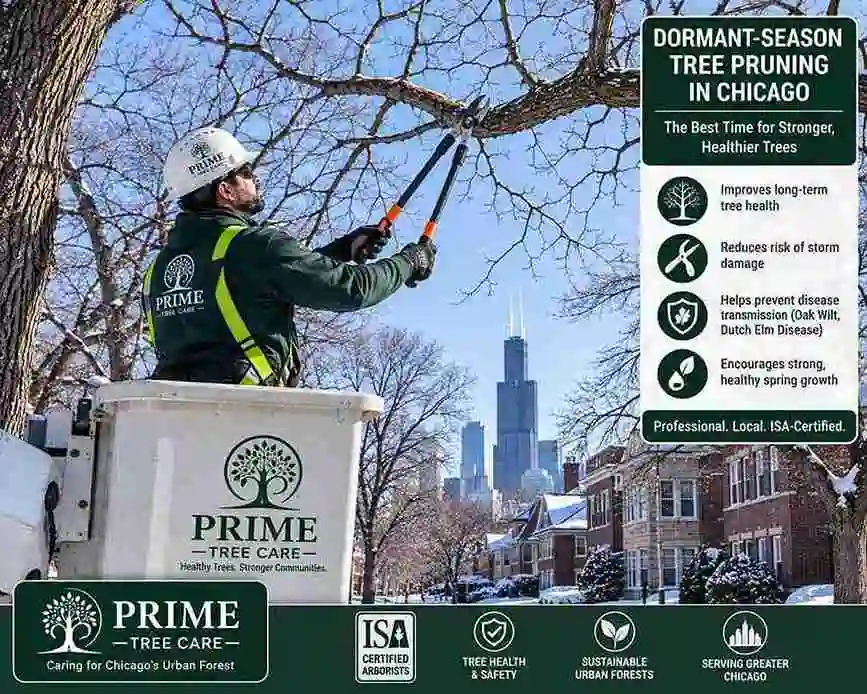
- What Is Dormant-Season Pruning?
- The Real Reason Arborists Avoid Growing-Season Oak Pruning
- How Oak Wilt Spreads
- How Dutch Elm Disease Spreads
- Oak Wilt vs. Dutch Elm Disease
- Why Late-Winter Pruning Is Safer
- Chicago's Oak Pruning Calendar
- Pruning Outside Dormant Season
- Trees That Benefit From Dormant Pruning
- Structural vs. Reactive Pruning
- Pruning & Storm Resistance
- Common Pruning Mistakes
- Our Dormant-Season Approach
- Frequently Asked Questions
What Is Dormant-Season Pruning?
Dormant-season pruning means cutting trees while they're in their winter resting period — after leaf drop in fall and before bud break in spring, when growth, sap movement, and insect activity have all slowed to their lowest annual levels.
Tree Dormancy Explained
Like many living things, deciduous trees cycle through active growth and dormant rest. During Chicago winters, trees essentially pause: they stop producing new leaves, slow internal sap flow, and shift energy toward root maintenance rather than canopy expansion. This dormant state changes how a tree responds to a pruning cut, and it changes what's happening in the surrounding environment — both of which matter enormously for disease risk.
Why Late Winter Is Often Preferred
Within the dormant window, late winter specifically — typically February and March in Chicago — is the sweet spot most ISA-certified arborists target. By this point, the coldest stretch of winter has passed, making outdoor work more practical, but spring bud break and rising insect activity haven't started yet. Pruning too early in winter isn't dangerous, but late-winter timing maximizes the gap between the cut and the first insects becoming active in spring.
Visibility & Structural Assessment Benefits
With no leaves obscuring the canopy, an arborist can see a tree's entire branch architecture at once — every crossing limb, every included bark union, every dead or cracked section. This dramatically improves the accuracy of structural pruning decisions compared to trying to evaluate the same tree buried in summer foliage.
Better Wound Response as Spring Growth Begins
A pruning cut made in late winter has the shortest possible wait before the tree's natural spring growth surge begins working to close and compartmentalize the wound. That timing advantage means cuts made in late winter often seal and callus more efficiently than cuts made at other points in the year.
Why February and March Are Common Arborist Pruning Months
Illinois Extension guidance consistently supports late-winter pruning for many deciduous species common throughout Chicagoland, citing the combination of reduced disease pressure, improved visibility, and favorable timing ahead of the spring growth flush. This isn't an arbitrary scheduling preference — it reflects a genuine convergence of biological factors that make February and March the lowest-risk, highest-value pruning window for most of the year.
Why Chicago's Climate Makes Dormant Pruning Effective
Chicago's distinct four-season climate, with a genuinely cold winter that suppresses insect activity across Cook County and the surrounding suburbs, makes dormant-season pruning particularly effective here compared to milder climates where insects may never fully go dormant. That seasonal insect shutdown is precisely what protects freshly cut oaks and elms from disease-carrying beetles.
The Real Reason Arborists Avoid Pruning Oaks During Growing Season
Most homeowners assume pruning timing is purely about shaping a tree or avoiding sap mess. The far bigger concern arborists are actually managing is disease transmission — and it's a risk most people have never heard explained clearly.
Fresh Wounds & Sap Flow
Every pruning cut creates an open wound in the tree's bark and outer wood. During the growing season, active sap flow at that wound site releases moisture and volatile compounds into the surrounding air.
Chemical Cues Released by Fresh Cuts
Those released compounds aren't just incidental byproducts — they act as chemical signals that certain insects are specifically drawn to. A fresh cut essentially broadcasts its presence to any nearby insect equipped to detect it.
Attraction of Sap-Feeding Beetles
For oaks specifically, sap-feeding beetles are strongly attracted to the smell of fresh wounds during their active season. If any of those beetles have recently visited an Oak Wilt-infected tree, they can carry fungal spores directly to your healthy tree's new wound — turning a routine pruning cut into an infection entry point. This single mechanism is the entire reason the "don't prune oaks in spring or summer" rule exists.
Homeowners are often surprised to learn that a single, otherwise-healthy pruning cut made at the wrong time of year can be the exact event that introduces Oak Wilt to a tree that had no prior disease exposure. The cut itself doesn't cause the disease — it's the open invitation the cut creates for disease-carrying insects during their active season.
How Oak Wilt Spreads
Understanding the actual transmission sequence makes the pruning-timing rule click into place immediately.
- Step 1: An infected oak develops fungal matsBeneath the bark of a tree already infected with Oak Wilt, the fungus produces spore-bearing mats, often with a distinct sweet or fermented odor.
- Step 2: Sap-feeding beetles visit infected materialBeetles drawn to the fungal mats pick up fungal spores on their bodies while feeding.
- Step 3: Beetles are attracted to fresh woundsThose same beetles, now carrying spores, are drawn to the chemical signal of a fresh pruning wound or storm-damaged limb on a nearby healthy oak.
- Step 4: Spores are transferredContact between the beetle and the open wound deposits fungal spores directly into the tree's vascular tissue.
- Step 5: The healthy oak becomes infectedThe fungus spreads through the tree's water-conducting tissue, triggering wilt symptoms that can progress to tree death within weeks in severe cases.
Red Oak Group Vulnerability & Rapid Mortality
Red oak group species (including red oak, black oak, and pin oak) are especially vulnerable to Oak Wilt, often dying within just a few weeks to months of infection — far faster than white oak group species, which can sometimes survive years with the disease. This rapid mortality timeline is exactly why prevention through correct pruning timing matters so much more than after-the-fact treatment.
Why Prevention Is Critical
Oak Wilt can also spread between neighboring oaks through connected, grafted root systems underground — meaning a single infected tree on a block can threaten every oak sharing its root zone, independent of any pruning activity at all. Because treatment options for an already-infected tree are limited, and because root-graft spread can silently move the disease between trees, preventing the initial above-ground infection through correct pruning timing is the single most effective control measure available to homeowners. Infection risk is highest during spring and early summer, when beetle activity is at its annual peak.
How Dutch Elm Disease Spreads
Dutch Elm Disease follows a strikingly similar transmission pattern to Oak Wilt, with a few important differences.
Elm Bark Beetles as the Vector
Instead of the sap-feeding beetles associated with Oak Wilt, Dutch Elm Disease is spread primarily by elm bark beetles, which breed in dead or dying elm wood and carry the causal fungus on their bodies as they move between trees.
Fresh Wounds as Entry Points
Just as with oaks, fresh pruning wounds on elms release chemical signals that can attract elm bark beetles carrying Dutch Elm Disease fungi during the growing season, creating the same kind of infection opportunity.
Root Graft Transmission
Dutch Elm Disease also spreads through root grafts between neighboring elms, exactly like Oak Wilt does between oaks — meaning a diseased elm can silently infect adjacent healthy elms underground, regardless of pruning timing.
Historic Impact on Chicago's Canopy
Few diseases have shaped Chicago's urban forest history as dramatically as Dutch Elm Disease. Decades ago, it devastated what was once an enormous American elm street-tree population throughout the city, permanently changing the character of many neighborhood canopies and prompting the diversified planting approach much of the region follows today.
Why Elm Pruning Timing Still Matters
Even with far fewer mature elms remaining citywide than a century ago, the surviving and replanted elms throughout Chicago's older neighborhoods remain genuinely vulnerable, which is why correct pruning timing continues to matter as much for elms as it does for oaks.
Oak Wilt vs. Dutch Elm Disease
These two diseases are often discussed together because their transmission mechanics and pruning implications are so similar — but they're not identical.
| Category | Oak Wilt | Dutch Elm Disease |
|---|---|---|
| Primary Host | Oaks (especially red oak group) | Elms |
| Disease Type | Fungal | Fungal |
| Insect Vector | Sap-feeding beetles | Elm bark beetles |
| Risk From Fresh Wounds | High | High |
| Recommended Pruning Season | Dormancy | Dormancy |
| Root Graft Spread | Yes | Yes |
| Potential Outcome | Tree death, often rapid in red oaks | Tree death, historically widespread citywide |
In practical terms for a Chicago property owner: if you own a mature oak or elm, the same core rule applies to both — avoid pruning cuts during the growing season, and treat any unavoidable wound during that window as a genuine disease-exposure risk worth managing carefully.
Why Late-Winter Pruning Is Safer
Reduced Insect Activity
Sap-feeding and elm bark beetles are largely dormant through Chicago's winter, dramatically shrinking the window of disease exposure around a fresh cut.
Lower Disease Transmission Risk
Fewer active vector insects means fewer opportunities for fungal spores to reach a newly wounded tree.
Better Structural Visibility
A leafless canopy reveals defects, crossing limbs, and weak unions an arborist might otherwise miss.
Easier Hazard Identification
Cracks, cavities, and dead wood are far easier to spot and correct without foliage in the way.
Improved Long-Term Structure
Structural decisions made with full canopy visibility tend to produce better-balanced, storm-resilient trees over time.
University-Backed Guidance
University of Illinois and regional Chicago-area forestry recommendations consistently support dormant pruning for these exact reasons.
Chicago's Recommended Oak Pruning Calendar
Not every month carries equal risk. Here's how Oak Wilt transmission risk shifts across a typical Chicago calendar year.
| Month | Oak Pruning Risk |
|---|---|
| January | Low |
| February | Low |
| March | Generally Low |
| April | High |
| May | Very High |
| June | Very High |
| July | Moderate |
| August | Moderate |
| September | Moderate |
| October | Moderate |
| November | Low |
| December | Low |
Highest risk period: April through June represents the highest Oak Wilt transmission risk in Chicago, coinciding with peak beetle activity and active tree sap flow. Why spring wounds are dangerous: A wound created during this window has the highest statistical odds of attracting a spore-carrying beetle before it can callus over. Conservative arborist recommendation: Illinois guidance generally advises avoiding oak pruning entirely during the active disease-transmission period from early spring through early summer, reserving that window strictly for genuine emergencies.
Can Trees Ever Be Pruned Outside Dormant Season?
Yes, sometimes. Dormant-season timing is the standard recommendation, not an absolute rule that overrides safety.
- Storm damage: A broken or hanging limb after a storm needs prompt attention regardless of the calendar.
- Broken limbs: Partially attached limbs are a falling hazard that can't safely wait for winter.
- Safety hazards: Limbs threatening a structure, walkway, or power line justify immediate action.
- Emergency tree situations: Any condition posing an active risk to people or property takes priority over disease-timing considerations.
When emergency pruning on an oak genuinely cannot be delayed, wound protection may be recommended immediately after the cut to reduce the exposure window while the tree begins to callus. Our emergency tree service team handles exactly these situations, balancing immediate safety needs against disease-risk best practices.
Common Chicago Trees That Benefit from Dormant Pruning
While oaks and elms carry the most disease-specific urgency, most of Chicago's common shade tree species benefit structurally from dormant-season pruning.
Oak Trees
Strict dormant-season timing due to Oak Wilt risk.
Elm Trees
Dormant timing plus sanitized tools due to Dutch Elm Disease risk.
Honey Locust
Benefits from winter structural visibility for canopy thinning.
Maple
Dormant pruning avoids heavy sap flow ("bleeding") common in spring cuts.
Hackberry
Winter timing simplifies deadwood and structural correction.
Linden
Dormant pruning supports better structural training on young trees.
Kentucky Coffeetree
Coarse branching is easiest to evaluate and correct without leaf cover.
Structural Pruning vs. Reactive Pruning
Proactive Winter Pruning
Better canopy structure, reduced storm damage risk, lower disease pressure, and lower cost over the long term compared to reactive work.
Emergency / Reactive Pruning
Storm response, hazard removal, and damage mitigation performed on an as-needed basis, regardless of season.
The two approaches aren't competitors — they're complementary. A property with a consistent proactive winter pruning schedule needs far less emergency reactive work when Chicago's next major wind event or derecho arrives, because the structural weaknesses that cause most storm failures have already been addressed ahead of time.
How Proper Pruning Improves Storm Resistance
Dormant-season structural pruning isn't only a disease-prevention tool — it directly reduces storm failure risk, which matters enormously given Chicago's exposure to severe spring and summer weather.
- Wind loading: A thinned, well-balanced canopy lets wind pass through instead of catching it like a sail.
- Branch weight reduction: Shortening overextended limbs reduces leverage on weak branch unions before a storm tests them.
- Co-dominant stem management: Winter visibility makes it far easier to identify and correct competing stems before they become a splitting hazard.
- Included bark correction: Early correction of weak branch unions prevents the catastrophic splits that cause major storm damage.
Proactive dormant-season pruning is one of the most effective tools available for reducing future storm failures — see our full breakdown in Chicago Derecho Storm Damage & Trees, and explore our storm prep & tree support systems service for cabling and bracing options on high-value trees.
Mistakes Homeowners Make When Pruning Trees
- ✕Topping trees — indiscriminately cutting back the entire crown, which weakens structure and triggers weak regrowth
- ✕Excessive canopy removal — removing more than 25% of live canopy in a single season stresses the tree unnecessarily
- ✕Summer pruning of oaks — the single highest-risk timing mistake for Oak Wilt transmission
- ✕Improper cuts — cutting at the wrong angle or location slows healing and invites decay
- ✕Flush cuts — cutting flush against the trunk removes the branch collar the tree needs to seal the wound properly
- ✕Ignoring branch collars — the collar is the tree's natural defense zone; cutting through it invites decay
- ✕Using dirty tools — pruning tools carried between trees without sanitizing can physically transfer fungal pathogens
That last point deserves emphasis: sanitizing pruning tools between individual trees, especially when working on or near oaks and elms, is a simple, low-cost habit that meaningfully reduces the odds of accidentally spreading disease from one tree to the next on the same property.
Prime Tree Care's Dormant-Season Pruning Approach
Every Prime Tree Care pruning plan starts with a genuine tree risk assessment, not a generic seasonal checklist. We evaluate species, health, structural condition, and disease exposure before recommending a pruning window — because a blanket "always prune in winter" rule misses the real nuance most properties actually need.
- Tree Risk Assessment: A documented evaluation of structural defects, disease indicators, and storm vulnerability before any cut is made.
- Structural Pruning: Targeted correction of co-dominant stems, included bark, and weight imbalance during the safest seasonal window.
- Species-Specific Timing: Oaks and elms are scheduled under strict dormant-season rules; other species are evaluated on their own merits.
- Disease Prevention: Sanitized tools, careful wound management, and conservative timing recommendations on every oak and elm job.
- Long-Term Canopy Management: A pruning plan designed around your tree's multi-year health and storm resilience, not just this season's appearance.
See our full tree trimming & pruning service page, or start with a tree health inspection if you're unsure whether your oak or elm currently shows any disease warning signs.
We regularly apply this exact dormant-pruning discipline on mature oaks and elms throughout Hyde Park, Lincoln Square, Oak Park, Evanston, and Elmhurst, as well as older parkway tree stock across both the North Side and South Side of the city. Chicago's urban canopy — much of it decades-old and maintained in coordination with the city's Bureau of Forestry on parkway trees — depends on this kind of species-specific, disease-aware pruning discipline to stay healthy for future generations. See our full Chicago, IL tree service coverage for neighborhood-specific details.
Not sure whether your oak or elm needs pruning now or should wait for the dormant season? Our ISA-certified arborists can evaluate your tree's condition and recommend the safest timing for your specific situation.
Frequently Asked Questions
What is the best time of year to prune trees in Chicago?
Late winter, typically February and March, is generally the best time to prune most Chicago tree species. Trees are dormant, insect activity is minimal, and the leafless canopy makes structural evaluation far easier for an arborist.
Why shouldn't oak trees be pruned in spring?
Fresh pruning wounds on oaks during spring and early summer release chemical signals that attract sap-feeding beetles. If those beetles have recently visited an Oak Wilt-infected tree, they can transfer fungal spores directly into the new wound, infecting the healthy tree.
What months are safest for oak tree pruning?
January through March carry the lowest Oak Wilt transmission risk in Chicago, with November and December also considered low risk. April through June represent the highest-risk window and should generally be avoided for non-emergency oak pruning.
Can pruning spread Oak Wilt?
Yes, indirectly. Pruning itself doesn't cause Oak Wilt, but a fresh pruning wound made during the growing season can attract disease-carrying beetles, creating an entry point for the fungus into an otherwise healthy tree.
Can pruning spread Dutch Elm Disease?
Yes, through the same basic mechanism as Oak Wilt. Fresh wounds on elms during the growing season can attract elm bark beetles carrying the Dutch Elm Disease fungus, making dormant-season pruning the safer choice for elms as well.
Is winter pruning better for tree health?
For most Chicago species, yes. Winter pruning reduces disease transmission risk, causes less stress to the tree during an active growth period, and allows an arborist to see and correct structural defects that would otherwise be hidden by foliage.
Should storm-damaged branches be removed immediately?
Yes. Broken, hanging, or hazardous limbs should be addressed promptly regardless of season, since the safety risk of leaving them in place outweighs the disease-timing considerations that apply to routine, non-emergency pruning.
Do pruning wounds need to be painted?
Generally, no, for most routine pruning cuts on most species. Wound dressing is occasionally recommended specifically for oaks when emergency pruning happens during the high-risk growing season, as a supplemental precaution against Oak Wilt exposure.
Can dead branches be removed year-round?
Dead wood carries lower disease-transmission risk than live wood since it isn't actively producing the sap and chemical signals that attract disease-carrying beetles, but removal near oaks and elms during peak beetle season should still be handled carefully by a professional.
Why do arborists recommend dormant-season pruning?
Dormant-season pruning minimizes disease transmission risk from insects like sap-feeding beetles and elm bark beetles, improves structural visibility across the bare canopy, and aligns with the tree's natural growth cycle for more efficient wound closure in spring.