Prime Tree Care helps Chicago property owners reduce storm-related tree failures through professional tree cabling, structural bracing, and storm preparedness planning. Our ISA-certified arborists identify structural weaknesses, install engineered support systems, and build proactive risk-reduction plans that help valuable trees withstand Chicago's severe weather.
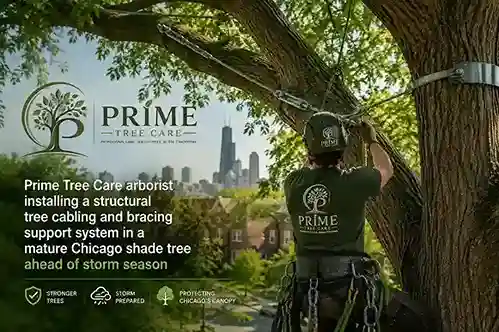
Chicago's weather asks a lot of its trees. Derechos, straight-line winds, sudden downburst thunderstorms, heavy wet snow, and ice accumulation all put real stress on limbs and trunks, often with very little warning. A tree that looks perfectly healthy on a calm afternoon can fail during a 60 mph wind gust if it already carries a structural weakness underneath the canopy.
Urban conditions make the risk worse. Chicago's tree population skews older in many established neighborhoods, lot sizes are small, root space is limited by sidewalks and foundations, and utility lines run through nearly every parkway. A single weak union or overextended limb has little margin for error when a home, driveway, or power line sits directly underneath it.
When a storm-stressed tree does fail, the consequences go beyond a fallen branch. Property owners are looking at roof and siding damage, vehicle damage, personal injury risk, utility outages that can affect an entire block, and insurance claims that take weeks to resolve. Proactive structural support is almost always less disruptive, and less expensive, than dealing with the aftermath of a failure.
Prime Tree Care tracks local storm activity closely and updates our risk guidance after every major Chicagoland weather event. Read our ongoing coverage on the Chicago derecho and storm damage page for recent, area-specific detail.
These structural conditions are the most common reasons an ISA-certified arborist recommends cabling, bracing, or a full risk assessment on a Chicago-area tree.
Tree cabling installs high-strength steel or synthetic cables high in the canopy to limit how far co-dominant stems or heavy limbs can move during wind loading. It reduces the chance of a limb splitting away from the main structure.
How it works. An arborist identifies the weak union or overextended limb, then installs a cable between two support points, usually one-third to two-thirds up the affected limbs. The cable does not hold the tree up. It limits excess movement so a gust of wind cannot swing a heavy limb far enough to snap the union.
Where cables are installed. Cabling typically targets co-dominant leaders, long horizontal limbs over a roof or driveway, and limbs with included bark at the union. Placement depends on the tree's species, canopy shape, and the specific defect being addressed.
What problems it solves. Cabling reduces the risk of limb failure from wind load, redistributes stress away from a compromised union, and often allows a structurally valuable tree to be preserved instead of removed.
| Cabling Type | Purpose | Typical Use |
|---|---|---|
| Dynamic cabling | Allows limited natural movement while limiting extreme swing | Young to semi-mature trees with early structural defects |
| Static cabling | Restricts movement more firmly using high-strength steel cable | Mature trees with significant co-dominant stem risk |
| Combined systems | Pairs cabling with bracing rods for full structural support | Trees with both canopy and trunk-level defects |
Tree bracing installs solid steel rods through the trunk or major limbs to reinforce a split, a weak union, or an already-cracked section of the tree's structure. Where cabling limits movement in the canopy, bracing reinforces the tree at the point of the defect itself.
Through-rod bracing drills a threaded steel rod directly through both sides of a split trunk or weak union, then secures it with hardware on each end. This physically holds the two sections together and prevents the crack from spreading further.
Rod installation requires careful placement to avoid unnecessary wounding, sized correctly to the tree's diameter and the severity of the defect. An ISA-certified arborist determines rod count, depth, and placement based on a hands-on structural evaluation.
Long-term structural integrity. Properly installed bracing can stabilize a split trunk or weak union for years, buying time for the tree to compartmentalize the wound and continue adding new, healthy wood around the repair.
| Support Method | Best For | Goal |
|---|---|---|
| Cabling | Co-dominant stems, overextended limbs | Limit movement, reduce wind-load stress |
| Bracing | Split trunks, cracked unions | Physically reinforce the structural defect |
| Combined systems | Trees with multiple, layered defects | Full-tree structural stabilization |
Some species planted throughout Chicago are naturally more prone to structural defects. Knowing which trees carry higher risk helps target inspections where they matter most.
| Tree Species | Common Structural Issue | Recommended Solution |
|---|---|---|
| Silver Maple | Fast growth, weak wood, frequent co-dominant stems | Cabling plus structural pruning |
| Oak | Heavy, overextended horizontal limbs | Cabling on major limb unions |
| Elm | Included bark at wide-spreading unions | Cabling, monitored for Dutch elm disease |
| Ash | Canopy decline from EAB weakening limb structure | Risk assessment before deciding support vs. removal |
| Honey Locust | Narrow branch angles, included bark | Cabling on co-dominant leaders |
| Cottonwood | Rapid growth, brittle wood, large limb failure | Bracing on split or cracked sections |
| Willow | Weak wood, frequent limb drop near water or low areas | Cabling combined with regular pruning |
Why silver maples need special attention. Silver maples were planted heavily across Chicago in the mid-20th century because they grow fast and fill in a yard quickly. That same fast growth produces weak, brittle wood and a tendency toward co-dominant stems with included bark. Many of Chicago's silver maples are now mature enough that this structural weakness shows up as limb failure during ordinary summer storms, not just severe events. See our dedicated guide on silver maple problems in Chicago for a deeper look.
Every cabling or bracing recommendation starts with a full, hands-on tree risk assessment performed by an ISA-certified arborist, not a quick visual guess from the sidewalk.
An ISA-certified arborist examines the tree in person, evaluating species, age, and overall condition against known regional risk patterns.
We check trunk and limb unions for cracks, included bark, co-dominant stems, and prior wound damage.
Soil heaving, exposed roots, and signs of decay at the base can point to instability that canopy support alone will not fix.
Canopy density, dieback patterns, and limb weight distribution all factor into the tree's overall wind-load risk.
We weigh the likelihood of failure against the size and condition of the defect to recommend cabling, bracing, or removal.
We factor in proximity to structures, sidewalks, vehicles, pedestrian traffic, and utility lines before finalizing a plan.
Storm resilience looks different depending on the property. Prime Tree Care builds plans specific to the setting, not a one-size-fits-all checklist.
Targeted inspections of mature yard and parkway trees near the home, garage, and driveway, with cabling or bracing where a valuable tree can be saved.
Risk-focused inspections around parking lots, building entrances, and signage where tree failure creates liability exposure.
Scheduled, community-wide inspections that prioritize high-risk trees across shared common areas and street frontage.
Storm resilience plans that account for high pedestrian traffic and the need for documented, defensible risk assessments.
Parkway and public-space tree evaluations coordinated around Bureau of Forestry requirements and public safety priorities.
Annual inspections, preventative structural pruning, targeted support systems, and species diversification via our planting and transplanting service.
In many cases, yes. A structural defect does not automatically mean a tree has to come down. The right call depends on how severe the defect is and how much healthy structure remains.
| Condition | Support System Recommended | Tree Removal Recommended |
|---|---|---|
| Co-dominant stems | Yes, cabling | Only if severely split |
| Weak branch unions | Yes, cabling or bracing | Only with active failure |
| Minor structural defects | Yes, monitored support | Rarely needed |
| Advanced internal decay | Case-by-case, arborist judgment | Often, depending on extent |
| Root failure | No, support cannot correct root loss | Usually yes |
| Severe instability or lean | No | Yes |
Cabling and bracing regularly preserve mature, high-value trees that would otherwise be scheduled for tree removal. When a tree's root system or trunk integrity has already failed, though, no amount of canopy support can safely correct it, and removal is the right call.
| Proactive Prevention | Emergency Response | |
|---|---|---|
| Cost | Lower, planned expense | Higher, often after-hours pricing |
| Risk | Controlled, scheduled work | Elevated, working around active damage |
| Property damage | Prevented before it happens | Has often already occurred |
| Safety | Planned, lower-pressure conditions | Time-sensitive, higher-stress conditions |
| Long-term tree preservation | Often preserves the tree | Often ends in removal |
Installing cabling or bracing before storm season is consistently less expensive than emergency removal after a preventable failure. Our tree removal cost guide breaks down what an emergency, storm-damaged removal typically runs across Chicagoland, for comparison.
Bark trapped inside a narrow union weakens the wood connection between limbs.
Uneven canopy weight distribution puts extra leverage on one side of the tree.
Open lots and street corners see higher direct wind load than sheltered yards.
Sidewalks, driveways, and foundations limit root spread and anchoring.
Chicago's dense clay soils restrict root growth and drainage, adding stress.
EAB-weakened ash trees lose structural integrity in the canopy well before visible dieback.
Fungal infection causes rapid wilting and weakens limb structure in elms.
Improper cuts and topping create weak regrowth prone to failure later. See our guide on dormant-season pruning timing.
Pricing depends on tree size, the number of support points needed, access, and structural complexity. These are typical Chicagoland ranges. Your arborist will confirm an exact price during your on-site assessment.
| Service | Typical Cost Range |
|---|---|
| Single cable installation | $250 to $600 |
| Multiple cable system | $600 to $1,500 |
| Bracing system (through-rod) | $400 to $1,200 |
| Combined cabling and bracing | $1,000 to $2,500 |
| Annual inspection and maintenance | $150 to $350 |
What affects the price: tree size and species, how difficult the tree is to access, how many support points the structure needs, the overall complexity of the defect, and whether specialized equipment like a bucket truck is required. Before you choose based on price alone, read why the cheapest tree quote is risky, it covers the corner-cutting and insurance gaps we see most often in the Chicago market.
Every risk assessment and support-system installation is led by a credentialed arborist, not a general labor crew.
We specialize in diagnosing the specific defects that lead to canopy and trunk failure in Chicago's common species.
Our teams install cabling and bracing ahead of Chicago's high-wind season, not just cleanup after it hits.
We recommend support systems whenever a tree can be safely saved, rather than defaulting to removal.
We use engineered, properly rated cabling and bracing hardware sized to each tree's specific needs.
Annual inspections track how installed systems and the tree's structure are holding up over time.
10 years of experience helping Chicago property owners reduce storm-related tree failures through structural support systems, emergency response planning, and advanced tree preservation techniques.
Severe weather exposure, an aging mature tree canopy, and neighborhood-specific storm risk all vary block by block across Chicagoland. Prime Tree Care builds storm resilience plans around what actually threatens your property, from lakefront wind exposure to open suburban lots.
Tree cabling installs a high-strength cable between two points in the canopy, usually connecting co-dominant stems or heavy limbs, to limit excess movement during wind and reduce the risk of a limb splitting away from the tree.
Tree bracing installs a steel rod through a split trunk or weak union to physically reinforce the structure, holding the two sides together while the tree compartmentalizes the wound over time.
Cabling significantly reduces the risk of limb failure at a specific weak union, but it cannot correct root failure or severe trunk instability. An ISA-certified arborist can confirm whether cabling is appropriate for your tree's specific defect.
Properly installed cabling systems typically last several years with regular monitoring, and are inspected annually to confirm hardware is still properly tensioned and effective as the tree continues to grow.
Often, yes. Co-dominant stems, weak unions, and minor structural defects can frequently be stabilized with cabling or bracing. Trees with root failure or severe trunk instability usually cannot be saved with support systems alone.
Silver maple, oak, elm, honey locust, cottonwood, and willow are among the species most commonly recommended for cabling or bracing in the Chicago area, due to their typical growth patterns and wood strength.
Prime Tree Care recommends an annual inspection for any tree with an installed cabling or bracing system, with an additional check after any major storm event.
Requirements vary by insurer and policy. Many homeowners request a documented tree risk assessment for liability purposes, particularly for large trees near a home, garage, or shared property line.
Included bark, co-dominant stems, weak branch unions, root restrictions, soil compaction, disease pressure like emerald ash borer, and poor prior pruning are the most common underlying causes of storm-related tree failure in Chicago.
A single cable installation typically runs $250 to $600, while a full multiple-cable or combined cabling and bracing system typically runs $600 to $2,500, depending on tree size, access, and structural complexity.
Tree cabling, bracing, and storm preparedness planning can significantly reduce failure risk, preserve mature trees, and help protect homes, vehicles, businesses, and communities throughout Chicago.
 Prime Tree Care Chicago Arborists