Prime Tree Care helps Chicago property owners select, plant, and transplant trees that thrive in local conditions. Our ISA-certified arborists develop species-diversification plans, replace ash trees lost to Emerald Ash Borer, and ensure proper site selection, soil preparation, and long-term success for every planting project.
Chicago's tree canopy has taken two serious hits in the last two decades, and both are still shaping what a smart planting plan looks like today.
Emerald Ash Borer (EAB) has killed or forced the removal of a substantial share of the region's ash trees, which for decades were among the most commonly planted street and residential species in Chicagoland. That loss wasn't just cosmetic. Mature ash canopy provided shade that reduced cooling costs, intercepted stormwater, and supported neighborhood property values — all of which disappear block by block as dead ash trees come down. Property owners who replace a lost ash with nothing, or with another single vulnerable species, are setting up the next generation of canopy loss instead of solving it.
Beyond EAB, Chicago's urban forest faces compounding pressure: increasingly frequent high-wind storm events that snap weak-wood species, an aging tree population planted in waves during the same eras (meaning many trees are reaching structural decline together), historically limited species diversity in many neighborhoods, and the general stress of urban soils, road salt, compaction, and reflected heat from pavement and buildings.
This is exactly why species diversity is the foundation of every planting plan we design. Dutch Elm Disease wiped out the American Elm as Chicago's dominant street tree in the mid-20th century. Cities responded by leaning heavily on ash as the replacement — and Emerald Ash Borer proved that lesson had been forgotten. A resilient canopy needs a genuine mix of species, families, and growth habits, so that no single pest or disease can ever again take out a whole neighborhood's tree cover in one pass. Our planting recommendations are built around the 10-20-30 rule of urban forestry: no more than 10% of one species, 20% of one genus, or 30% of one family in a given planting area.
Understanding what happened with Emerald Ash Borer in Chicago and the earlier wave of Dutch Elm Disease is the starting point for any serious replanting strategy — both are covered in more depth on our dedicated resource pages.
Not sure whether your property needs a new planting plan? These are the most common triggers we see on Chicago properties.
An open gap in the canopy is the easiest time to plan a better replacement — before the stump is even ground.
If EAB took an ash tree, that spot needs a non-ash species chosen deliberately, not a like-for-like replacement.
A tree lost to wind or structural failure is a chance to choose a species with better long-term storm resilience.
Yards with little shade coverage benefit from strategic placement of shade trees on the south and west exposures.
Homes without mature shade see higher summer cooling costs — a well-placed shade tree pays for itself over time.
Bare or unbalanced landscapes are one of the fastest, most cost-effective improvements for a property's street presence.
New builds and additions often need a full replanting plan once grading and construction disturbance is complete.
Mature, healthy trees are a documented factor in resale value and buyer perception for Chicago-area homes.
HOAs and commercial properties increasingly plant for stormwater management, heat-island reduction, and sustainability targets.
Planting a tree that survives 30, 50, or 100 years takes more than digging a hole. Here's exactly how we approach every project.
This is the single most common question we get from Chicago homeowners who lost a mature ash to Emerald Ash Borer.
Replacing a lost ash tree matters because that tree was likely providing meaningful shade, stormwater interception, and canopy structure that took decades to grow. Skipping replacement — or replacing it thoughtlessly — extends the canopy loss that EAB started.
Diversity is the whole point. Ash trees became a dominant Chicago species precisely because they were planted so heavily as replacements for the elms lost to Dutch Elm Disease. That decision is exactly why EAB was able to devastate so much of the region's canopy at once. Planting the same replacement species across a block or neighborhood — even a currently healthy one — sets up the next monoculture collapse. Our species recommendations intentionally spread risk across genus and family lines.
| Replacement Species | Growth Rate | Shade Value | Disease Resistance | Urban Tolerance |
|---|---|---|---|---|
| Kentucky Coffeetree | Medium | High | Excellent | Excellent |
| Hackberry | Medium-Fast | High | Very Good | Excellent |
| Bur Oak | Slow-Medium | Very High | Excellent | Very Good |
| Swamp White Oak | Medium | Very High | Excellent | Very Good |
| Honey Locust | Fast | Medium | Good | Excellent |
| Ginkgo | Slow | Medium-High | Excellent | Excellent |
| American Linden | Medium | High | Good | Good |
| DED-Resistant Elm Cultivars | Fast | High | Good (Bred Resistance) | Very Good |
Every recommendation below is filtered through what actually survives Chicago's clay soil, road salt, and temperature swings — not generic national planting lists.
Clay soil challenges: Much of Cook County sits on dense, compacted clay that drains slowly and resists root penetration. Species selection and soil amendment both need to account for this from day one, or a newly planted tree will struggle for years.
Drainage considerations: Standing water around a root ball after heavy rain is one of the fastest ways to kill a newly planted tree. We evaluate drainage patterns before recommending final placement.
Root space requirements: Below-grade space is often more limiting than above-grade space, especially near sidewalks, driveways, and parkways. We plan for mature root spread, not just canopy spread.
Utility conflicts: Overhead power lines and underground utilities both restrict which species and locations are viable. We coordinate placement to avoid future utility trimming or conflicts.
Parkway tree considerations: Trees planted between the sidewalk and street are typically governed by the City of Chicago's Bureau of Forestry, with species, spacing, and permitting requirements that differ from private-property plantings.
Property line & easement considerations: Easements, right-of-way restrictions, and utility vegetation management zones can all limit where a tree may legally be planted.
Sometimes the right tree is already on your property — it just needs to move. Transplanting can save an established tree instead of removing and starting over.
When transplanting makes sense: Construction relocation, correcting an original planting mistake, or saving a tree with sentimental or landscape value are the most common reasons Chicago property owners choose transplanting over removal.
Small tree relocation is the most reliable category — young trees under about 2 inches in trunk diameter transplant with a high success rate and minimal setback. Mature tree relocation is far more complex, requiring specialized equipment, a properly sized root ball, and realistic expectations about post-transplant stress.
Survival factors include tree species, age, root ball size relative to trunk diameter, soil moisture at the time of the move, and how quickly the tree is watered and monitored afterward. Best timing is generally late fall through early spring, while the tree is dormant and root disturbance causes the least stress.
Root ball preparation — root pruning several months before the move, when possible — significantly improves survival odds by encouraging a denser, more transportable root mass.
| Tree Size | Typical Success Rate | Recommended? |
|---|---|---|
| Under 2" trunk diameter | High (85%+) | Yes — strong candidate |
| 2"–4" trunk diameter | Moderate-High | Yes, with proper root ball prep |
| 4"–8" trunk diameter | Moderate | Case-by-case, arborist evaluation required |
| 8"+ trunk diameter (mature) | Low-Moderate | Only with specialized equipment; often not advised |
We're direct about the odds before you commit to a transplant. In many mature-tree cases, a new, well-selected planting outperforms a stressed transplant within a decade.
Large shade trees planted too close to a foundation can cause soil moisture swings that stress footings over decades.
Surface roots from poorly placed trees are one of the most common causes of sidewalk heaving in Chicago neighborhoods.
Trees planted directly under overhead lines are guaranteed to need repeated, disfiguring utility trimming for life.
Root systems from trees placed too close to pavement can crack and lift driveways within 10–15 years.
Overhanging limbs near a roofline create debris buildup, moisture retention, and storm-damage risk.
A tree planted too close to a boundary can create disputes and legal complications as it matures.
We plant for the tree's size in 30 years, not its size on installation day — the most common mistake we correct.
Improper placement is the single biggest driver of expensive, avoidable tree removals down the road. Getting placement right the first time is dramatically cheaper than correcting it later.
Chicagoland has seen a documented rise in high-wind derecho and straight-line wind events in recent years — and species selection is your first line of defense.
Species selection: Weak-wood species like Silver Maple and Callery Pear fail at branch unions far more often than strong-wood species like Oak and Kentucky Coffeetree. We steer new plantings away from historically storm-prone species.
Structural development: Early structural pruning during a tree's first decade establishes a strong central leader and well-spaced scaffold branches — the biggest factor in whether a tree survives high wind decades later.
Wind resistance is influenced by canopy density, branch attachment angles, and root architecture. Root establishment in the first several years determines a tree's structural anchoring, which is why proper planting depth and watering schedules matter so much early on.
We design every planting plan with Chicago's exposure to derecho and straight-line wind events in mind — building long-term stability into the tree from the day it goes into the ground, not as an afterthought.
The first two to three years after planting determine whether a tree thrives for decades or struggles indefinitely.
Deep, slow watering 1–2 times per week during the first growing season — more during hot, dry stretches — is the single biggest survival factor.
A 2–3 inch mulch ring, kept off the trunk itself, conserves moisture and moderates soil temperature around new roots.
Most newly planted trees don't need fertilizer in year one — soil testing should guide any amendments, not a blanket schedule.
Limit pruning in the first year to damaged or crossing branches only; structural pruning begins once the tree is established.
Check for leaning, girdling stakes, pest activity, and leaf stress regularly through the establishment period.
Planting too deep, over-mulching against the trunk ("mulch volcanoes"), and inconsistent watering are the top causes of early tree failure.
Need ongoing support after planting? Our teams also provide tree & shrub fertilization, tree trimming & pruning, and tree health inspection & treatment to keep new plantings healthy for the long run.
Every planting plan is developed by a credentialed arborist, not a landscaping crew guessing at species selection.
We know which species genuinely thrive in Chicago's clay soil, salt exposure, and temperature swings — not generic national nursery lists.
We've replaced ash trees across Chicagoland and understand exactly how to avoid recreating the same vulnerability.
We plant for the property's canopy 30 years from now, not just what looks good on installation day.
Every project starts with real evaluation of your soil, drainage, sun exposure, and utility constraints.
Our species recommendations follow established urban forestry principles like diversity ratios, not trends.
15+ years helping Chicago property owners build healthier, more resilient landscapes through strategic tree selection, species diversification, and long-term canopy planning.
There isn't one single best tree — the right choice depends on your site, soil, and space — but resilient, well-adapted options for most Chicago properties include Bur Oak, Swamp White Oak, Kentucky Coffeetree, Hackberry, and disease-resistant elm cultivars. These species tolerate clay soil, urban stress, and Chicago's temperature swings better than many ornamental imports.
Avoid replacing one ash with another ash, and avoid planting the same species as your neighbors to prevent a future monoculture. Strong replacements include Kentucky Coffeetree, Bur Oak, Swamp White Oak, Hackberry, Honey Locust, Ginkgo, and American Linden, chosen based on your site's sun, soil, and space.
Early spring after the ground thaws and fall before the ground freezes are both strong planting windows in Chicago. Fall planting is often preferred for many species because cooler air and warm soil encourage root establishment before the stress of summer heat.
Cost depends on tree size, species, site preparation, and accessibility. A small ornamental tree costs less than a large shade tree requiring soil amendment or crane placement. Prime Tree Care provides a free, written, on-site estimate before any work begins.
Yes, but success depends heavily on tree size, species, root ball preparation, and timing. Smaller and younger trees transplant far more reliably than large, mature specimens. An arborist evaluation can set realistic expectations before you commit to a mature tree relocation.
As a general rule, large shade trees should be planted at least 15 to 20 feet from a foundation, while smaller ornamental trees can be planted closer, around 8 to 10 feet. The right distance depends on the species' mature canopy spread and root system.
Bur Oak, Swamp White Oak, Hackberry, Kentucky Coffeetree, and Honey Locust are well suited to Chicago's dense clay soil because they tolerate compaction and variable drainage better than many shallow-rooted ornamental species.
Emerald Ash Borer only attacks true ash (Fraxinus) species, so any non-ash tree is inherently resistant. Strong alternatives include Kentucky Coffeetree, Bur Oak, Hackberry, Ginkgo, and Honey Locust, none of which host EAB.
As a general guideline, trees need roughly one year of establishment time per inch of trunk diameter. During this period, consistent watering and monitoring are critical to long-term survival.
Yes. An ISA-certified arborist evaluates your soil, sun exposure, drainage, utility lines, and long-term space constraints to recommend species that will actually thrive on your specific property, rather than a generic, one-size-fits-all suggestion.
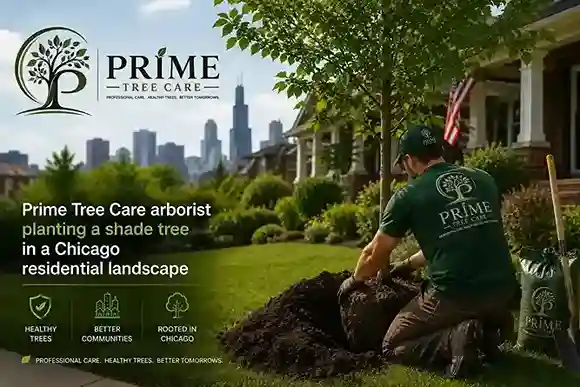
Local soil conditions, urban planting constraints, and canopy-restoration priorities vary block by block across Chicagoland — our recommendations reflect the specific area we're planting in, not a one-size-fits-all list.
From Chicago's dense clay-soil neighborhoods to the more open lots of the western and southern suburbs, we adjust species selection, soil preparation, and spacing to match what each community actually needs. Many of the suburbs we serve are in active canopy-restoration phases following heavy ash losses, and we coordinate species diversity across entire blocks where possible to avoid repeating past mistakes.
See our full coverage area and zip codes on the Service Areas page.
Ongoing diagnosis and treatment for EAB, Dutch Elm Disease, and other regional pests and pathogens.
Soil-based fertilization plans built for Chicago's clay soil, not generic national programs.
Structural pruning that builds storm resilience and healthy form from a tree's earliest years.
Safe removal of hazardous, dead, or storm-damaged trees to clear the way for new, healthier plantings.
Cabling and bracing that protects mature trees before the next high-wind event hits Chicagoland.
See our complete range of Chicago tree care services, from planting to emergency response.
The right tree, planted in the right place, can provide shade, beauty, storm resilience, and environmental benefits for generations. Let's plan yours.