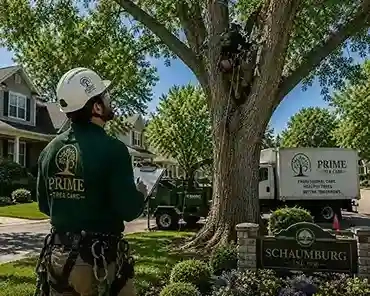
From mature residential subdivisions to the office campuses lining Golf Road, Schaumburg's tree canopy spans very different property types — and each one needs a different care strategy. We work across all of them.
Storm-driven limb failures and wind damage are the #1 reason for emergency calls in Schaumburg. Keeping an eye on conditions helps property owners know when to call.
Schaumburg's tree canopy isn't generic suburban landscaping — it's a mix of 1960s–80s subdivision plantings, a dense commercial core, and real northwest-suburban storm exposure. Here's what that actually means for property owners.
Neighborhoods like Weathersfield, Timbercrest, Sheffield Estates, Lexington Village, Meadow Knolls, Hill N Dale, and Spring Valley Estates were largely built out decades ago, and the shade trees planted alongside those homes are now fully mature. Weathersfield alone is threaded with parks — Terada, Pochet, Campanelli, Jaycee, and Oak Hollow Conservation — where large canopy trees now need structural pruning, canopy reduction, deadwood removal, and periodic risk assessments rather than routine trimming. Timbercrest, sitting between Bode Road and Roselle Road near the Meineke Recreation Center, shows the same pattern: quiet, tree-lined streets where 40- and 50-year-old trees are entering the stage of life where storm risk and structural defects become real concerns.
Schaumburg's business district is unlike a typical residential suburb — it includes the Woodfield area, the Golf Road corridor, Meacham Road, and American Lane, home to major office campuses, hotels, and retail centers. Commercial property managers here have different priorities: sightline and visibility clearance along roadways, parking-lot tree maintenance that won't drop limbs on vehicles, storm preparation before severe weather threatens a leased building, liability reduction, and annual arborist inspections that satisfy property insurance and HOA requirements.
The northwest suburbs sit squarely in the path of Chicagoland's summer storm season — severe thunderstorms, straight-line winds, and the occasional derecho event that can down large limbs with almost no warning. Winter brings its own risk from ice accumulation on already-stressed limbs. A proper tree risk assessment before storm season, combined with structural pruning and, where needed, cabling and bracing, is the difference between a tree that sheds a small branch in a storm and one that takes down a fence, a garage, or a power line. Storm damage prevention isn't optional maintenance in Schaumburg — it's the single biggest reason property owners here call an arborist proactively instead of waiting for an emergency.
A quick reference for the corridors, parks, and destinations that frame our service area within Schaumburg.
Major retail anchor along Golf Road; heavy parking-lot and boulevard tree maintenance nearby.
Golf Rd & Route 53Family attraction inside the Streets of Woodfield complex, near dense commercial landscaping.
601 N Martingale Rd135-acre nature preserve — a good reference point for the native tree species common across Schaumburg.
1111 E Schaumburg RdHome of the Schaumburg Boomers; surrounding grounds and parking areas require regular tree upkeep.
Near Route 53 & Springinsguth RdCultural landmark near Schaumburg's older residential streets and mature parkway trees.
190 S Roselle RdVillage government hub and downtown green space bordering several established neighborhoods.
101 Schaumburg CtMajor highway convergence point — our fastest route in from Hickory Hills, roughly 32 miles southeast.
~39 min via I-290 ECore office-campus corridor where we handle commercial visibility clearance and storm prep.
Schaumburg business districtEvery service below is performed by ISA-certified arborists, backed by proper equipment — aerial lifts, bucket trucks, and crane access when a job genuinely requires it.
Safe removal of hazardous, dead, or storm-damaged trees, including crane removals for oversized trees and tight-access jobs in established Schaumburg subdivisions where backyard clearance is limited.
Learn more about tree removal →Structural pruning, clearance pruning around structures and utility lines, deadwood removal, and dormant-season pruning timed to reduce disease transmission — including oak wilt awareness for Schaumburg's mature oak population.
Learn more about trimming & pruning →On-site diagnosis for Emerald Ash Borer, Dutch Elm Disease, canopy decline, root stress, and fungal issues common to Schaumburg's older residential canopy and clay-influenced soils.
Learn more about health inspections →Cabling, bracing, and wind-load reduction pruning installed ahead of northwest-suburban storm season, plus preventive risk inspections for large, storm-exposed trees near homes and parking lots.
Learn more about storm prep →Below-grade stump removal that clears trip hazards and preps the site for replanting, sod, or landscaping upgrades — a common follow-up after removal in Schaumburg's tree-lined subdivisions.
Learn more about stump grinding →24/7 response for storm damage, fallen limbs, and trees threatening a structure or power line — dispatched to Schaumburg and the surrounding northwest suburbs any time, day or night.
Learn more about emergency service →Schaumburg's canopy leans on a handful of species that were planted heavily during the village's residential boom. Each one carries its own maintenance concerns.
Oaks are common throughout Weathersfield and Timbercrest. Structural weight, deadwood accumulation, and oak wilt risk mean pruning timing matters — cuts made during active growing season carry real infection risk.
A popular street and parkway tree valued for its storm resistance, but it still benefits from regular maintenance pruning to keep its open canopy structurally sound.
Widely planted across residential Schaumburg, maples frequently develop co-dominant stems — a structural weak point that's a leading cause of storm failures if not corrected early with structural pruning.
Ash trees across Schaumburg continue to face Emerald Ash Borer pressure. We evaluate each one individually to determine whether treatment can still save the tree or removal is the safer path.
Remaining elms require ongoing Dutch Elm Disease monitoring, since the disease can move quickly through root grafts between nearby trees on the same block.
Species-specific care matters because a treatment that's safe and effective for a honey locust can be the wrong call for an oak, and vice versa. Misapplied pruning timing or the wrong diagnosis can accelerate decline instead of preventing it — which is why every Schaumburg inspection starts with correct species identification.
Brittle, bark-free limbs are a fall hazard, especially over driveways and roofs.
A new or worsening lean can signal root failure, especially after heavy rain.
Cracked pavement or exposed, cut roots near construction can destabilize a tree.
Vertical cracks or splits often indicate internal structural failure in progress.
Cavities reduce structural strength and may indicate advanced internal decay.
Broken limbs, split unions, or torn bark after wind events need prompt evaluation.
Mushrooms or conks at the base or on the trunk usually point to internal decay.
A visibly sparser crown than in past seasons signals declining vigor.
Overhanging limbs near a structure raise both storm risk and liability exposure.
Branches growing into power lines need professional clearance pruning, not DIY trimming.
Every Schaumburg job follows the same structured process, backed by ISA-certified arborists trained in current safety standards and utility awareness.
A certified arborist inspects the tree, property access, and surrounding structures in person.
We assess structural integrity, decay, lean, and storm vulnerability using ISA risk-assessment standards.
You receive a clear, written scope of work and pricing — no vague verbal estimates.
If your project requires village permitting, we help you understand what's needed before work begins.
Our crew performs the work with proper aerial lift, bucket truck, or crane equipment and utility awareness.
The site is cleaned thoroughly, and we follow up with any additional care recommendations.
We don't publish fixed prices because tree work genuinely varies job to job — but here's what actually drives cost so you know what to expect before we arrive.
| Factor | How It Affects Cost |
|---|---|
| Tree size | Larger trees require more labor, equipment time, and disposal volume. |
| Species | Wood density and branch structure affect cutting time and technique. |
| Accessibility | Tight backyards or fenced subdivisions common in Weathersfield and Timbercrest can require specialized rigging. |
| Crane requirement | Large removals near structures or with no ground access may need crane support. |
| Utility conflicts | Work near power lines requires additional caution and sometimes utility coordination. |
| Emergency response | After-hours or storm-emergency calls carry different scheduling and staffing needs. |
| Disposal requirements | Debris hauling and stump disposal volume affect total job cost. |
Every Schaumburg estimate is written, itemized, and provided after an in-person assessment — never a flat number quoted sight-unseen. For a general sense of removal cost ranges across the Chicago area, see our tree removal cost guide.
Every inspection and treatment plan is led by a credentialed arborist, not a general landscaping crew.
Verified coverage protects your property, your neighbors', and our crew on every Schaumburg job.
Aerial lifts, bucket trucks, and crane access dispatched based on what the job actually requires.
Written, itemized recommendations grounded in a real risk evaluation, not a rushed estimate.
Careful staging and thorough cleanup, whether it's a residential backyard or a commercial parking lot.
From Weathersfield backyards to Golf Road office campuses, we work both sides of Schaumburg's property mix.
Cost depends on tree size, species, accessibility, and whether crane support or utility coordination is needed. We provide a free, written, on-site estimate before any work is scheduled — see our general Chicago-area cost guide for a broader sense of pricing ranges.
It depends on the tree's location and, in some cases, its size and species. Private residential trees generally have different requirements than trees on village-owned parkways. We help confirm what applies to your specific property before work begins.
Dormant-season pruning, typically late fall through early spring, is ideal for most species, since it reduces disease transmission risk and stresses the tree less than pruning during active summer growth. Oaks in particular should avoid pruning cuts during peak oak wilt season.
Maples with co-dominant stems, mature trees with existing decay or cavities, and any tree with a recent lean or root disturbance are the most vulnerable during Schaumburg's high-wind storm events.
Yes, in many cases, if the infestation is caught early enough. An ISA-certified arborist can assess canopy condition and confirm whether treatment can still save the tree or whether removal is the safer, more cost-effective option.
It depends on the specific structural defect. A tree with a strong root system and a single weak union may be a good candidate for cabling or bracing, while a tree with significant decay, a severe lean, or multiple defects is often safer to remove.
Yes. We provide 24/7 emergency response for storm damage, fallen limbs, and trees threatening a structure or power line across Schaumburg and the surrounding northwest suburbs.
We generally recommend an arborist risk assessment every one to two years for mature trees, and immediately after any major storm event, especially for large trees near homes, driveways, or parking areas.
Prime Tree Care dispatches crews to Schaumburg from our Hickory Hills base, roughly 32 miles and a 39-minute drive southeast via I-290 E. We regularly work throughout Schaumburg's established residential subdivisions and its commercial core along Golf Road and Meacham Road.
Certified arborist evaluations, honest recommendations, tree preservation when possible, safe removals when necessary, and 24/7 emergency response — request your free Schaumburg inspection today.
 Prime Tree Care