Prime Tree Care provides professional tree trimming, tree removal, tree health inspections, Dutch Elm Disease monitoring, stump grinding, storm cleanup, and emergency tree service throughout Elmhurst. Elmhurst's mature, historic canopy — including a lingering population of legacy American elms — requires the kind of specialized, tree-preservation-first care that only ISA-certified arborists can provide.
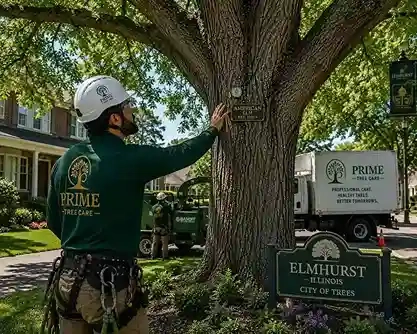
Elmhurst is one of the few Chicago-area communities literally named after its trees — "elm" plus "hurst," an old English word for a wooded grove. That heritage isn't just historical trivia; it shaped decades of community emphasis on urban forestry, legacy street tree planting along corridors like York Street and Prospect Avenue, and a civic pride in tree-lined neighborhoods that still shows up in how the city and its residents care for mature trees today. The downside of that heritage is real too: Elmhurst's historic elm population makes it more exposed to Dutch Elm Disease than communities with a more diversified urban canopy.
Walk through nearly any established Elmhurst block and you'll find large, decades-old American elm and hybrid elm, red oak, white oak, honey locust, silver maple, sugar maple, and hackberry trees towering over single-family homes. That's a beautiful thing for curb appeal and shade — and it also means large canopy spread, aging root systems, and real storm vulnerability. Root-zone competition between closely spaced mature trees is common on Elmhurst's smaller residential lots, especially in neighborhoods platted before modern spacing standards existed.
We regularly work throughout South Elmhurst, North Elmhurst, Yorkfield, Crescent Park, and Brynhaven — older, established neighborhoods where mature trees, long-settled root systems, and structural pruning needs go hand in hand. Homes here were often built around trees that were already decades old, which means today those same trees are approaching the age where storm risk and disease vulnerability increase and professional evaluation matters most.
Prime Tree Care is based at 8811 W 87th St in Hickory Hills. Here's what that means for scheduling and emergency response if your property is in Elmhurst.
Crews typically route north via I-294 to I-88 or Roosevelt Road, then into Elmhurst via York Street, St. Charles Road, or Butterfield Road — the same key thoroughfares Elmhurst residents use for local trips. That gives us reliable access to South Elmhurst, North Elmhurst, Yorkfield, Crescent Park, and Brynhaven alike.
Elmhurst's inland DuPage County location means it experiences the full range of Chicago-area seasonal extremes — heavy spring storms, humid summers, an ideal fall pruning window, and winter snow and ice load on mature limbs.
ISA-certified diagnosis, canopy decline investigation, root-zone stress assessment, Dutch Elm Disease monitoring, Emerald Ash Borer evaluation, and full tree risk assessment.
Learn More →Structural pruning, deadwood removal, clearance pruning, and dormant-season pruning, with Oak Wilt awareness built into every plan for storm risk reduction.
Learn More →Safe removal of dead, hazardous, diseased, and storm-damaged trees using rigging systems, bucket trucks, and crane-assisted removals when the site requires it.
Learn More →Storm response for fallen limbs, split trunks, and leaning trees, with safe operations around energized power lines and direct coordination with utilities when needed.
Learn More →Species diversification to replace declining elms and ash trees, with site selection and long-term canopy planning built for Elmhurst's soil and lot sizes.
Learn More →Complete trip-hazard removal and below-grade grinding that prepares your yard for replanting, lawn restoration, or landscape improvement right away.
Learn More →Elmhurst's name and identity are tied directly to its historical elm population, and while Dutch Elm Disease devastated much of the Chicago area's elm canopy decades ago, Elmhurst still has a meaningfully mature urban canopy with surviving and replanted elms scattered throughout its established neighborhoods. Disease spread patterns favor exactly this kind of environment — closely spaced host trees along parkways and residential blocks, connected root systems, and beetle-vectored transmission that can move quickly once it takes hold on a street.
Foliage discoloration out of season, often starting in the upper canopy.
Individual limbs wilting while the rest of the tree still looks healthy.
Symptoms spreading from one section of the crown to the rest of the tree over weeks.
Sudden browning of leaves on individual branches, a classic early Dutch Elm Disease sign.
Catching Dutch Elm Disease early opens real treatment opportunities that simply aren't available once infection has spread through a large percentage of the crown. Early intervention can mean the difference between a preserved tree and a total loss, and it also reduces the odds of the disease spreading to neighboring elms through connected root systems along the same block. If you suspect a declining elm on your Elmhurst property, our tree health inspection team can evaluate it quickly — and if the tree can't be saved, we'll walk you through removal options that protect the rest of your canopy.
Read our full Dutch Elm Disease in Chicago guide →Elmhurst's legacy elm population remains vulnerable to this fast-moving, beetle-vectored fungal disease.
Ash tree decline continues to affect DuPage County properties, often requiring removal once infestation is advanced.
Severe spring and summer thunderstorms stress large, mature limbs throughout Elmhurst's older neighborhoods.
Decades of lawn traffic, construction, and paving compact soil around mature root systems, limiting oxygen and water uptake.
Hot, dry summer stretches weaken large shade trees, making them more vulnerable to pests and disease.
A common legacy species in Elmhurst, silver maples are fast-growing but structurally weak and prone to limb failure with age.
Common in many mature Elmhurst shade trees, codominant stems create weak unions prone to splitting.
Home additions, driveway work, and utility trenching near mature trees frequently damage root zones without homeowners realizing it.
Every Elmhurst job follows ISA standards from first visit to final cleanup, with safety procedures and property protection built into each step.
We walk the property and evaluate every tree in question in person.
ISA-certified evaluation of species, health, and structural risk.
Clear, itemized pricing and next steps before any work begins.
Work performed to ISA standards, with full property protection.
Debris removed, site cleaned, and a follow-up plan provided.
Every Elmhurst property is different, so we don't publish flat pricing — but here's what typically drives the cost of tree work in this area:
For a full breakdown of regional pricing ranges, see our tree removal cost guide, or request a free on-site estimate for exact Elmhurst pricing.
Every recommendation comes from a credentialed professional, not a general landscaping crew.
We know this city's canopy, its legacy elms, and its established neighborhoods firsthand.
Complete coverage on every job, protecting your property and ours.
Rigorous safety procedures on every removal, prune, and emergency call.
We recommend removal only when preservation genuinely isn't an option.
Documented, written evaluations you can reference and share.
Bucket trucks, rigging systems, and crane coordination when the job calls for it.
Clear pricing and straight answers, every time.
Jake is an ISA-certified arborist with years of Chicago-area urban forestry experience, including deep familiarity with Dutch Elm Disease detection and management across DuPage County's mature canopy communities. He specializes in tree risk assessment for Elmhurst's aging elms, oaks, and silver maples, and takes a preservation-first approach to every property he evaluates — recommending removal only when a tree's structural or disease condition leaves no safer alternative. Jake has worked extensively throughout South Elmhurst, North Elmhurst, Yorkfield, Crescent Park, and Brynhaven, and understands the specific canopy management challenges of Elmhurst's older, established residential blocks.
Elmhurst's historic elm population and mature urban canopy mean surviving and replanted elms are still common throughout the city, and the beetle-vectored fungus that causes Dutch Elm Disease can move quickly between closely spaced host trees along the same block or connected root system.
Late fall through early spring, during dormant season, is generally best for most Elmhurst species. It reduces stress on the tree, improves visibility of structural defects, and lowers disease transmission risk, particularly important for elms and oaks.
Watch for yellowing leaves out of season, wilting on individual branches (flagging), and progressive canopy dieback spreading from one section of the crown outward. These are classic early signs of Dutch Elm Disease and warrant a prompt arborist inspection.
Sometimes, especially if the disease is caught early. Treatment options exist for early-stage Dutch Elm Disease and other conditions, but a tree with advanced, widespread infection usually cannot be saved and removal becomes the safer option to protect neighboring trees.
Requirements can vary by tree location and size. Parkway trees generally fall under city jurisdiction, while trees fully on private property typically have different rules. We can help you confirm what applies to your specific tree before work begins.
Cost depends on tree height, diameter, access, crane needs, utility conflicts, and disease condition. See our tree removal cost guide for typical regional ranges, or request a free on-site estimate for exact Elmhurst pricing.
Keep people and pets away from the damaged area, avoid any limb near a power line, and call for an emergency tree assessment. We provide 24/7 storm-damage response throughout Elmhurst.
Not always — it depends on the service package. We're happy to quote stump grinding alongside removal or as a standalone service if you have an existing stump you'd like cleared.
Our Elmhurst coverage connects directly with these nearby service areas.
From a single legacy elm on a South Elmhurst block to a full-property canopy plan, our ISA-certified arborists are ready to help.
On-site evaluation from a certified arborist, no obligation.
Documented review of structural risk and disease condition.
24/7 dispatch for fallen limbs and hazardous trees.
Clear, written pricing before any work is scheduled.
 Prime Tree Care Chicago Arborists