8811 W 87th St, Hickory Hills, IL 60457 Mon–Sat: 7:00 AM – 7:00 PM 24/7 Emergency Storm Response
(773) 302-8351
Oak Park, Illinois

Tree Service in Oak Park, IL

Prime Tree Care provides tree trimming, tree removal, tree health inspections, tree cabling & bracing, emergency storm response, stump grinding, and tree planting throughout Oak Park. Our ISA-certified arborists specialize in preserving the mature canopy trees found on Oak Park's historic properties, protecting root systems during renovation projects, and planning for long-term tree health.

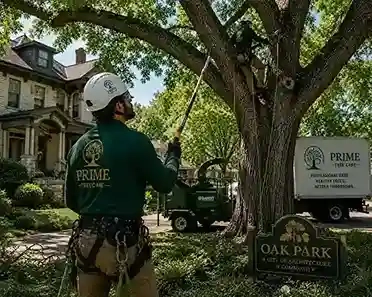
ISA-certified arborist pruning a mature oak tree near a historic Oak Park home
~19 miFrom Our Hickory Hills Office
ISACertified Arborists
Root-SafeRenovation Protection
24/7Emergency Response
Local Context

Why Tree Care Is Different in Oak Park

Oak Park is one of the few Chicago-area communities where the tree canopy and the housing stock aged together — which means both now need the same kind of careful, preservation-minded attention.

Historic Homes & Mature Trees

Walk any street in the Frank Lloyd Wright-Prairie School Historic District or the Ridgeland-Oak Park Historic District and you'll see it: mature oaks, maples, elms, and honey locusts that were planted decades ago, standing alongside century-old homes. These legacy shade trees are frequently reaching the stage where aging canopies, developing structural defects, and root systems under long-term stress require genuinely preservation-focused arboriculture rather than routine trimming. Long-term maintenance planning — not reactive service calls — is what keeps these trees safe and standing for the next generation of homeowners.

Tree Protection During Renovation Projects

This is where Oak Park tree care gets genuinely different from a typical suburban service call. Oak Park's steady pace of home additions, garage construction, driveway replacements, hardscape projects, and excavation work puts mature root systems directly in the path of construction equipment — and root damage during construction is one of the leading causes of delayed tree decline, often not showing up as canopy dieback until one to three years after the project is finished.

We recommend establishing a documented Root Protection Zone before any digging begins, typically fenced at or beyond the tree's dripline to keep equipment and material staging out of the root zone. Poor root management — cutting major structural roots during trenching, or compacting soil under heavy equipment traffic — reduces a tree's ability to take up water and nutrients for years afterward, even when the tree looks fine on the surface immediately after construction. An arborist consultation before excavation is the single highest-leverage step an Oak Park homeowner can take to protect a valuable legacy tree before a shovel ever hits the ground.

Tight Residential Lots

Oak Park's historic lots were platted for narrower homes set close to property lines, which means mature trees are often boxed in by garages, fences, and neighboring structures with very little clearance. Safe pruning and removal work in these conditions frequently requires specialized rigging systems to lower limbs in sections, aerial lifts to access canopy without climbing spikes that could injure the tree, and in the largest cases, crane-assisted removals to lift a tree out cleanly over a house or garage roofline rather than dropping it through a tight side yard.
What We See

Common Tree Problems We See in Oak Park

Storm Damage & Limb Failure

Straight-line winds and severe thunderstorms move through the Chicago area regularly, and ice loading during winter storms adds sudden, heavy weight to weakened limbs. On Oak Park's aging canopy, this combination frequently produces split leaders and heavy limb failures on trees that looked structurally sound just weeks earlier — a strong argument for proactive structural pruning rather than waiting for storm damage to force the issue.

Emerald Ash Borer

Ash tree decline from Emerald Ash Borer remains an active issue on Oak Park properties still holding onto mature ash trees. Treatment decisions come down to timing: ash trees caught in early-to-moderate decline often respond well to systemic treatment, while advanced infestations generally call for prompt removal timing before the wood becomes structurally unsafe. See our full guide on Emerald Ash Borer in Chicago.

Dutch Elm Disease

Oak Park still has legacy elms worth protecting, which makes Dutch Elm Disease monitoring an ongoing priority. Symptoms typically begin as flagging — wilted, yellowing leaves on a single branch — and require prompt diagnosis to determine whether management through pruning and fungicide injection is still viable. Learn more in our guide to Dutch Elm Disease in Chicago.

Oak Tree Preservation

Oak Park's namesake species deserves namesake attention. Structural pruning that develops strong scaffold branching, general oak wilt awareness during pruning season, and ongoing canopy management are central to keeping mature oaks safe and healthy for decades. See our tree trimming & pruning services.

Construction-Related Tree Stress

This is the problem we see most often that homeowners don't expect. Root cutting during footing excavation, grade changes that bury or expose the root flare, trenching damage from utility work, and soil compaction from equipment and material staging all combine to stress a tree's root system in ways that aren't visible until real canopy decline sets in a year or more later. Because the cause and the symptom are separated by time, this is the category of damage most often misdiagnosed — and most preventable with planning done before construction starts.

Our Services

Tree Services We Provide in Oak Park

Tree Health Inspection & Treatment

A full tree risk assessment covering canopy health, root condition, and pest or disease activity. See our tree health inspection & treatment services →

Tree & Shrub Fertilization

Soil-based fertilization plans that support root recovery after construction stress or general urban soil compaction. See our tree & shrub fertilization services →

Tree Trimming & Pruning

Structural pruning, deadwood removal, and canopy management for mature, tightly-spaced legacy trees. See our tree trimming & pruning services →

Tree Removal

Safe removal for hazardous, dead, or irreversibly declining trees, including tight-access and crane-assisted jobs. See our tree removal services →

Emergency Tree Service

24/7 response for storm damage, fallen limbs, and hazardous leaning trees, even on Oak Park's narrowest lots. See our emergency tree service →

Storm Prep & Tree Support Systems

Cabling and bracing that reduce structural risk on high-value legacy trees before storm season arrives. See our storm prep & tree support systems →

Stump Grinding

Full landscape restoration and site preparation once a stump is ground down. See our stump grinding services →

Tree Planting & Transplanting

Species diversification and replacement planning so Oak Park's next generation of canopy isn't vulnerable to the same pests that took out prior plantings. See our tree planting & transplanting services →

Warning Signs

Signs Your Trees May Need Professional Attention

A certified arborist relies on a documented tree risk assessment to weigh these signs together, but any single one is worth a professional look.

1

Dead Branches

Often the first visible symptom of root or trunk stress.

2

Leaning Trunks

Sudden or worsening lean can indicate root failure.

3

Cracks in Major Limbs

A serious structural warning sign requiring prompt evaluation.

4

Mushroom Growth

Fungal conks at the base often indicate internal decay.

5

Bark Separation

Peeling or splitting bark can expose the tree to pests and disease.

6

Canopy Thinning

Sparse leaf coverage versus prior seasons can signal decline.

7

Root Exposure

Visible surface roots can point to soil erosion or grade changes.

8

Construction Damage

Nearby digging or grading is a red flag even without visible symptoms yet.

9

Utility Conflicts

Growth into overhead lines requires utility vegetation management coordination.

10

Repeated Limb Drop

Recurring limb loss without storm cause suggests a deeper structural issue.

Our Process

Our Arborist Assessment Process

1

Property Evaluation

We walk the full site, noting lot constraints, structures, and access for equipment like an aerial lift, bucket truck, or crane.

2

Species Identification

Accurate identification shapes every recommendation that follows, from pruning timing to pest and disease risk.

3

Tree Risk Assessment

A structured, ISA-based evaluation of failure likelihood and consequences, factoring structures, driveways, and rigging systems needed.

4

Treatment Plan Development

Clear, written recommendations covering preservation options first, removal only where warranted.

5

Safe Work Execution

Work performed with the right equipment for tight lots — rigging, aerial lifts, or crane-assisted removals as needed.

6

Long-Term Care Recommendations

A forward-looking plan for monitoring, fertilization, and inspection intervals to protect the tree for years to come.

Pricing

Tree Service Costs in Oak Park

Ranges below are educational starting points — every Oak Park property gets a free, written, on-site estimate before work begins.

ServiceTypical Cost Range
Tree Trimming$300 – $1,500+
Tree Removal$500 – $9,000+
Stump Grinding$150 – $1,000+
Cabling & Bracing$500 – $3,500+

The biggest cost drivers on Oak Park properties are tree size, location on tight lots, accessibility between homes and garages, utility conflicts overhead, whether a crane is needed for safe removal, and proximity to structures like porches, additions, or historic architectural details that need protection during the work. Full cost breakdown: Tree Removal Cost in Chicago.

Historic Property Authority

Tree Preservation for Historic Oak Park Properties

Why Preservation Matters

A mature oak or elm standing beside a century-old Oak Park home is part of the property's character in the same way the architecture is. Losing it isn't a landscaping inconvenience — it's the loss of decades of canopy that no replacement planting will match for a generation.

Protecting Trees During Renovation

This is the single most common way we see valuable Oak Park trees put at risk. Coordinating root protection zones, equipment routing, and trenching plans with your contractor before permits are even pulled is the most effective preservation tool available.

Long-Term Canopy Management

Aging trees on historic lots need a monitoring rhythm, not a one-time visit — regular inspection intervals catch structural issues while they're still manageable through pruning or cabling.

Species Diversity Planning & Risk Reduction Without Removal

Where a legacy tree can't be saved, we plan replacement plantings with genuine species diversity in mind, and we lean on cabling, bracing, and corrective pruning to reduce risk on trees that are still fundamentally healthy rather than defaulting to removal.

Getting to You

Serving Oak Park From Hickory Hills

Prime Tree Care is based at 8811 W 87th St in Hickory Hills, roughly 19 miles and about 32 minutes from downtown Oak Park via I-294 and I-290 (the Eisenhower Expressway), or via Harlem Avenue running north. We work throughout Oak Park's historic districts and surrounding blocks.

Downtown Oak Park

Near Lake St & Marion St, Oak Park's commercial and Green Line hub

~19 mi~32 min

Frank Lloyd Wright Historic District

Near Chicago Ave & Forest Ave, dense mature canopy on tight lots

~19 mi~32 min

Ridgeland-Oak Park Historic District

East side of the village, along Ridgeland Ave

~18 mi~30 min

Austin Gardens / Village Hall Area

Near Forest Ave & Ontario St, civic core of Oak Park

~19 mi~32 min
Frank Lloyd Wright Home & StudioAnchoring the historic district, surrounded by mature legacy trees on narrow lots.
Unity TempleA Wright-designed landmark on Lake Street, near dense residential canopy.
Austin GardensA wooded park in downtown Oak Park with mature oaks and a public arboretum feel.
Ernest Hemingway Museum & BirthplaceNear Oak Park Ave, surrounded by classic Oak Park streetscape trees.
Eisenhower Expressway (I-290)The main east-west route connecting Oak Park to Chicago and our Hickory Hills office.
CTA Green Line & Blue LineBoth terminate in Oak Park, running along Lake St and the I-290 median.
Metra Union Pacific West LineOak Park's commuter rail corridor, running parallel to North Blvd.
Harlem Avenue & Chicago AvenueTwo of Oak Park's principal arterials, both lined with mature parkway trees.
Storm Readiness

Oak Park Seasonal Weather & Tree Risk

Oak Park sits close enough to Chicago's urban core to share the same severe weather patterns — useful context for planning proactive tree care rather than reacting after damage.

Spring

40°F–65°F · Storm Season Begins

Thunderstorms and straight-line winds pick up through April and May, often before new leaf-out has hardened, raising limb failure risk on aging trees.

Summer

70°F–85°F · Wind & Drought

Severe thunderstorms remain common through August, alongside dry stretches that add stress to trees already weakened by construction-related root damage.

Fall

45°F–65°F · Pruning Window

Cooler temperatures make this the right season to schedule dormant-season structural pruning and pre-winter inspections.

Winter

15°F–35°F · Ice Loading

Wet snow and ice accumulation add sudden weight to weak branch unions, often revealing structural defects that went unnoticed the rest of the year.

On the Village Calendar

Oak Park Events That Touch the Tree Canopy

Several of Oak Park's best-known community events happen right underneath its historic tree canopy — a reminder of why that canopy is worth protecting.

Spring

Wright Plus Housewalk

Annual tour through Oak Park's Frank Lloyd Wright Historic District, showcasing homes set among the neighborhood's mature legacy trees.

Late Spring–Fall

Downtown Oak Park Farmers Market

A weekly market held along the village's tree-lined downtown streets near Lake Street.

Summer

Concerts in Austin Gardens

Outdoor performances held beneath the wooded canopy of Austin Gardens in downtown Oak Park.

Fall

Oak Park Historic District Walking Tours

Self-guided and docent-led tours through the neighborhoods where mature oaks and historic homes share the same century-old streetscape.

Our Commitment

Caring for Oak Park's Historic Tree Canopy

Oak Park's mature residential neighborhoods present a challenge most tree companies aren't built to handle well: historic properties where the trees and the architecture have to be protected together, not treated as separate concerns. Preservation-focused tree care here means understanding that a large legacy tree standing beside a century-old home isn't just landscaping — it's part of what makes that block worth living on.

Balancing property improvements with tree protection is the defining challenge of tree care in this village. A homeowner planning an addition, a new garage, or a driveway replacement deserves an arborist who can sit down with their contractor before permits are pulled, not one who shows up after root damage has already been done. That's the standard we hold ourselves to on every Oak Park property we work on.

Your Local Arborist

Meet Your Local Arborist

MR

Michael Reynolds

ISA Certified Arborist

Michael brings hands-on urban forestry expertise to Oak Park's historic properties, with particular focus on mature canopy preservation, construction-related tree protection, and storm preparedness planning. He regularly consults with homeowners and contractors before renovation projects begin, coordinating root protection zones and equipment access plans to keep legacy oaks, elms, and maples healthy through construction and beyond.

Common Questions

Oak Park Tree Service FAQ

How can I protect trees during a home renovation?

Establish a Root Protection Zone before any excavation begins — typically fenced off at or beyond the tree's dripline — and route equipment, material staging, and foot traffic outside that zone to prevent soil compaction. Consult a certified arborist before finalizing addition, garage, or driveway plans so footings and trenching can be positioned to avoid major structural roots. Tunneling under roots instead of trenching through them, and using plywood tracking mats for heavy equipment, further reduce root and soil damage.

Can construction damage kill a mature tree?

Yes, and often not immediately. Root cutting, soil compaction from equipment, and grade changes near a mature tree can trigger a slow decline that shows up as canopy thinning or dieback one to three years after construction ends, well after the project is complete and the connection is no longer obvious. This delayed pattern is exactly why an arborist consultation before excavation is so much more effective than treatment after symptoms appear.

Should mature oak trees be removed or preserved?

Preservation should always be the starting point for a structurally sound mature oak. A certified arborist evaluates canopy health, structural defects, decay, and root condition through a tree risk assessment before recommending removal. Many oaks with early structural issues can be preserved through corrective pruning or cabling; removal is reserved for trees with advanced decay, unmanageable structural risk, or confirmed oak wilt that threatens to spread to neighboring oaks.

How often should trees be inspected in Oak Park?

Mature trees on Oak Park's historic lots should generally be inspected every 1–2 years, with additional inspections after any nearby construction, excavation, or severe storm event. Given how common renovation projects are throughout the village's historic districts, a pre-construction inspection is worth scheduling any time digging will occur near a valued tree's root zone.

What are the most common tree problems in Oak Park?

The most frequent issues we see in Oak Park are storm-related limb failure and split leaders on aging shade trees, Emerald Ash Borer decline in remaining ash trees, Dutch Elm Disease in legacy elms, oak wilt risk on mature oaks, and construction-related root stress from the village's steady pace of home additions, garages, and driveway projects on tight residential lots.

Do you provide emergency tree service?

Yes. Prime Tree Care provides 24/7 emergency tree service throughout Oak Park for storm damage, split trunks, fallen limbs, and hazardous leaning trees, including situations involving tight lot access between historic homes, garages, and fences.

How much does tree removal cost in Oak Park?

Tree removal in Oak Park generally runs from about $500 for a small tree to $9,000 or more for a large, mature tree requiring crane assistance or tight-access rigging between close-set historic homes. Final cost depends on tree size, species, accessibility, proximity to structures or power lines, and whether specialized equipment is needed. A free, on-site estimate gives you an exact number.

Can tree cabling help save a large tree?

Yes. Cabling and bracing redistribute structural load across weak branch unions or split leaders, reducing the risk of failure on otherwise healthy, high-value trees. It's a common preservation tool for Oak Park's large legacy shade trees that have developed a structural defect but are still fundamentally sound and worth protecting rather than removing.

Nearby Service Areas

Serving Communities Near Oak Park

See our complete coverage area on the Service Areas page.

Get Started

Protect Oak Park's Legacy Canopy

Planning a renovation, worried about a leaning limb, or just due for an inspection — an ISA-certified arborist can give you a clear, honest plan before you commit to anything.

Call Now Free Estimate