Prime Tree Care provides tree trimming, tree removal, emergency storm service, cabling and bracing, tree health inspections, and stump grinding throughout Mount Greenwood. Our ISA-certified arborists know the neighborhood's large residential lots and mature shade trees firsthand, and respond quickly when a limb comes down along 111th Street, Kedzie Avenue, or the quiet side streets near Mount Greenwood Park.
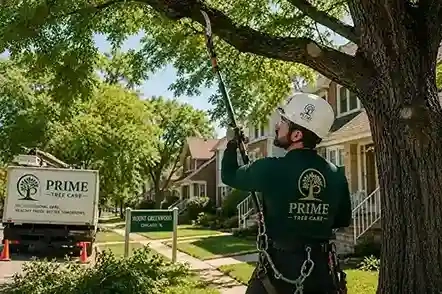
Large residential lots mean larger tree inventories. Mount Greenwood is one of the few Chicago neighborhoods with genuinely suburban-scale lots, and many homes on streets like Rockwell, Talman, and Sacramento carry three, four, or more mature trees on a single property. That means more root systems competing for space, more canopy to monitor, and more long-term maintenance responsibility than a typical Chicago bungalow lot two or three neighborhoods over.
Mature canopy trees require ongoing monitoring. Much of Mount Greenwood's tree canopy was planted in the mid-20th century, and those trees are now old enough to show real structural weakness, aging limbs, included bark at old unions, and canopy imbalance from decades of uneven growth. A tree that looked fine five years ago can develop a hazardous defect quickly once it reaches this stage of maturity.
Storm preparedness is increasingly important. Straight-line winds, summer thunderstorms, heavy wet snow, and ice accumulation all put direct stress on Mount Greenwood's older trees. With homes set closer to mature trees than in newer developments, a failed limb here has a shorter distance to travel before it reaches a roof, garage, or parked car.
From routine health checks to full storm cleanup, every job in Mount Greenwood is handled by an ISA-certified arborist familiar with the neighborhood's species mix, soil, and lot layout.
Full tree risk assessments, Emerald Ash Borer detection, canopy decline diagnosis, and root stress evaluation for Mount Greenwood's aging ash and oak population.
Deadwood removal, weight reduction pruning, clearance pruning near homes and driveways, and structural pruning for long-term canopy health.
Safe removal of dead trees, hazardous trees, declining EAB-infested ash trees, and storm-damaged trees, including tight backyard access common on Mount Greenwood lots.
Around-the-clock response for fallen limbs, split trunks, and leaning trees after storms move through the Southwest Side.
Cabling installation and structural bracing for co-dominant stems and heavy lateral limbs, reducing wind-load risk before the next storm.
Trip hazard removal, replanting preparation, and lawn restoration after a removal, so the yard is ready for the next step.
Mount Greenwood's open, low-rise residential layout gives storms a fairly direct path across the neighborhood, with less high-rise wind buffering than denser parts of the city.
Cabling redistributes wind load away from a weak union, limiting how far a heavy limb can swing during a gust. Bracing physically reinforces a split trunk or cracked union with steel rod hardware. Together, they give Mount Greenwood's mature trees the structural support their aging wood no longer provides on its own, often preserving a tree that would otherwise need removal.
Spring brings the heaviest thunderstorm activity and the season's first straight-line wind events. Summer adds the risk of fast-moving derechos with little advance warning. Late fall and winter shift the risk toward heavy wet snow and ice accumulation, which loads down limbs already weakened by summer storm stress. Prime Tree Care times inspections and support-system installations around this cycle rather than reacting after damage occurs.
Mount Greenwood's older, larger lots support a wide mix of shade and ornamental species, each with its own risk profile.
White oak, red oak, and bur oak are common on Mount Greenwood's larger lots. These trees can live for well over a century, but oak wilt spreads quickly through root grafts and pruning wounds, so structural pruning is scheduled outside the high-risk spring and summer window.
Silver maple and sugar maple both grow throughout the neighborhood. Silver maples in particular grow fast and develop weak, storm-susceptible wood, making them a frequent candidate for cabling and structural pruning.
Ash trees planted throughout Mount Greenwood decades ago have been heavily impacted by Emerald Ash Borer. Early detection allows treatment; advanced infestations usually require removal before the tree becomes hazardous.
Remaining elms in the neighborhood face ongoing pressure from Dutch Elm Disease, a fungal infection spread by bark beetles that causes rapid canopy wilting if left untreated.
Spruce and pine ornamentals planted as windbreaks and privacy screens carry their own risk from wind and snow loading, particularly when branches accumulate heavy, wet winter snow.
A popular parkway and yard tree in the area, honey locust generally handles wind well but benefits from periodic structural pruning to manage narrow branch angles.
Every recommendation in Mount Greenwood starts with a structured, five-step tree risk assessment performed on site by an ISA-certified arborist.
A certified arborist examines the tree, species, age, and site conditions in person.
We identify cracks, cavities, deadwood, included bark, and root-zone issues.
Each defect is weighed against likelihood of failure and what's underneath the tree.
We recommend pruning, cabling and bracing, treatment, or removal, whichever fits.
Ongoing inspection schedules keep mature trees monitored year after year.
Mount Greenwood has a healthy mix of parkway trees along streets like 111th and Kedzie and private trees on residential lots, and the rules differ for each.
Parkway trees, the ones growing in the strip between the sidewalk and the street, are owned and maintained by the City of Chicago's Bureau of Forestry. If a parkway tree near your Mount Greenwood home looks hazardous, a request goes through the city rather than a private contractor working alone.
Private trees, anywhere on your own property, are your responsibility to maintain, insure, and remove if necessary. Many Mount Greenwood homeowners are unsure which category a given tree falls into, especially on corner lots where the parkway strip is wider than usual.
Before removing any tree in Mount Greenwood, confirm whether it's a parkway or private tree, and check whether a permit applies to your specific situation. Our full breakdown covers this in more detail: parkway trees vs. private trees in Chicago.
If you're stuck waiting on a slow-moving city request for a hazardous parkway tree, we can perform a private documentation inspection to support your case and help you decide on interim safety steps.
Our crews regularly work on properties near these Mount Greenwood landmarks, giving us a genuine feel for the neighborhood's tree canopy, lot sizes, and access conditions block by block.
The neighborhood's anchor park, with a fieldhouse, swimming pool, playground, and refrigerated ice rink, surrounded by mature shade trees that our crews regularly inspect and maintain.
Founded in 1879 and among the oldest features of the neighborhood, this historic cemetery is lined with mature specimen trees dating back generations.
Located in Mount Greenwood since 1956, the campus grounds include a substantial tree canopy typical of the neighborhood's older plantings.
Sited at the southeast corner of 111th and Pulaski on what was once one of the city's last working farms.
The neighborhood's main commercial corridor and business district, where our crews regularly handle parkway tree work for nearby homes and storefronts.
Two of Mount Greenwood's most prominent Catholic parishes, both set on well-treed properties typical of the surrounding blocks.
Every inspection and treatment plan is led by a credentialed arborist, not a general labor crew.
Verified coverage protects your property, your neighbors', and our crew on every Mount Greenwood job.
Utility-aware procedures and modern equipment keep every job site safe, even on tight backyard lots.
We recommend cabling, bracing, or treatment whenever a tree can be safely saved, rather than defaulting to removal.
We know Mount Greenwood's lot sizes, species mix, and parkway rules firsthand, not from a generic playbook.
Bucket trucks and aerial lifts handle everything from routine pruning to complex, near-structure removals.
Years of hands-on experience across Mount Greenwood, Beverly, and Morgan Park mean our crews have already seen your tree's problem before, and know what actually fixes it.
Prime Tree Care serves the neighborhoods and suburbs surrounding Mount Greenwood, from the Southwest Side into Cook County.
Pricing depends on tree size, species, accessibility, and proximity to structures or power lines. Small trees typically run a few hundred dollars, while large, mature specimen trees common on Mount Greenwood's bigger lots can run several thousand. See our Chicago tree removal cost guide for typical ranges, or request a free on-site estimate.
Often, yes. Minor limb loss and cracked unions can frequently be stabilized with structural pruning, cabling, or bracing. Severe trunk splits, root plate movement, or major canopy loss usually mean removal is the safer path.
Mature trees, especially the older canopy common throughout Mount Greenwood, benefit from at least an annual tree risk assessment, plus an additional check after any major storm event.
Cabling installs a high-strength cable in the canopy to limit excess limb movement in wind. Bracing installs a steel rod through a split trunk or weak union to physically reinforce the structure. Both reduce failure risk on Mount Greenwood's mature trees.
Healthy, structurally sound oaks generally handle wind well. Risk increases with age, decay, or overextended horizontal limbs, which is why a tree risk assessment matters more than species alone.
Ash trees caught in the early stages of an EAB infestation can often be treated successfully. Advanced infestations with significant canopy dieback usually require removal before the tree becomes structurally hazardous.
Private trees on your own property generally don't require a city permit to remove. Parkway trees are owned by the City of Chicago's Bureau of Forestry and typically require going through the city rather than a private contractor alone.
The City of Chicago's Bureau of Forestry owns and maintains parkway trees, the strip between the sidewalk and the street. Private property trees remain the homeowner's responsibility.
Most mature shade trees benefit from structural pruning every three to five years, with oaks scheduled outside the spring-to-fall oak wilt risk window whenever possible.
Keep people and vehicles away from the affected area, avoid contact with any downed limbs near power lines, and call for an emergency assessment. Prime Tree Care provides 24/7 emergency response throughout Mount Greenwood.
Whether it's a routine health check, storm damage, or a hazardous tree on a large Mount Greenwood lot, our ISA-certified arborists are ready to help. Free estimates, 24/7 emergency dispatch.
 Prime Tree Care Chicago Arborists