Structural pruning, cabling & bracing, storm damage cleanup, and preservation-focused tree care for Alsip's mature residential canopy — from the Cicero Avenue corridor to the quiet streets around Stony Creek.
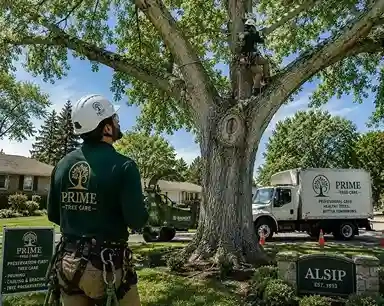
Much of Alsip was built out in the postwar decades after the Tri-State Tollway reached the village in 1959, and the shade trees planted on those original residential lots — off Central, Kostner, Kedzie, Karlov, and Kilbourn Avenues — are now 50, 60, even 70 years into their lifespan. That's exactly the age window where structural defects stop being hypothetical.
Homes in Alsip's older subdivisions south of 115th Street and north of the Cal-Sag Channel were built with modest setbacks, which means a large limb failure has a short distance to travel before it reaches a roofline, a detached garage, a driveway, or a parked car. As these trees age, large limbs get heavier, root systems face more stress from decades of soil compaction along parkways and driveways, and storm vulnerability climbs every season.
Preventative maintenance is the difference between a scheduled pruning appointment and a 2 a.m. emergency call. A structured tree risk assessment catches included bark, cavities, and root-plate movement long before they become an emergency removal — and long before they become a claim on your homeowner's insurance.
| Village Founded | Settled 1830s; incorporated as Alsip, named for brickyard owner Frank Alsip (1885) |
| Location | South suburban Cook County, Worth Township |
| Population | 19,063 residents (2020 Census) |
| Main corridors | Cicero Avenue (IL-50), Pulaski Road, 127th Street, 115th Street |
| Highway access | I-294 Tri-State Tollway runs directly through the village |
| Waterway | Cal-Sag Channel & Stony Creek corridor |
| Nearest Metra | Chicago Ridge Station, SouthWest Service line, ~5 miles |
| Distance from our office | Approx. 7 miles / 15–20 min from Hickory Hills |
| Housing pattern | Single-family ranch & split-level homes, mature parkway & yard trees |
No other tree defines Alsip's residential canopy like the silver maple — and no other tree causes more storm-related insurance claims. This is where Prime Tree Care's preservation-first approach sets us apart from companies that only advertise removal.
Silver maples were a favorite choice for Alsip's postwar subdivisions because they grow fast — often 3 to 5 feet a year — and cast a full, cooling canopy within a decade. Builders and homeowners planted them by the thousands across the south suburbs from the 1950s through the 1970s. Today those same fast-growing trees have matured into towering 60–80 foot specimens that shade entire yards along streets like Kostner, Kilbourn, and Kedzie.
The same fast growth that made silver maples popular also gives them weak wood and poor branch architecture. Co-dominant stems with included bark — two trunks growing so closely they trap bark instead of fusing solidly — are common. Combined with wide, heavy horizontal limbs and brittle wood, these trees are structurally predisposed to sudden failure, especially in mature specimens over 40 years old.
South suburban Cook County sits squarely in a corridor prone to fast-moving summer thunderstorms and straight-line wind events, the kind that can snap a weak union in seconds with almost no warning. Heavy, wet spring and late-fall snow adds direct weight to horizontal limbs already carrying included bark defects. Ice accumulation during freeze-thaw cycles compounds the problem, coating limbs in a layer that can double their effective weight overnight. Each of these events is a real, recurring risk for the mature silver maples lining Alsip's residential streets.
Our ISA-certified arborists evaluate structural integrity, defect severity, cabling potential, and long-term viability before ever recommending removal. If a tree can be made safe, we say so — and explain exactly how.
A properly installed cable system redistributes wind load away from a weak union, while steel bracing rods reinforce a cracked or split trunk — often extending a valuable shade tree's life by decades.
Reducing end-weight on long horizontal limbs and removing deadwood lowers wind resistance and leverage — the two forces that turn a manageable defect into a catastrophic failure.
Alsip's flat, open terrain and its position along the Cal-Sag Channel and I-294 corridor give summer storm systems a direct, largely unobstructed path across the village. When National Weather Service Chicago issues a severe thunderstorm or straight-line wind warning for south suburban Cook County, Alsip's mature canopy is squarely in the impact zone.
Proactive tree care — structural pruning, cabling, and bracing performed before severe weather season — measurably reduces the odds of:
When a limb comes down along Cicero Avenue, Pulaski Road, or a quiet side street near Stony Creek, our crews respond around the clock — including safe procedures near energized power lines and coordination with utility crews when needed.
Emergency Tree Service Details →Every job in Alsip is performed by an ISA-certified arborist familiar with the village's species mix, soil, and lot layout.
Structural pruning, deadwood removal, weight reduction on long horizontal limbs, clearance pruning near rooflines and driveways, and canopy balancing for long-term health.
Learn More →Safe removal of hazardous trees, dead trees, failing silver maples, and storm-damaged trees — including difficult-access backyard removals common on Alsip's residential lots.
Learn More →Fallen trees, hanging limbs, storm damage, and leaning trees stabilized around the clock, every day of the year, throughout Alsip and surrounding South Suburban communities.
Learn More →Cabling installation, structural bracing, and proactive wind-load reduction for co-dominant stems and heavy lateral limbs — before storm season arrives, not after.
Learn More →Canopy decline diagnosis, disease identification, root stress evaluation, and full tree risk assessments performed on site by a certified arborist.
Learn More →Full below-grade stump removal, landscape restoration, and site preparation so your yard is ready for new sod, planting, or hardscaping right away.
Learn More →Alsip's residential lots support a recognizable mix of shade and ornamental species, each with its own maintenance profile.
Alsip's dominant shade tree and our primary focus in this village. Fast growth, weak wood, and included bark make structural pruning and cabling the highest-value maintenance you can perform.
Long-lived white, red, and bur oaks appear on many larger Alsip lots. Structural pruning is timed outside the spring-summer window to limit oak wilt transmission risk.
Decades-old ash plantings throughout Alsip remain under pressure from Emerald Ash Borer (EAB). Early-stage infestations can often be treated; advanced dieback typically calls for removal.
A popular, urban-adaptable parkway and yard tree in Alsip's newer plantings. Generally wind-tolerant, but benefits from routine structural pruning to manage narrow branch angles.
Remaining elms face ongoing pressure from Dutch Elm Disease, a fungal infection spread by bark beetles that can cause rapid canopy wilting if left unmonitored.
Spruce and pine plantings used as privacy screens and windbreaks around Alsip properties carry their own snow- and wind-loading risk, particularly after heavy wet snow events.
If you notice any of the following on a tree at your Alsip property, it's time for a professional tree risk assessment rather than a wait-and-see approach.
Every Alsip evaluation follows the same structured, six-step process.
Lot layout, structures, and target zones assessed on arrival.
Confirming species-specific risk factors before inspection.
Canopy, bark, and root-zone signs of decline or disease.
Defects weighed against likelihood of failure and targets below.
Pruning, cabling, treatment, or removal — whichever genuinely fits.
Work performed safely, cleanly, and on the agreed schedule.
Every property is different, so we don't publish fixed pricing — but these are the main factors that shape a quote for tree work in Alsip:
Mature silver maples and oaks cost more to remove or maintain than younger ornamentals.
Tight backyard access, fences, and proximity to structures affect equipment needs.
Decay, cavities, and lean angle change the complexity and risk of the work.
Some large removals near homes or power lines require crane-assisted rigging.
After-hours storm calls are prioritized for safety and typically dispatched fastest.
Chipping, hauling, and full stump grinding all factor into a complete quote.
Preserving a mature tree with cabling is almost always less costly than full removal and stump grinding.
Parkway trees may require village coordination before any removal work begins.
For typical ranges across our full service area, see our Chicago tree removal cost guide, or request a free, no-obligation on-site estimate for your Alsip property.
Our crews regularly work on properties near these Alsip landmarks and corridors, giving us a genuine feel for the village's canopy, lot sizes, and access conditions block by block.
Home of the village's annual Fun Fest and Concerts on the Green at 11930 S. Kostner Ave, surrounded by park district shade trees our crews regularly inspect. The Park District also runs a memorial tree-planting program in Alsip's parks — a reminder of how much this community values its canopy.
Alsip's primary commercial spine, lined with retail, dining, and hospitality properties from 115th to 127th Street — including several corridor hotels — where we handle both commercial and adjacent residential tree work.
Located at 4500 W. 123rd Street, the village's civic core sits among established residential blocks that carry some of Alsip's oldest silver maple plantings.
At 11960 S. Pulaski Road, the library anchors a residential stretch of Pulaski where mature parkway trees require regular clearance pruning near sidewalks and overhead lines.
The channel corridor bordering Alsip's southern edge supports a green trail system where root management and canopy health matter for both private and public trees near the water.
One of the region's most historically significant cemeteries, lined with mature specimen trees that reflect generations of plantings along the 127th Street corridor.
The tollway's arrival in 1959 accelerated Alsip's residential growth — and the shade trees planted in those original subdivisions are now reaching the age where structural risk climbs fastest.
About 5 miles from central Alsip, this SouthWest Service stop serves commuters throughout the area, with Pace bus routes connecting Alsip neighborhoods to the line.
Alsip's school campuses sit within established residential neighborhoods where our crews frequently perform clearance pruning near play areas and parking lots.
Every inspection, diagnosis, and cut is led by a credentialed arborist, not a rotating labor crew.
Deep, specific experience with the structural risks unique to Alsip's dominant shade species.
We recommend cabling, bracing, or treatment whenever a tree can be safely saved, not by default removal.
Verified coverage protects your property, your neighbors', and our crews on every Alsip job.
Bucket trucks, aerial lifts, and crane-assisted rigging for any Alsip lot, tight-access or open.
Clear, written estimates with no vague verbal quotes or last-minute surprise fees.
Prime Tree Care serves the neighborhoods and suburbs surrounding Alsip throughout Cook County and the South Suburbs.
Silver maples grow quickly and often develop weak, narrow-angled branch unions with included bark instead of solid wood connections. As limbs mature and gain weight, these weak unions can't handle the added leverage during wind gusts or ice loading, so large sections fail even on trees that otherwise look healthy.
Often, yes. If the trunk and root system are structurally sound, an ISA-certified arborist can install cabling or bracing at weak unions to limit movement and redistribute wind load, frequently avoiding removal of a large, mature shade tree.
Most mature trees in Alsip benefit from a full risk assessment at least once a year, plus an additional inspection after any significant storm with high winds, heavy rain, or ice accumulation.
Common causes include co-dominant stems with included bark, decay or cavities inside the limb, excessive end-weight from unpruned growth, root stress that limits anchorage, and sudden wind loading during thunderstorms or straight-line wind events.
Late winter through early spring, before Chicagoland's peak thunderstorm season, is the ideal window for structural pruning, cabling, and bracing. Trees can also be assessed in fall before heavy snow and ice loading begins.
For a structurally sound, mature tree with a repairable defect, cabling is usually far less costly than removal and stump grinding, and it preserves shade, property value, and canopy that took decades to grow.
Yes. Prime Tree Care provides 24/7 emergency tree service throughout Alsip for fallen trees, hanging limbs, storm damage, and leaning trees that threaten a home, garage, vehicle, or power line.
Warning signs include cracks in the trunk or major limbs, a new or worsening lean, hollow cavities, heavy deadwood, root plate lifting near the base, and mushroom-like fungal growth at the base of the trunk. Any of these warrant a professional risk assessment.
From storm risk reduction and silver maple preservation to cabling, bracing, and full tree health monitoring — an ISA-certified arborist inspection is the best move you can make before Chicagoland's next round of thunderstorms or heavy winter snow.
 Prime Tree Care