8811 W 87th St, Hickory Hills, IL 60457 Mon–Sat: 7:00 AM – 7:00 PM 24/7 Emergency Storm Response
(773) 302-8351
South Side · Chicago, IL

Tree Service on Chicago's South Side

Prime Tree Care provides tree trimming, tree removal, emergency tree service, tree health inspections, tree preservation, stump grinding, and storm preparation across Chicago's South Side. Our ISA-certified arborists take a preservation-first approach to the historic, mature canopy found throughout Hyde Park, Beverly, Morgan Park, Chatham, and surrounding neighborhoods — diagnosing before recommending removal.

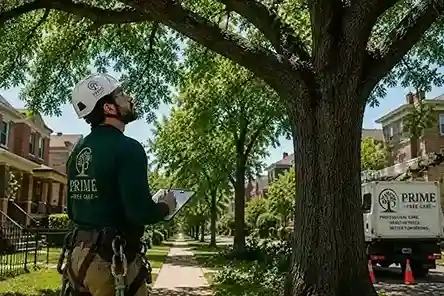
ISA-certified arborist inspecting a mature oak tree canopy on Chicago's South Side
~14 miFrom Our Hickory Hills Office
ISACertified Arborists
PreserveFirst Philosophy
24/7Emergency Response
Our Philosophy

Why South Side Trees Deserve Preservation-First Care

Few parts of Chicago carry as much tree canopy history as the South Side. From the century-old oaks lining Beverly's ridge streets to the legacy elms still standing in pockets of Hyde Park and Morgan Park, this is a part of the city where the trees are often as old as the housing stock itself.

Historic tree canopy: Mature trees throughout South Side neighborhoods aren't just landscaping — they're part of what defines these blocks. Decades-old oaks and large maples shape neighborhood identity, add measurable property value, cut summer cooling costs with real shade coverage, and provide environmental benefits like stormwater interception that a newly planted tree can't replicate for 40 or 50 years.

Preservation before removal: Our approach on every South Side property is the same: diagnose first, treat where it's realistically possible, and remove only when a tree presents a genuine, unmanageable safety risk. A tree showing early canopy decline or a treatable pest issue is not the same situation as a structurally failed tree leaning over a garage — we make that distinction with a documented Tree Risk Assessment, not a sales pitch.

Why mature trees are worth saving: A mature shade tree removed today isn't replaced in any meaningful sense for decades. Replacement saplings take 25–40 years to provide comparable shade and canopy volume. When a tree can be safely preserved through structural pruning, cabling, root management, or targeted treatment, that decision protects both the immediate landscape and the long-term canopy continuity of the block.

Getting to You

Serving South Side Neighborhoods From Hickory Hills

Prime Tree Care is based at 8811 W 87th St in Hickory Hills — a short drive from the South Side via the Dan Ryan Expressway (I-94), I-57, and major arterials like Western Avenue, Halsted Street, and Stony Island Avenue. Approximate distances below help South Side homeowners know what to expect for response times.

Morgan Park

Near Vermont St & Longwood Dr, along the Rock Island District Metra line

~7 mi~15 min
Beverly

Beverly/Morgan Park Historic Ridge District, along Longwood Drive

~8 mi~15 min
Washington Heights

Near 95th & Halsted, close to the Dan Ryan/I-57 interchange

~9 mi~17 min
Auburn Gresham

Near 79th & Halsted, west of the Dan Ryan Expressway

~10 mi~18 min
Roseland

Along Michigan Avenue near the Metra Electric District

~12 mi~20 min
Chatham

Near 79th & Cottage Grove, east of the Dan Ryan

~13 mi~22 min
Pullman

Near the Pullman National Historical Park, off I-94

~15 mi~24 min
Woodlawn

Adjacent to Jackson Park and the University of Chicago

~15 mi~25 min
Hyde Park

Near the Museum of Science and Industry and U. of Chicago campus

~16 mi~26 min
South Shore

Along South Shore Drive, near the South Shore Cultural Center

~17 mi~28 min

Drive times are estimates and vary with traffic on the Dan Ryan Expressway (I-94) and I-57. Emergency storm response is prioritized across all South Side neighborhoods regardless of distance.

Local Landmarks

Familiar South Side Ground

We work in the shadow of the same landmarks South Side residents pass every day — useful reference points when describing where a tree issue is located.

Jackson ParkBordering Hyde Park and Woodlawn, home to mature oak and hickory stands along the lagoons.
Museum of Science and IndustryHyde Park's landmark building, surrounded by some of the neighborhood's oldest canopy trees.
Beverly/Morgan Park Ridge Historic DistrictA designated historic district along Longwood Drive known for its century-old shade trees and elevated terrain.
Pullman National Historical ParkThe South Side's National Park Service site, set among Pullman's historic rowhouse blocks and parkway trees.
South Shore Cultural CenterA lakefront landmark along South Shore Drive with mature parkland trees exposed to lake-effect wind.
Dan Ryan Expressway (I-94)The main north-south corridor separating many South Side neighborhoods, with I-57 branching southwest.
Metra Electric & Rock Island LinesCommuter rail corridors running through Hyde Park, Woodlawn, Roseland, and Morgan Park.
Western Avenue & Halsted StreetTwo of the South Side's major north-south arterials, both lined with parkway trees under Bureau of Forestry jurisdiction.
Our Services

Tree Services We Provide Across the South Side

Tree Health Inspection & Treatment

Every preservation decision starts with a proper diagnosis. Our inspections include a full Tree Risk Assessment, Emerald Ash Borer detection, Dutch Elm Disease monitoring, canopy decline diagnosis, and soil and root health evaluation — the same process we'd use on our own property's oldest tree. See our tree health inspection & treatment services →

Tree Trimming & Structural Pruning

Structural pruning, deadwood removal, canopy balancing, and clearance pruning keep mature South Side trees safe without compromising their form or health. We schedule dormant-season pruning to reduce disease transmission risk on species like oak and elm. See our tree trimming & pruning services →

Tree Removal

Removal is a last resort in our process, reserved for hazardous, dead, irreversibly declining, or storm-damaged trees where preservation is no longer a responsible option. When removal is necessary, it's performed safely and with full attention to structures, alleys, and utility lines common in South Side lots. See our tree removal services →

Emergency Tree Service

Fallen limbs, storm-damaged trees, split trunks, leaning trees, and utility hazards need an immediate, professional response. Our crews are available around the clock across the South Side. See our emergency tree service →

Storm Prep & Tree Support Systems

Cabling and structural bracing installed ahead of storm season reduce limb failure risk on mature, high-value trees — a proactive alternative to reactive storm cleanup. See our storm prep & tree support systems →

Stump Grinding

Once removal is unavoidable, stump grinding restores the landscape, eliminates trip hazards, and prepares the site for replanting or yard improvements. See our stump grinding services →

Local Species

Common Tree Species Found Throughout the South Side

Oak Trees

Common in Beverly and Morgan Park's ridge terrain. Long-lived with real structural pruning needs as they age; oak wilt risk means pruning must avoid spring and early summer.

Maple Trees

Widespread across residential blocks. Fast growth patterns can mean weaker branch unions, making them more storm-vulnerable than slower-growing species.

Ash Trees

Heavily impacted by Emerald Ash Borer across the South Side. Early-detected cases are often treatable; advanced infestations typically require removal.

Elm Trees

Legacy elms still stand in pockets of Hyde Park and Morgan Park. Ongoing Dutch Elm Disease monitoring is essential to protecting these increasingly rare survivors.

Honey Locust

Common as a street and parkway tree for its urban adaptability. Generally lower maintenance but still needs periodic structural pruning.

Decision Framework

Tree Preservation vs. Tree Removal

ISA-certified arborists don't default to removal — every recommendation follows a structured evaluation of condition, risk, and realistic treatment options.

ConditionPreservation Possible?Recommended Action
Minor canopy declineYes, in most casesSoil correction, fertilization, monitoring
Emerald Ash Borer (early-moderate)Often, if caught earlySystemic insecticide treatment
Emerald Ash Borer (advanced)RarelyRemoval, with diverse species replanting
Structural defects (minor)YesStructural pruning, cabling, or bracing
Storm damage (limited)OftenCorrective pruning, structural support
Advanced decayCase-by-caseRisk assessment; removal if structural integrity is compromised
Root failureRarelyRemoval — root failure is a high-priority safety risk

Every recommendation is grounded in a documented Tree Risk Assessment weighing the likelihood of failure against the consequences — proximity to a home, driveway, alley, or power line — rather than a blanket policy in either direction.

Warning Signs

Signs Your Tree Needs Professional Evaluation

1

Dead Branches

Especially in the upper canopy, often a first sign of root or trunk stress.

2

Leaning Trunks

A sudden or worsening lean can signal root failure or soil heaving.

3

Bark Loss

Missing or peeling bark can expose the tree to pests and disease.

4

Fungal Growth

Mushrooms or conks at the base often indicate internal decay.

5

Cracks

Vertical trunk or branch cracks are a serious structural warning sign.

6

Cavities

Hollow sections reduce structural strength and load capacity.

7

Root Upheaval

Lifted soil or sidewalk near the base can indicate root failure risk.

8

Canopy Thinning

Sparse leaf coverage compared to prior seasons signals decline.

9

Storm Damage

Broken limbs or split unions after wind events need prompt evaluation.

10

Insect Activity

D-shaped exit holes, boring dust, or woodpecker damage warrant inspection.

Storm Readiness

South Side Storm Preparedness Guide

South Side trees face a genuine seasonal risk cycle — knowing what each season brings helps property owners plan ahead instead of reacting after damage occurs.

Spring
40°F–65°F · Severe Storm Season Begins

Thunderstorms and straight-line winds increase through April and May, often before newly leafed-out canopies have hardened off — a high-risk window for limb failure.

Summer
70°F–85°F · Drought & Wind Risk

Heat and dry stretches stress root systems while severe thunderstorms and occasional derecho-style straight-line wind events remain a real threat through August.

Fall
45°F–65°F · Ideal Pruning Prep

Cooling temperatures make this the right window to schedule dormant-season pruning appointments and pre-winter risk assessments before ice season arrives.

Winter
15°F–35°F · Ice & Snow Loading

Heavy wet snow and ice accumulation add significant weight to weakened limbs, making previously unnoticed structural defects fail suddenly.

Before Storm Season

Schedule a Tree Risk Assessment on mature trees, especially oaks and maples with large canopy spread. Install cabling or bracing on trees with known structural weaknesses. Remove dead or hanging limbs proactively.

During Severe Weather

Stay indoors and away from windows near large trees. Never attempt to clear a downed limb or tree touching a power line — treat it as energized and call ComEd and emergency services.

After Storm Damage

Photograph damage for insurance before any cleanup. Avoid walking under hanging "widowmaker" limbs. Call a certified arborist to evaluate whether the tree can be stabilized and preserved or requires removal.

Ownership & Permits

Parkway Trees vs. Private Trees

One of the most common points of confusion for South Side homeowners is who's actually responsible for a given tree. A parkway tree — growing in the strip between the sidewalk and the street — is owned and managed by the Chicago Bureau of Forestry, and removal or major work typically requires going through the city. A private tree, anywhere on your own lot, is entirely your responsibility to maintain, insure, and remove when necessary.

This distinction matters for permitting too: private tree removal generally doesn't require a city permit, while parkway tree work does. It also affects who to call first when a tree is damaged or hazardous — city-owned parkway trees go through the Bureau of Forestry's request system, which can involve longer wait times than a private arborist call.

Why Prime Tree Care

Why South Side Residents Choose Prime Tree Care

DK

David Kowalski

Founder & Lead Arborist

15+ years helping Chicago property owners protect mature, historic canopy through preservation-first evaluation, structural pruning, and long-term tree stewardship.

Common Questions

South Side Tree Service FAQ

Can mature trees be saved instead of removed?

Often, yes. A certified arborist performs a Tree Risk Assessment to evaluate structural integrity, decay extent, and canopy health before recommending removal. Many South Side trees showing early decline, minor deadwood, or treatable pest activity can be preserved through structural pruning, cabling, soil correction, or targeted treatment. Removal is recommended only when a tree presents an unmanageable safety risk or has progressed past the point where treatment can realistically extend its safe lifespan.

How much does tree removal cost on the South Side?

Cost varies based on tree size, species, structural condition, proximity to structures or power lines, and access. A small ornamental tree costs far less than a large, mature oak requiring crane support or tight-access removal near a garage or alley. Prime Tree Care provides a free, written, on-site estimate so South Side property owners know the exact cost before any work begins.

What is a Tree Risk Assessment?

A Tree Risk Assessment is a structured, ISA-based evaluation of a tree's likelihood of failure and the potential consequences if it fails, considering trunk condition, root health, canopy structure, and target proximity such as homes, driveways, or power lines. It's the foundation of every preservation-versus-removal decision Prime Tree Care makes, replacing guesswork with a documented, professional evaluation.

Can Emerald Ash Borer trees be treated?

Yes, in many cases. Ash trees caught in the early-to-moderate stages of Emerald Ash Borer infestation can often be saved with systemic insecticide treatment, particularly high-value or structurally sound trees. Once canopy dieback exceeds roughly 30–50%, treatment success drops significantly and removal typically becomes the safer, more cost-effective option. Early detection is the deciding factor.

What causes canopy decline?

Canopy decline on South Side properties is commonly caused by root zone compaction, construction damage, drought stress, aging, pest pressure such as Emerald Ash Borer, disease, and girdling roots. Because canopy dieback is often a visible symptom of an underlying root or soil issue, a full site evaluation is usually needed to identify the actual cause rather than treating the canopy alone.

How often should mature trees be inspected?

Mature trees on South Side properties should generally be professionally inspected every 1–2 years, and immediately after any major storm event, construction activity nearby, or visible changes like leaning, cracking, or sudden leaf loss. Legacy oaks, elms, and large maples in historic neighborhoods benefit from more frequent monitoring given their age and structural investment.

Do I need a permit to remove a tree?

It depends on whether the tree is on private property or a city-owned parkway. Private trees generally don't require a City of Chicago permit to remove. Parkway trees, located in the strip between the sidewalk and street, are owned and managed by the Chicago Bureau of Forestry, and removal typically must go through the city rather than a private contractor alone.

Who is responsible for a parkway tree?

The City of Chicago's Bureau of Forestry owns and is responsible for parkway trees — those growing in the public strip between the sidewalk and the street. Homeowners are responsible for trees located entirely on their own private property, including maintenance, insurance, and removal.

What is the best time to prune trees in Chicago?

Late winter, while trees are dormant, is generally the best time for structural pruning in Chicago, as it reduces disease transmission risk and lets arborists see branch structure clearly without leaf cover. Oak pruning specifically should avoid spring and early summer months due to oak wilt risk, and elm pruning should avoid the Dutch Elm Disease transmission season for the same reason.

What should I do after storm damage?

Stay away from any tree with broken limbs still hanging (known as "widowmakers"), downed branches near power lines, or a visibly leaning trunk, and call a professional immediately rather than attempting cleanup yourself. Document the damage with photos for insurance, and request an arborist evaluation to determine whether the tree can be stabilized and preserved or needs removal.
Neighborhoods We Serve

South Side Communities Covered by Prime Tree Care

From the historic ridge of Beverly to the lakefront blocks of South Shore, we adjust our approach to match each neighborhood's tree stock, terrain, and canopy age.

Hyde Park Beverly Morgan Park Chatham South Shore Pullman Woodlawn Washington Heights Auburn Gresham Roseland

See our complete coverage area on the Chicago, IL service area page, or explore nearby areas: Mount Greenwood, Brighton Park, and Chicago Heights.

Learn More

South Side Tree Care Resources

Emerald Ash Borer in Chicago

Identification, treatment windows, and removal timelines for EAB-affected ash trees.

Dutch Elm Disease in Chicago

How to monitor and protect the South Side's remaining legacy elms.

Oak Wilt, Dutch Elm & Dormant Pruning Season

Why timing matters when pruning oaks and elms in Chicago.

Tree Law & Neighbor Disputes in Chicago

What Chicago law says about boundary trees and shared canopy issues.

Tree Removal Cost in Chicago

What actually drives pricing for removal across Chicago neighborhoods.

Do I Need a Permit to Remove a Tree?

Permit rules for private trees versus city-owned parkway trees.

Get Started

Protect the Canopy That Defines Your Block

Whether it's a century-old oak in Beverly or a storm-damaged limb in Chatham, our ISA-certified arborists will give you an honest, preservation-first evaluation before recommending removal.

Call Now Free Estimate