Not Legal Advice: This guide explains common situations, general principles, and practical steps homeowners can take. It is not a substitute for advice from a licensed attorney. For a significant dispute, damage claim, or dispute that hasn't resolved through documentation and communication, consult a lawyer familiar with Illinois property law.
Few things strain a good neighbor relationship faster than a dispute over a tree — especially in a city like Chicago, where mature urban canopy, older housing stock, dense residential lots, and narrow alley access mean trees and property lines are often closely intertwined. If you're dealing with a fallen limb, a disagreement about a shared tree, or genuine concern about a neighbor's declining tree, this guide walks through how these situations typically play out, what actually matters for liability and insurance, and what practical steps protect you either way.
Chicago Tree Law Quick Reference
| Situation | Typical Responsibility |
|---|---|
| Tree entirely on your property | Property owner |
| Property-line tree | Often shared responsibility |
| Healthy tree falls during storm | Usually affected owner's insurance |
| Known hazardous tree fails | Potential liability for tree owner |
| Overhanging branches | Neighbor may trim within property line (subject to limitations) |
| Root damage dispute | Depends on circumstances and evidence |
| Parkway tree issue | City involvement may apply |
The Most Important Question First: Who Owns the Tree?
Before liability, insurance, or removal rights ever come into play, the foundational question is simple: whose tree is it? This determines who's generally responsible for maintenance, who bears greater liability exposure if something goes wrong, and who has the right to make removal decisions.
Tree Fully on One Property
If a tree's trunk is entirely within one owner's property boundary, that owner generally holds full responsibility for its maintenance and any liability tied to its condition, even if branches or roots extend onto a neighboring lot.
Property-Line Trees
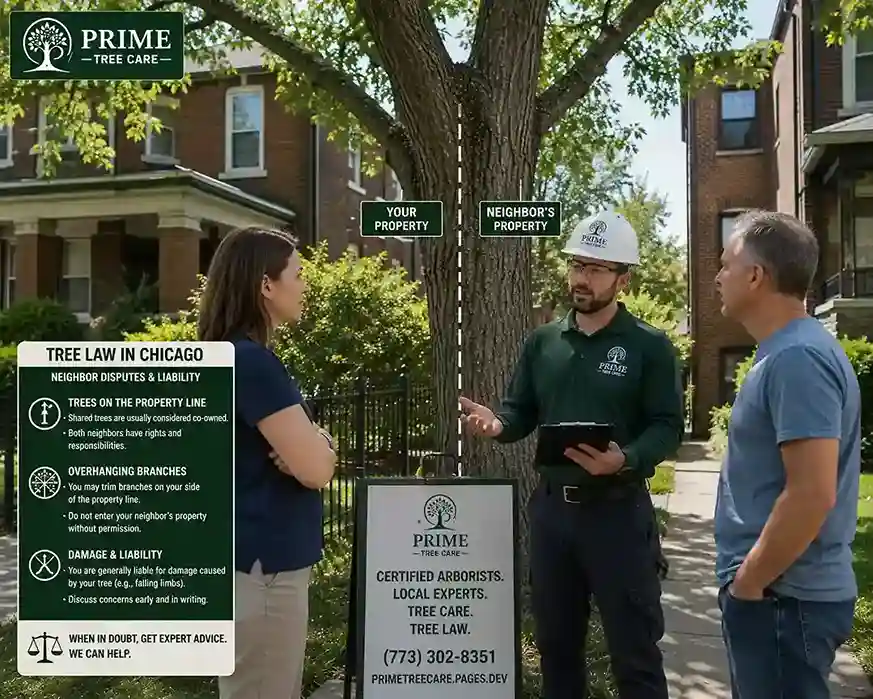
When a trunk sits directly on or straddles the boundary between two properties, ownership can become shared under general tree-law principles — meaning decisions about the tree, including removal, often require mutual agreement rather than one owner acting unilaterally.
Shared Ownership Situations
Shared ownership can also apply in less obvious situations — for example, a tree planted decades ago near an old, informal boundary marker that no longer precisely matches a modern survey. This is more common in Chicago's older neighborhoods than newer subdivisions with more standardized lot lines.
Why Ownership Matters
Ownership determines:
- Maintenance responsibility — who is expected to prune, monitor, and manage the tree's condition over time
- Liability exposure — who bears greater risk if the tree causes damage, particularly if a hazard was foreseeable
- Removal decisions — who has unilateral authority, and where mutual agreement is legally expected instead
- Dispute prevention — clear ownership understanding upfront avoids many disagreements before they start
Example: A large silver maple stands just behind a shared fence line in a Portage Park backyard. The homeowner assumes it's entirely theirs since it's on their side of the fence — but an old plat survey shows the actual property line runs several feet further back, meaning the tree trunk sits almost exactly on the boundary, creating a shared-ownership situation neither neighbor realized existed.
What Is a Property-Line Tree?
A property-line tree is one whose trunk crosses or sits directly on the legal boundary between two adjoining properties. This is distinct from a tree that simply grows near a boundary but has its full trunk base on one side.
Visualizing a Property-Line Tree
Property A | Tree Trunk | Property B
When the trunk itself straddles the line — not just branches or roots — both property owners typically hold a legal interest in the tree.
Ownership implications: Because both owners may hold an interest, one owner generally cannot unilaterally remove a healthy property-line tree without the other's consent. Shared decision-making is the expected norm — removal, major pruning, or treatment decisions ideally involve agreement from both sides. Removal complications arise when one neighbor wants a tree gone (for sunlight, root concerns, or simple preference) and the other wants it preserved; this is one of the more common and genuinely difficult categories of neighbor tree dispute in Chicago's older, densely built neighborhoods.
Can You Trim Branches Hanging Over Your Property?
General Rights
Most jurisdictions, including general Illinois property-law principles, allow a property owner to trim vegetation encroaching from a neighbor's tree up to their own boundary line, without needing the neighbor's permission for reasonable maintenance trimming.
Property-Line Limits
The key limitation: you can generally only cut back to your own property line. Cutting further — reaching onto the neighbor's side, or removing so much of the canopy that it affects the tree overall — moves beyond ordinary self-help trimming and into territory that could itself create liability if it damages or kills the tree.
Practical Considerations & Why Professional Pruning Matters
Cutting too aggressively on one side of a mature tree can genuinely destabilize its structure, creating a lopsided canopy or compromised root support that becomes a new hazard down the line — sometimes worse than the original overhang. This is especially relevant for large, older trees common throughout Chicago's historic residential blocks. A professional, ISA-certified pruning approach protects the tree's long-term health and avoids inadvertently creating exactly the hazard you were trying to prevent.
What About Tree Roots Crossing Property Lines?
Root disputes are among the most heavily searched tree-law questions, and for good reason — root damage is often slow, hard to definitively trace to a single tree, and expensive to fix.
- Sidewalk damage: Root heaving can crack or lift concrete sidewalk panels, creating both a property issue and, on public sidewalks, a potential trip-hazard liability question.
- Foundation concerns: Root intrusion near an older home's foundation is a common concern in Chicago's older housing stock, though definitively linking foundation issues to a specific tree's roots typically requires professional assessment.
- Sewer line issues: Root infiltration into aging sewer lines is a frequent problem in older Chicago neighborhoods with clay or older sewer pipe materials, and can be costly to resolve.
- Driveway damage: Similar to sidewalks, root growth beneath a driveway can cause cracking or heaving over time.
- Retaining wall problems: Root pressure against retaining walls can contribute to shifting or cracking, particularly on the sloped lots found in some Chicago-area neighborhoods.
Why documentation is critical: Root damage disputes are inherently harder to prove than a fallen-tree scenario, since the damage accumulates gradually and multiple factors (soil conditions, existing structural issues, age of the pipe or pavement) can contribute. Photographic documentation over time, and ideally a professional assessment connecting the specific root system to the specific damage, significantly strengthens any claim or conversation with a neighbor.
Who Pays When a Tree Falls On a Neighbor's Property?
Common Scenarios
- Healthy tree + severe storm: Generally treated as an "act of nature" — the affected owner's insurance typically handles the claim.
- Hidden internal decay: If decay wasn't visible or reasonably detectable beforehand, this often still falls closer to the "unforeseeable" category, though facts vary case by case.
- Known hazard ignored: If the tree's owner was previously aware of a visible hazard (documented lean, large dead limbs, prior arborist warning) and took no action, liability exposure for that owner increases substantially.
- Previously documented defects: A written arborist report noting a specific defect, if it later contributes to a failure, can become significant evidence in a liability discussion.
- Dead tree failure: A dead tree is generally considered a foreseeable hazard, which tends to shift more responsibility toward the owner who allowed it to remain standing.
- Leaning tree collapse: Similar to a dead tree, an existing, visible lean is generally considered a known or reasonably knowable condition.
Tree Damage Liability Examples
| Scenario | Potential Responsibility |
|---|---|
| Healthy tree falls during storm | Often affected property owner's insurance |
| Dead tree ignored for years | Possible liability concerns for the tree's owner |
| Known hazard documented previously | Increased owner exposure |
| Sudden, severe weather event | Often treated differently (less foreseeable) |
| City-owned tree involvement | Special circumstances — city process applies |
What Makes a Tree "Hazardous"?
Arborists evaluate several concrete indicators when assessing whether a tree poses a genuine hazard, rather than relying on general appearance alone:
⚠ Hazard Indicators Checklist
- Dead or significantly declining canopy
- Severe or worsening lean
- Visible root failure or uprooting at the base
- Large dead limbs (deadwood) in the canopy
- Trunk cavities or visible decay
- Prior storm damage that hasn't been addressed
- Split leaders or codominant stem cracking
- Direct conflict with utility lines or structures
A tree can appear generally healthy from a distance and still carry one or more of these defects — which is exactly why a formal, professional evaluation matters more than a visual assessment from the sidewalk.
Why Arborist Documentation Matters
If a dispute or insurance claim ever arises, a professional paper trail is often the single most valuable asset you can have. This includes:
- Tree risk assessment: A formal, structured evaluation of a tree's condition and hazard level, performed by an ISA-certified arborist
- Written reports: A dated, professional document describing specific findings, not just a verbal opinion
- Photographic documentation: Timestamped images showing the tree's condition at a specific point in time
- Hazard ratings: A standardized risk classification that gives objective weight to a subjective-seeming concern
- Condition monitoring: Repeat assessments over time that show whether a concern is worsening
- Insurance support: Documentation that substantiates a claim, rather than relying on a homeowner's own account alone
- Liability protection: For a tree owner, proactive documentation showing reasonable maintenance can help demonstrate the tree wasn't a known, ignored hazard
This kind of documentation matters for both sides of a potential dispute — it protects a concerned neighbor building a case for action, and it protects a tree owner who has been proactively maintaining their tree from being unfairly blamed after an unforeseeable weather event.
What Happens If You Warned Your Neighbor?
If you've previously raised a concern with a neighbor about a tree you believe is hazardous, documentation of that warning can matter significantly if the tree later causes damage.
- Written documentation: A dated note, letter, or text message describing your concern is far stronger evidence than a verbal conversation alone.
- Email records: If you've communicated by email, keep those records — they establish a clear timestamp and content of what was communicated.
- Inspection reports: If you obtained an independent arborist assessment and shared its findings with your neighbor, that combination is particularly strong documentation.
- Certified arborist assessments: A professional, third-party opinion carries more weight than a neighbor's personal assessment of "that tree looks bad."
- Follow-up communication: If the concern persisted without action, a follow-up message reinforcing the original warning further establishes an ongoing, documented concern.
This documentation can help establish that a hazard was reasonably known before it caused damage — a key factor in how responsibility tends to shift toward a tree's owner in these situations.
Insurance Claims After Tree Damage
If a tree — yours, a neighbor's, or a shared one — has already caused damage, here's a realistic, practical walkthrough of the insurance process:
- Ensure safety first. Confirm there's no ongoing hazard (downed power lines, unstable remaining limbs) before approaching the area.
- Document immediately. Photograph the damage, the fallen tree, and surrounding conditions from multiple angles as soon as it's safe to do so.
- Contact your homeowners insurance. Report the incident promptly; most policies have windows for timely reporting.
- Understand your deductible. Your out-of-pocket responsibility depends on your specific policy terms.
- Arrange emergency mitigation. Insurers typically expect reasonable steps to prevent further damage (tarping a roof, for example) and often cover these costs as part of the claim.
- Arrange temporary protection. Board up openings or tarp exposed areas to prevent weather intrusion while repairs are pending.
- Get tree removal cost estimates. Your insurer may need this as part of the claim; a licensed, insured tree service can provide a written estimate.
- Cooperate with the claim investigation. Your insurer may send an adjuster to assess the damage directly.
- Work with the adjuster. Provide your documentation (photos, any prior arborist reports) to support a fair and complete claim assessment.
Common Chicago Neighbor Tree Disputes
Overhanging Branches
Trim to your property line; communicate with your neighbor first when possible to avoid unnecessary friction.
Blocking Sunlight
Generally not treated as a legal hazard issue; this is more often a conversation about aesthetic preference or garden impact than liability.
Leaf Cleanup Complaints
Typically considered a normal, shared cost of living near mature trees rather than a liability matter.
Root Encroachment
Document damage over time; professional assessment helps establish a clear connection before any claim.
Fence Damage
Photograph the damage and the responsible tree; fence repair costs are often negotiated directly between neighbors or through insurance.
Property-Line Tree Removal
Requires mutual agreement in most cases; an independent arborist opinion can help both sides reach a fair decision.
Storm Damage Arguments
Insurance typically resolves the immediate damage regardless of blame; liability conversations matter more for repeat or foreseeable hazards.
Tree Replacement Disputes
Disagreements over whether and what to replant after a removal are common on shared or property-line trees; written agreement upfront helps avoid future conflict.
Parkway Trees Create Unique Legal Questions
Parkway trees add a distinct legal wrinkle to neighbor disputes, since a third party — the City of Chicago — owns the tree in question.
- What is a parkway tree? A tree planted in the public right-of-way strip between the sidewalk and the street.
- City ownership: These trees belong to the City of Chicago, not the adjacent homeowner.
- Bureau of Forestry: This division manages planting, pruning, and removal of parkway trees.
- Who handles maintenance? The city, not the adjacent property owner, though the city works on its own rotational schedule rather than individual demand.
- Who to contact: CHI311 is the correct channel for reporting concerns about a parkway tree, including hazard conditions or disputes about its condition.
For a full breakdown of parkway versus private tree rules, see our dedicated guide: Parkway Trees vs. Private Trees in Chicago.
What To Do Before A Dispute Escalates
- Document the tree's current condition with dated photos from multiple angles.
- Photograph specific concerns — cracks, lean, deadwood, root issues — clearly and up close.
- Speak with your neighbor directly in a calm, non-confrontational way before escalating further.
- Obtain an independent arborist assessment to bring objective, professional evidence into the conversation.
- Keep written records of every communication, whether by text, email, or letter.
- Contact your insurance company if damage has already occurred or seems imminent.
- Seek legal guidance if the dispute involves significant damage, a refusal to act on a documented hazard, or simply doesn't resolve through the steps above.
Real Chicago Scenarios (Direct Answers)
Why Homeowners Request Arborist Inspections Before Legal Action
Before escalating a tree dispute toward legal action, many Chicago homeowners start with an independent arborist inspection, since it offers several practical advantages:
- Lower-cost first step compared to legal consultation, while still producing real, usable documentation
- Objective documentation from a neutral, credentialed professional rather than either party's personal opinion
- Risk assessment that clarifies whether a genuine hazard exists, rather than a subjective aesthetic disagreement
- Ownership clarification — an arborist visit is also a natural opportunity to confirm exactly where a tree's trunk sits relative to the property line
- Treatment recommendations that may resolve the underlying concern (pruning, cabling, monitoring) without removal or conflict at all
- Dispute resolution support — a shared, professional opinion often helps both neighbors reach agreement faster than continued back-and-forth alone
Why Homeowners Call Prime Tree Care First
We're not attorneys, and we won't pretend to be — for a genuine legal dispute, we'll always recommend speaking with one. What we can do is provide an ISA-certified tree risk assessment, a written, dated report on a tree's condition, and straightforward documentation you can use in a conversation with your neighbor, your insurance company, or your attorney if it comes to that.
Frequently Asked Questions
Who owns a property-line tree in Chicago?
When a tree's trunk sits directly on or straddles a boundary line, both property owners can hold a shared ownership interest under general tree-law principles. This typically means decisions about removal require mutual agreement rather than one owner acting alone, though specific facts and any documentation matter.
Can I cut branches hanging over my property?
Generally, a property owner may trim branches and roots that cross onto their own property up to the boundary line, but should avoid cutting so aggressively that it damages the tree's health or structural stability, since that can create new liability.
Who pays if my neighbor's tree falls on my house?
It depends on the circumstances. If a healthy tree fails during a severe storm, the affected property owner's own homeowners insurance typically covers the damage. If the tree was already known to be hazardous and the owner failed to address it, that owner may face greater liability exposure.
What makes a tree legally hazardous?
Indicators include a dead or significantly declining canopy, severe lean, visible root failure, large dead limbs, trunk cavities or decay, prior storm damage, split leaders, and conflicts with structures or utility lines. A formal tree risk assessment from a certified arborist documents hazard level most reliably.
Can I force a neighbor to remove a dangerous tree?
There's no simple universal mechanism to compel removal. Practical first steps include documenting the hazard, communicating concerns in writing, and obtaining an independent arborist assessment. If a neighbor refuses to act on a documented, genuine hazard, legal guidance may be appropriate.
What if roots damage my foundation?
Document the damage with photos and, ideally, a professional assessment connecting the root activity to the specific damage. Responsibility often depends on the specific facts and foreseeability, which is why professional documentation matters before any claim or dispute.
What should I document before filing an insurance claim?
Photograph the damage and the tree from multiple angles as soon as safely possible, note the date and weather conditions, obtain a written arborist assessment if available, and keep records of any prior communication about the tree's condition.
Do parkway trees follow different rules?
Yes. Parkway trees are owned by the City of Chicago and maintained by the Bureau of Forestry, so disputes or damage involving a parkway tree typically involve a 311 report to the city rather than a direct neighbor-to-neighbor resolution.