 Prime Tree Care
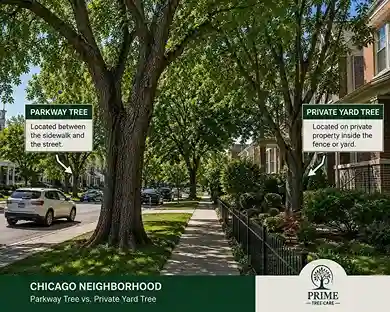
1. What Is a Parkway Tree?
In Chicago, the parkway is the strip of public land between the curb (street) and the sidewalk, or between the sidewalk and the private property line where no separate strip exists. It's public right-of-way — legally part of the street system, not part of anyone's yard — even though it often looks and feels like an extension of a homeowner's lawn.
Chicago's Municipal Code defines a parkway as the area between the street and the nearest property line, which includes the sidewalk area itself. That means the strip of grass in front of your house, the tree planted in it, and even the sidewalk running through it are all technically public property under the city's jurisdiction — not yours, even though you're the one mowing it.
Street, Sidewalk, Parkway, and Private Yard — What's the Difference?
- Street: The paved roadway itself, owned and maintained by the city.
- Parkway: The public strip between the street/curb and the sidewalk (or between the sidewalk and the property line). This is where most city-owned street trees grow.
- Sidewalk: The public pedestrian path, often running through or alongside the parkway.
- Private yard: Everything on your side of the property line — the area you actually own and control.
On many Chicago blocks the parkway is a narrow grass strip a few feet wide; on tree-lined boulevards like those near the Midway Plaisance or in neighborhoods with wide medians, the parkway can be substantially larger, sometimes described as a boulevard parkway. Either way — narrow residential parkway or wide boulevard planting strip — the ownership rule is the same: if it's between the curb and your property line, it's public land.
2. What Is a Private Tree?
A private tree is any tree growing entirely within your property boundary — front yard, back yard, side yard, or on a commercial or multi-family lot. If the trunk base sits inside your legal property line, it's yours: you own it, you're responsible for its care, and you're the one who decides whether it gets pruned, treated, or removed.
This is where responsibility differs sharply from public trees: a private tree owner can generally trim, treat, or remove their own tree without city permission (though some situations, like protected heritage trees or work near utility lines, can still involve outside coordination). A parkway tree owner — the city — retains that same authority over its trees, and private residents don't get to make those calls even though the tree sits right in front of their home.
3. Quick Ownership Chart
Here's the short version, for anyone who wants the answer without reading the whole guide:
| Tree Location | Who Owns It? | Who Trims It? | Who Removes It? |
|---|---|---|---|
| Parkway | City of Chicago | Bureau of Forestry | Bureau of Forestry |
| Front Yard | Property Owner | Property Owner | Property Owner |
| Back Yard | Property Owner | Property Owner | Property Owner |
| Commercial Property | Property Owner | Property Owner | Property Owner |
Exceptions to keep in mind: a tree that straddles the property line (trunk partially on public land, partially private) can create shared responsibility questions best clarified with the Bureau of Forestry. Trees on easements — such as utility easements — may also involve a utility company's vegetation management rights even on private property. And HOA-governed communities sometimes have their own tree covenants layered on top of city rules for common-area trees.
4. Who Is Responsible for Parkway Trees in Chicago?
The Chicago Bureau of Forestry, operating under the Department of Streets and Sanitation, is the city department responsible for the public tree canopy. Its responsibilities include:
- Tree planting — selecting and planting new parkway trees, including species diversification efforts
- Tree inspections — assessing parkway tree health and structural condition
- Tree trimming — routine and zone-based pruning cycles for city trees
- Tree removals — taking down dead, diseased, or hazardous parkway trees
- Urban forest management — long-term canopy planning across Chicago's neighborhoods
City forestry crews have sole authority over trees on parkways and other public property. Requests for service typically route through CHI311, Chicago's non-emergency service request system, which logs and dispatches forestry requests by location and priority.
5. What Responsibilities Do Homeowners Still Have?
This is where a lot of Chicago homeowners get caught off guard — many assume that because the parkway tree belongs to the city, they have zero responsibility toward it. In practice, adjacent property owners are generally expected to handle a few routine, lower-level obligations even though they don't own the tree:
- Watering young trees — newly planted parkway trees often depend on nearby residents for supplemental watering during establishment, especially in dry summer stretches
- Protecting roots — avoiding soil compaction, chemical damage, or construction impact within the tree's root zone
- Avoiding physical damage — not attaching signs, lights, wires, or hardware directly to a parkway tree, and being careful with mowers and trimmers around the trunk
- Reporting hazards — flagging dead limbs, leaning trunks, or visible decay to CHI311 rather than assuming the city will notice on its own
- Monitoring decline — keeping an eye on canopy thinning or dieback, which can be an early sign of pest or disease pressure like Emerald Ash Borer
In short: the city owns the tree and has final authority over trimming and removal, but the person closest to it — you — is often the first line of defense in catching problems early.
⚠️ Can You Remove a Parkway Tree Yourself?
No. Once a tree is planted in the parkway, it's considered city property and is protected under municipal rules — regardless of how long it's been there, how much it interferes with your driveway, or how confident you are that it's dying. Unauthorized removal can result in penalties, and it also removes a public asset without the city's urban forestry planning being factored in. If a parkway tree needs to come down, the right move is a CHI311 request or a conversation with the Bureau of Forestry — not a chainsaw.
6. Can You Plant Your Own Tree in the Parkway?
This is a common misconception: because the parkway strip looks like part of your yard, many residents assume they're free to plant whatever they like there. In reality, species selection in the parkway is managed by the Bureau of Forestry, not the adjacent homeowner.
Chicago manages parkway species selection deliberately, aiming to improve canopy diversity and reduce citywide vulnerability to pests and diseases such as Emerald Ash Borer and Dutch Elm Disease — both of which caused massive losses in the past specifically because too many blocks were planted with a single vulnerable species. If you'd like a parkway tree planted or replaced in front of your home, the correct path is requesting it through CHI311 or the city's tree planting programs, rather than planting one independently.
7. When Should You Call 311?
CHI311 is the right first call for anything involving a tree in the public right-of-way:
📞 Call 311 When...
- A parkway tree appears dead or severely declining
- A city tree has a broken or hanging branch
- A parkway location is missing a tree entirely
- You want a parkway tree inspection
- There's a hazard in the public right-of-way (leaning trunk, exposed roots, storm damage)
🌳 Call a Private Arborist When...
- The tree is on your private property
- You want a second opinion on a city assessment
- You need documentation for insurance
- You're planning construction near root zones
- You have a property-line tree dispute with a neighbor
Chicago generally works through a zone-based trimming approach for routine parkway maintenance, meaning neighborhoods are cycled through on a rotating schedule rather than trimmed on-demand. Hazardous conditions reported through 311 are typically prioritized ahead of the routine cycle, but response times can still vary based on current request volume.
8. When Should You Call a Private Arborist?
For anything on your own property — or anything where you want independent expertise — an ISA-certified arborist fills a role the city simply doesn't provide:
- Tree risk assessments — a formal, documented evaluation of a tree's structural condition and failure risk
- Second opinions — an independent read on a tree the city has assessed differently than you expected
- Documentation for insurance — written reports that support a claim after storm damage or a tree-related incident
- Construction root protection — planning root-zone protection before a renovation, addition, or driveway replacement
- Emergency hazard evaluations — fast, private assessment when you need an answer faster than the city queue allows
- Property-line disputes — clarifying ownership and responsibility when a tree sits near or on a boundary line
An ISA-certified arborist can help you understand risk before a major limb failure or full tree failure happens — rather than reacting after the fact. That's the core value a private arborist adds on top of whatever the city provides for public trees.
9. Who Pays If a Parkway Tree Damages Your Property?
This is one of the most-searched tree questions in Chicago, and unfortunately there's no single blanket answer — it depends on the type of damage, the specific circumstances, and sometimes your own insurance policy. Here's how the major categories generally break down conceptually (this is general information, not legal advice — for anything involving a real claim or dispute, consult your insurer or an attorney):
- Sidewalk damage: Roots from a parkway tree lifting a public sidewalk is generally treated as a city infrastructure issue, reportable through 311.
- Fence damage: Often involves your own homeowner's insurance, regardless of whether the tree was public or private, though documentation of the tree's ownership and condition matters.
- Roof damage: Typically handled through homeowner's insurance; a prior inspection record showing the tree's condition (or lack of one) can become relevant.
- Vehicle damage: Usually a matter for auto insurance, again with documentation of the tree and incident helping the claims process.
- Sewer concerns: Root intrusion into sewer lines is a common older-neighborhood issue and may involve the city's water management department in addition to a plumber.
- Root conflicts: Ongoing root damage to hardscaping is best documented over time with photos and, where useful, a formal arborist inspection.
Across all of these scenarios, the practical steps are consistent: document the tree and the damage (photos, dates, prior complaints if any), report public-tree hazards through 311 so there's an official record, keep any inspection reports from the city or a private arborist, and loop in your insurance provider early if there's property damage involved.
10. Parkway Tree Problems Common in Chicago
Chicago's parkway trees face a specific set of regional pressures. Understanding them helps explain why the city manages species and timing so deliberately.
Emerald Ash Borer
This invasive beetle devastated Chicago's ash-heavy parkway plantings over the past decade, which is a major reason the Bureau of Forestry now prioritizes species diversity in replanting programs. Learn more in our Emerald Ash Borer Chicago guide.
Dutch Elm Disease
Historic elm-lined parkways in older neighborhoods remain vulnerable to this fungal disease, spread by bark beetles and root grafts between neighboring trees. Read our Dutch Elm Disease Chicago guide for more detail.
Silver Maple Failures
Fast-growing but structurally weak, silver maples planted decades ago along many Chicago parkways are now a common source of limb failure during storms.
Storm Damage
Derecho-strength straight-line winds and heavy snow loading regularly cause parkway tree limb failures across the city, particularly along more exposed corridors.
Salt Stress
Winter road salt application near parkway strips can stress root systems and soil chemistry over time, especially for trees planted close to heavily salted streets and sidewalks.
Compacted Urban Soils
Parkway strips are narrow and heavily trafficked by foot and vehicle traffic, leading to soil compaction that restricts root growth and water infiltration — part of why Chicago's overall urban forest requires more deliberate management than a typical suburban canopy.
11. Parkway Trees During Construction Projects
Renovations, driveway replacements, utility work, and home additions are a frequent source of unintentional parkway tree damage — and a frequent source of city fines when root zones aren't protected.
- Renovations and additions: Heavy equipment staged near a parkway tree's root zone can cause soil compaction that harms the tree for years, even without visible impact.
- Driveway replacements: Cutting or paving near root zones can sever structural roots, destabilizing a mature tree.
- Utility work: Trenching near parkway trees requires care to avoid severing major roots — coordination with utility vegetation management practices helps reduce this risk.
- Root-zone protection: Fencing off the critical root zone before construction begins is one of the most effective ways to protect a parkway tree during a project.
Chicago's landscape and parkway tree requirements generally expect property owners undertaking construction near a parkway tree to take reasonable precautions to protect it — and permit applications for certain projects may require sign-off confirming nearby trees won't be harmed. If you're planning a project near a parkway tree, it's worth having a private arborist assess root-zone protection needs before work begins.
12. Chicago Tree Law: Common Misunderstandings
"It's in front of my house, so it's mine."
Location relative to your home doesn't determine ownership — the property line does. A tree in the parkway is city property regardless of how close it is to your front door.
"I can trim it however I want."
Parkway trees are maintained by the Bureau of Forestry. Unauthorized trimming — including topping or over-pruning — can damage the tree and isn't within a resident's authority, even for branches that overhang your yard.
"The city must pay for everything."
Responsibility depends on the specific type of damage and circumstances. Some situations involve city infrastructure programs; others involve your own homeowner's insurance. It's rarely an automatic blanket payout.
"I can remove roots whenever I want."
Cutting roots from a parkway tree — even roots extending into your own yard — can destabilize or kill the tree and may fall outside your authority, since the tree itself remains city property.
13. Parkway Trees vs Private Trees: Real Chicago Scenarios
Lincoln Square Parkway Oak
A mature oak on a Lincoln Square parkway begins dropping large dead limbs onto the sidewalk. The correct step is a CHI311 hazard report — not private removal — since the tree remains city property despite sitting right at the resident's front walk.
Hyde Park Boulevard Tree
A homeowner near a Hyde Park boulevard wants a second opinion after the city recommends removal for a boulevard tree. A private ISA-certified arborist inspection can help clarify the tree's true condition, even though the city retains final authority over the parkway tree itself.
Mount Greenwood Storm Damage
After a high-wind event, a Mount Greenwood resident finds a large limb down from a parkway tree in their yard. The debris in the public right-of-way is reported to 311, while any resulting damage to a private fence goes through the resident's homeowner's insurance.
Evanston Property-Line Example
A tree trunk sits directly on the boundary between two Evanston properties. Both neighbors share practical interest in the tree's condition, and a private arborist assessment can help clarify structural risk and inform a conversation between the property owners.
Dunning Sidewalk Root Conflict
Roots from a parkway tree in Dunning have visibly lifted a public sidewalk slab, creating a trip hazard. Since the sidewalk and the tree are both in the public right-of-way, this is reported through 311 rather than handled by the adjacent homeowner.
14. Frequently Asked Questions
Who owns parkway trees in Chicago?
Can I cut down a parkway tree?
Can I request tree trimming from the city?
Does Chicago replace removed parkway trees?
Who pays for sidewalk damage caused by tree roots?
Can I plant a different species in the parkway?
What if a city tree looks dangerous?
How long does city tree service take?
What is the Bureau of Forestry?
Can a private arborist inspect a city tree?
💡 Related Reading
Explore more Chicago tree regulation guides: Do I Need a Permit to Remove a Tree in Chicago?, Chicago Tree Law & Neighbor Disputes, Emerald Ash Borer Chicago, and Dutch Elm Disease Chicago.