Prime Tree Care provides professional tree trimming and pruning services throughout Chicago, helping property owners improve tree structure, reduce storm damage risk, enhance appearance, and promote long-term health. Our ISA-certified arborists use proper pruning techniques and dormant-season scheduling to minimize disease transmission risks such as Oak Wilt while preserving the natural form of your trees.
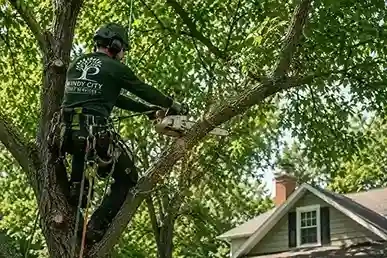
Chicago trees carry a heavier structural burden than trees almost anywhere else in the Midwest. Heavy wet snow settles into unbalanced canopies, ice accumulation adds unforgiving dead weight to already-weak limb unions, and high-wind events — including the derecho-style straight-line wind storms that have grown more frequent across Chicagoland — test every branch attachment on the tree at once. Add in decades-old urban trees that were never trained when young, and you get a canopy full of latent hazards that only show themselves the moment a storm arrives.
Pruning is preventative maintenance for that risk. Removing dead, crossing, and overextended limbs reduces sail area and wind resistance, corrects weight distribution across the crown, and eliminates the weak branch unions most likely to fail under load. Pruning cuts made at the right time of year, in the right location on the branch, also close faster and cleaner — which matters directly for disease transmission risk in species like oak and elm that are common throughout Chicago's neighborhoods.
The inverse is just as true: improper pruning creates the exact hazards it's supposed to prevent. Topping, flush cuts, over-thinning, and "lion-tailing" (stripping interior growth and leaving foliage only at branch tips) all weaken a tree's structure, trigger stress-response sprouting that regrows even weaker, and leave large wounds that decay organisms exploit for years afterward. A tree pruned badly by an unqualified crew often looks fine the season it's cut and becomes a liability three, five, or ten years later — which is why species-specific technique and correct cut placement matter as much as the decision to prune in the first place.
| Service | Purpose | Typical Goal |
|---|---|---|
| Tree Trimming | Appearance, canopy shaping, clearance from structures and walkways | Neater form, unobstructed sightlines and access |
| Tree Pruning | Structural correction, disease and decay management, hazard reduction | Stronger branch architecture, reduced storm and disease risk |
| Combined Service | Both appearance and structure addressed in a single visit | A tree that looks better and stands up to Chicago weather |
Most tree failures give warning signs well before they happen. If you notice any of the following, it's worth having an ISA-certified arborist take a look before the next major storm.
Dry, brittle, or bark-free limbs are structurally unpredictable and a common source of falling debris.
Branches that rub together wear through bark, creating entry points for decay and pests.
Long, heavy branches with little support are the first to fail under snow, ice, or wind load.
Split, cracked, or hanging limbs need prompt attention to prevent further tearing and decay.
A lopsided crown puts uneven stress on the trunk and root plate, raising the risk of a full failure.
Limbs contacting roofs, siding, or windows create ongoing wear and storm-damage exposure.
Growth near power lines is a safety hazard that requires trained, careful pruning.
Overcrowded interior growth blocks airflow and light, encouraging fungal issues.
Co-dominant stems and included bark are leading causes of catastrophic limb failure.
Thinning foliage or dying sections can signal disease that spreads without corrective pruning.
Every pruning job follows the same disciplined process, whether it's a single ornamental tree or a full-property canopy plan.
What is structural pruning? It's the deliberate shaping of a tree's branch architecture — establishing a dominant central leader, well-spaced scaffold limbs, and strong branch unions — so the tree develops (or is corrected toward) a form that can carry wind, snow, and ice loads without failing.
Why structural defects develop: Urban trees are frequently planted in tight spaces, pruned inconsistently by different crews over the years, or left completely unpruned until a defect is already established. Without early correction, trees develop the same predictable weak points again and again.
Two same-size stems competing for dominance create a narrow, weak union prone to splitting under load.
Bark trapped inside a tight branch union prevents strong wood-to-wood connection, creating a hidden failure point.
Steep, narrow-angle attachments carry far less structural strength than wide, well-spaced unions.
Correcting defects early prevents them from becoming major hazards decades later.
Early structural pruning is the cheapest, most effective intervention a tree will ever receive.
Established trees are managed conservatively — reducing risk without over-pruning stressed limbs.
Consistent structural pruning over a tree's lifetime meaningfully reduces the odds of catastrophic failure during Chicago's high-wind and heavy-snow events — it's an investment that pays off every storm season for decades.
What is dormant-season pruning? Pruning performed after leaf drop and before spring bud break, when the tree has entered its winter dormancy and growth has stopped.
Chicago's cold winters make dormant pruning especially practical — frozen or firm ground reduces soil compaction and turf damage from equipment, and our crews can access more of the canopy safely with a clear view of every cut.
What is Oak Wilt? Oak Wilt is an aggressive fungal disease that blocks a tree's water-conducting tissue, killing red oak family trees — often within weeks of infection — and spreading to neighboring oaks through connected root systems.
How it spreads: Two ways — underground through grafted root systems between nearby oaks, and above ground when sap beetles, attracted to the smell of a fresh pruning wound, carry fungal spores from an infected tree to a healthy cut.
Why timing matters: A single ill-timed cut during beetle season can introduce Oak Wilt to an otherwise healthy tree — and once established, it can move through an entire block of connected oaks. Timing is the single biggest controllable factor in prevention.
Peak beetle activity. Avoid all oak pruning and wounding.
Beetles remain active. Emergency pruning only, with wound treatment.
Beetle activity declining. Non-urgent pruning still best delayed.
Dormant season. The recommended window for oak pruning in Chicago.
Special considerations for oak trees: If an oak must be pruned outside the dormant window due to storm damage or safety hazards, wounds should be sealed immediately and equipment sanitized between trees to limit spread risk.
Read our full guide to Oak Wilt & Dutch Elm dormant pruning season →Chicago's urban canopy is dominated by a handful of species, each with its own pruning considerations and vulnerabilities.
| Species | Common Issues | Pruning Objective |
|---|---|---|
| Oak | Oak Wilt vulnerability, co-dominant stems | Strict dormant-season timing, structural correction |
| Maple | Included bark, weak branch unions | Structural pruning, weight reduction |
| Elm | Dutch Elm Disease risk | Timed pruning, sanitized equipment, deadwood removal |
| Ash | Emerald Ash Borer decline | Health assessment prior to pruning, canopy thinning |
| Honey Locust | Fast, dense re-growth | Canopy thinning, clearance pruning |
| Hackberry | Witches'-broom growth, weak wood | Deadwood removal, structural thinning |
| Kentucky Coffeetree | Coarse branching, uneven form | Crown shaping, structural training |
| Ornamental Trees | Overcrowding, poor early training | Formative and maintenance pruning |
Chicagoland's exposure to derecho-strength wind events and severe summer storms makes proactive pruning one of the most effective property-protection steps a homeowner can take.
A thinned, balanced canopy lets wind pass through instead of catching it like a sail.
Shortening overextended limbs reduces leverage and stress on weak branch unions.
An evenly distributed canopy reduces uneven stress on the trunk and root system.
Eliminating the branches most likely to fail removes the biggest storm-damage risk first.
A properly thinned crown carries winter loads far more safely than a dense, uncorrected one.
Clearance pruning near power lines reduces the risk of outages and fire hazards during storms.
Pruning can't fix every tree. Our arborists will always tell you honestly when removal is the safer, more cost-effective option.
| Condition | Pruning Recommended | Removal Recommended |
|---|---|---|
| Severe decay | Localized, minor decay | Decay affecting the main trunk or root flare |
| Structural instability | Correctable defect in an otherwise sound tree | Leaning trees with root plate movement |
| Advanced disease | Early-stage, treatable conditions | Widespread infection with no viable treatment |
| Hazardous defects | Single correctable defect | Multiple compounding structural failures |
Not sure which category your tree falls into? Our tree health inspection & treatment service can determine whether pruning, treatment, or removal is the right call for your property.
Every pruning plan is designed and led by a credentialed arborist, not a general landscaping crew.
We prune oak, elm, maple, and ash differently — because their structure and vulnerabilities are different.
Strict adherence to dormant-season timing and sanitized equipment on every oak we touch.
Rope systems, bucket trucks, and defined safety zones on every job, every time.
Aerial lifts and proper rigging mean cleaner cuts and safer work around structures and power lines.
Our goal is always the healthiest outcome for your tree, not the fastest job for us.
Leads emergency tree operations throughout Chicago, specializing in structural pruning, cabling systems, storm mitigation, and safe work around structures and power lines.
For most species, late fall through early spring — while trees are dormant — is the best window. It reduces stress on the tree, improves visibility of branch structure, and minimizes disease transmission risk.
Trimming focuses on appearance and clearance, shaping the canopy and keeping branches away from structures. Pruning targets structural integrity and tree health, removing defects that create long-term risk.
Yes. Removing dead, damaged, or diseased wood improves airflow and light penetration, reduces pest and fungal pressure, and redirects the tree's energy toward healthy growth.
Most mature trees benefit from professional pruning every 2–4 years, though young trees in structural training and storm-damaged trees may need more frequent attention.
For most Chicago species, yes. Dormant-season pruning reduces stress on the tree, improves visibility of defects, and lowers the risk of spreading pests or disease active during warmer months.
Pruning significantly reduces storm damage risk by removing weak limbs, balancing the canopy, and reducing wind resistance — though it cannot eliminate risk entirely on a severely compromised tree.
Structural pruning corrects a tree's branch architecture — establishing strong scaffold limbs and branch unions — to reduce the likelihood of limb or trunk failure over the tree's lifetime.
It requires specialized training and equipment. Our crews are trained to work safely around power lines and structures, and we coordinate with utility providers when clearance work is required.
Properly timed pruning during the dormant season is one of the most effective ways to prevent Oak Wilt transmission. Pruning oaks between April and July significantly raises infection risk and should be avoided.
Cost depends on tree size, species, condition, and site access. Visit our tree trimming cost guide for typical Chicago pricing, or request a free on-site estimate for an exact quote.
Prime Tree Care provides tree trimming and structural pruning across the City of Chicago and surrounding Cook, DuPage, Kane, and McHenry County suburbs. Urban tree maintenance in Chicago comes with its own challenges — compacted soil, tight-access lots, aging parkway trees, and canopy pressure from storms and disease — and our crews handle it street by street, neighborhood by neighborhood, rather than applying one generic plan everywhere.
From dense city blocks to wooded suburban lots, we tailor pruning schedules to local species mix, storm exposure, and each neighborhood's canopy history — helping protect property values and prevent the kind of storm damage that catches unprepared homeowners off guard every season.
Professional pruning improves tree health, protects property, enhances appearance, and helps trees withstand Chicago's challenging weather conditions.
Free, no-obligation written pricing from a certified arborist.
On-site evaluation of your tree's structure, health, and pruning needs.
24/7 response for storm-damaged limbs and hazardous trees.
 Prime Tree Care Chicago Arborists