
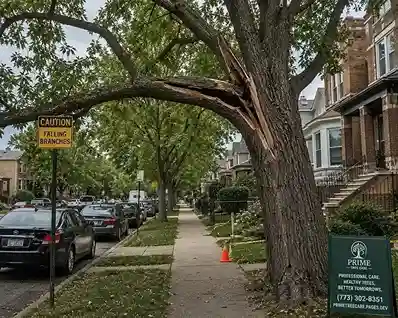
First, Determine Whether the Tree Is Actually City-Owned
Before anything else, it helps to know who is actually responsible for the tree you're worried about. Ownership in Chicago comes down to location, and getting this right determines whether your next call goes to 311 or to a private tree company.
Parkway Trees
A parkway tree sits in the strip of grass between the sidewalk and the street — the public right-of-way. These trees are almost always city-managed, planted and maintained by the Bureau of Forestry, even though they sit directly in front of a private home.
Trees Inside Parks
Trees within Chicago Park District property are managed separately from parkway trees. If the hazardous tree is inside a park rather than along a street, the Park District — not the Bureau of Forestry — is generally the right contact.
Private Property Trees
Any tree in a front yard, backyard, or elsewhere on private property is the homeowner's responsibility, regardless of how close it sits to the sidewalk or street. This is true even if the tree could plausibly fall toward a neighbor's property or the public way.
Quick Ownership Checklist
| Tree Location | Likely Responsible Party |
|---|---|
| Parkway (between sidewalk and street) | City of Chicago |
| Front yard | Property owner |
| Backyard | Property owner |
| Park property | Chicago Park District |
For a deeper breakdown of edge cases; like trees that straddle a property line — see our guide on Parkway Trees vs. Private Trees in Chicago.
What Makes a City Tree Hazardous?
Not every parkway tree that looks a little rough is a genuine hazard. A hazardous condition is typically defined by structural signs that suggest the tree, or a major part of it, could fail.
- Dead tree — no live foliage during the growing season, brittle bark, or a hollow-sounding trunk.
- Major trunk cracks — vertical splits or seams that weren't there before, especially after wind or storm events.
- Large hanging limbs — broken branches still attached to the tree, sometimes called "hangers," which can fall without warning.
- Uprooting — visible lifting of the root plate at the base of the trunk.
- Leaning after storms — a new or worsening lean following wind events, especially combined with soil heaving.
- Decay cavities — open wounds or cavities in the trunk that suggest internal decay.
- Root failure — exposed, cut, or decayed roots near the base, often from nearby construction or utility work.
- Limb failure over sidewalks — dead or cracked limbs positioned directly over a walking path.
Warning Signs Homeowners Should Never Ignore
- A sudden new lean in the trunk, even a small one
- Fresh cracking sounds during wind, without an obvious cause
- Fungal growth (mushrooms or conks) at the base of the trunk
- A large limb that has separated but hasn't fallen
- Soil lifting or cracking around the base of the tree
Why Some Residents Wait So Long for Tree Work
It's a fair and common frustration: you've reported a hazardous tree, and weeks or months later, nothing has visibly changed. This isn't unique to any one resident's experience, and it's worth understanding honestly rather than guessing at the reason.
The Bureau of Forestry manages requests using a combination of hazard severity and a citywide grid cycle, meaning routine trimming and removal requests are worked through block by block over time, not necessarily in the order they're submitted. Requests flagged as posing an immediate public safety threat are generally moved ahead of routine ones, but "immediate" and "routine" aren't always obvious from a resident's point of view, and that gap between how a resident perceives urgency and how a request gets triaged is often the real source of frustration.
Bureau of Forestry Priorities
Forestry crews work from a queue that has to account for the entire city at once, not just one block. A tree with an active, visible failure risk — a large hanging limb, an active lean, exposed roots after a storm — is generally treated differently from a tree that's simply overgrown or aesthetically in need of pruning. The distinction matters when you're describing your situation to 311; specific, observable defects tend to move differently than general concern.
Emergency vs. Routine Requests
An emergency request typically involves an immediate, visible danger — a tree already down, a limb hanging directly over a walkway, or storm damage in progress. A routine request covers everything else: a tree that looks unhealthy, a canopy that needs thinning, or a hazard that's developing but not yet acute. Both are legitimate to report, but they move through the system differently, and it's worth being clear in your own mind which category your situation falls into before you call.
Storm Backlogs
After a significant wind, ice, or derecho event, the volume of new requests can spike dramatically across the entire city at once. Crews already stretched across the regular grid cycle now have an emergency backlog layered on top of routine work, and it's common for non-emergency requests submitted just before or during storm season to sit longer than they would in a calmer stretch of the year.
Citywide Grid Cycle
Chicago's forestry maintenance follows a grid-based cycle, meaning different sections of the city are scheduled for routine trimming and inspection on a rotating basis over roughly five years. If your block isn't currently in the active rotation, a routine request may sit until that cycle reaches your area again, unless the hazard is reclassified as urgent.
Staffing and Budget Limitations
Like most municipal forestry departments, the Bureau of Forestry's capacity varies year to year based on staffing levels and budget allocation, both of which affect how quickly the routine queue moves. We won't speculate on exact numbers, but it's well documented that some residents report waiting months or longer for a non-emergency request to be resolved.
None of this is meant to excuse a genuinely dangerous situation going unaddressed — it's meant to explain, honestly, why the system moves the way it does, so you can plan your own next steps accordingly rather than assuming something has gone wrong with your specific request. If you want a deeper look at how the grid system itself works, see our explainer on the City of Chicago Tree Trimming Grid System.
What To Do Immediately If You're Concerned
While you wait for the city, there's a lot within your control. This sequence is what we recommend to homeowners who call us about a hazardous parkway tree.
- 1Photograph everything.Take photos from multiple angles — the trunk, the base, the canopy, and any specific defect. Include something for scale, like a car or a person, if possible.
- 2Document dates.Note when you first noticed the issue and any changes since. A simple dated log, even a few lines in your phone's notes app, is enough.
- 3Submit a 311 request.Use 311 or the CHI311 app to report the hazard, describing the exact location and the specific concern.
- 4Save your request number.This is your reference point for any follow-up call or escalation.
- 5Monitor changes.Check the tree periodically, especially after wind or storms, and note anything that's gotten worse.
- 6Avoid working or parking under the tree.Until the hazard is resolved, treat the area beneath it as off-limits for parking, play, or yard work.
- 7Schedule an independent arborist inspection.A professional condition report gives you documentation you control, separate from the city's process.
Documentation matters here for two reasons: it strengthens any escalation you make to the city, and it protects you if the tree fails before the city gets to it — particularly for insurance and liability purposes, which we cover further down.
Why an Independent Arborist Inspection Can Help
An independent inspection doesn't change who owns the tree, but it gives you something the city's queue doesn't: a dated, professional record of the tree's condition from someone with no stake in the outcome either way.
- Professional risk assessment — a structured evaluation of the tree's condition using recognized arborist methods.
- Hazard documentation — a written and photographic record you can reference or share.
- Species identification — some species fail differently than others, which matters for the assessment.
- Defect mapping — a specific record of where the cracks, decay, or lean are located.
- Condition reports — a dated document, useful if the situation changes later.
- Liability protection — evidence that you identified and reported the hazard proactively.
Homeowners typically use these inspections to understand their actual level of risk, build a documented record over time, and support an escalation if the city's routine timeline doesn't match the urgency they're seeing in person.
What If the Tree Is Getting Worse?
A hazard that was borderline a month ago can become urgent quickly. Watch specifically for an increased lean, additional or widening cracks, any limb failure since your last check, visible storm damage, or new conflicts with nearby utility lines. If any of these appear, submit updated documentation — new photos and a new 311 note referencing your original request number — so the city's record reflects the current, more urgent condition rather than the one you first reported.
How Emergency Escalation Typically Works
Some situations shouldn't wait for the routine process at all. These generally include an immediate public safety threat: a blocked road, a fallen tree, a sidewalk fully obstructed, a tree or limb in contact with an energized power line, or any hazard directly threatening an occupied structure.
For everything short of that — a worsening but not yet fallen hazard — calling 311 again with updated documentation and clearly describing the immediate danger is the appropriate escalation path. This is different from simply re-submitting the same request; make clear what has changed.
Can You Hire a Private Company to Remove a City Tree?
Generally, no — not without authorization. Parkway trees are public assets, and removing or significantly pruning one without going through the city can create complications, since the tree isn't yours to authorize work on. This is not legal advice, and specific situations can vary, but as a general rule, work on a city-owned tree should go through the city's process, even when it's slow. If a limb is an immediate danger, that's a 911 or emergency-response situation rather than a private removal decision.
What Happens If a City Tree Damages Property?
When a parkway tree damages a vehicle, roof, fence, or sidewalk, the aftermath usually runs through your own insurance first. Homeowner's and auto policies commonly cover storm and tree-fall damage regardless of who owned the tree, though details vary by policy and carrier.
- Vehicle damage — typically handled through comprehensive auto coverage.
- Roof damage — typically handled through homeowner's insurance.
- Fence and sidewalk damage — often covered, depending on your policy's specifics.
Photos of the damage, and any prior hazard report or independent inspection you'd already completed, can meaningfully support a claim by establishing that the tree's condition was known and documented. This is educational information, not a guarantee of coverage — always confirm details with your insurer. For property-line and liability questions specifically, see our guide on Tree Law and Neighbor Disputes in Chicago.
Common Hazardous Tree Species Seen in Chicago
Certain species show up disproportionately often in hazard reports across the city, each for different structural reasons.
Silver Maple
Fast-growing but structurally weak wood, prone to limb failure in wind even without obvious disease.
Ash Trees Affected by EAB
Emerald Ash Borer causes rapid canopy decline and brittle wood, making dead ash trees a frequent hazard report.
Aging Cottonwoods
Large, fast-growing trees that develop internal decay and heavy limbs as they mature.
Older Elm Trees
Surviving mature elms can carry significant decay and disease pressure after decades in the urban environment.
Large Multi-Stem Trees
Trees with multiple trunks from a shared base are prone to splitting at the union under wind or ice load.
Chicago Storms and Why Proactive Documentation Matters
Chicago's tree hazard reports spike predictably around certain weather patterns: derechos and straight-line wind events, ice storms, wet heavy-snow events, and summer thunderstorms with strong gusts. Each stresses trees differently — wind tests root and trunk stability, while ice and wet snow add sudden weight to limbs already weakened by decay.
This is exactly why documentation taken before a storm has value. If you've already photographed and dated a hazard, and the tree fails or worsens during a storm event, you have a clear record showing the condition predated the weather — useful for both your escalation to the city and any insurance conversation that follows. See our storm-specific coverage for more on how these events affect trees across the region.
Realistic Expectations for Residents
It helps to know, plainly, what each party in this situation can and can't do.
| Party | Can Do | Cannot Do |
|---|---|---|
| The City | Assess, prioritize, trim, or remove parkway trees through its official process | Guarantee a specific timeline for routine requests |
| Private Arborists | Inspect and document a parkway tree's condition; work on private trees | Remove or prune a city-owned tree without authorization |
| Homeowners | Report hazards, document conditions, escalate genuine emergencies, avoid the risk area | Legally remove or significantly alter a city-owned tree themselves |
When You Should Call an Emergency Tree Service
Emergency tree services and city ownership are two separate issues, and it's worth keeping them distinct in your mind. Call an emergency tree service directly when a tree is already down, resting on your house, blocking access to your property, showing a split trunk, has failed during a storm, or is in conflict with a utility line on your side of the property.
There's a meaningful difference between emergency stabilization — making a dangerous situation safe right now — and emergency cleanup after the fact, and neither one changes who owns the tree if it's a parkway tree. A private emergency response can address the immediate danger and debris even while the underlying city-ownership question is handled separately. See our Emergency Tree Service page for what that response looks like, or our Storm Prep & Support Systems page if you're trying to prevent this situation on your own trees going forward.
Frequently Asked Questions
How do I report a hazardous city tree in Chicago?
Submit a request through 311 or the CHI311 app, describing the hazard and its exact location. Include photos if the system allows it, and save the request number for your records.
How long does Chicago take to remove a dangerous tree?
It varies significantly based on hazard severity, storm backlog, and the Bureau of Forestry's grid cycle. Some residents report routine requests taking months, while trees posing an immediate public safety threat are generally prioritized faster.
Can I trim a city-owned tree myself?
Generally no. Parkway trees are public assets managed by the Bureau of Forestry, and unauthorized trimming or removal can create complications. If a limb poses an immediate danger, contact 311 or emergency services rather than handling it yourself.
What qualifies as an emergency tree situation?
A tree already down, a tree resting on a house or vehicle, a trunk blocking a road or sidewalk, a split trunk, or any limb or tree in contact with power lines. These situations call for immediate action rather than a routine request.
What if a city tree damages my house?
Document the damage thoroughly with photos, keep any prior hazard reports you filed, and contact your homeowner's insurance company. An independent arborist inspection report can support your claim by establishing the tree's condition.
What is the difference between a parkway tree and a private tree?
A parkway tree sits in the strip of public right-of-way between the sidewalk and the street and is generally city-managed. A private tree, in a front or back yard, is the property owner's responsibility.
Can an arborist inspect a city tree?
Yes. An independent arborist can assess a parkway tree from the property side and produce a condition report, even though the tree itself remains city-owned. This documentation is often used to support an escalation or insurance claim.
Should I call 311 or a tree company first?
For a non-emergency hazard, start with 311 since the city owns the tree. In parallel, or if you want documentation while you wait, an independent arborist inspection can record the tree's condition regardless of who ultimately does the work.
Prime Tree Care Certified Arborist Team
ISA Certified · Chicago-Based
Our ISA-certified arborists document parkway and hazardous tree conditions across Chicago every week, from Hyde Park to Mount Greenwood. We're familiar with the species, storm patterns, and Bureau of Forestry process specific to this city, and we build every condition report to hold up for escalation or insurance purposes.