Lincoln Square's tree-lined boulevards are one of the neighborhood's defining features, and much of that canopy dates back decades. Walk the residential blocks around Western Avenue, Lincoln Avenue, and the side streets feeding into Ravenswood, and you'll see mature maples, oaks, and honey locust plantings standing shoulder to shoulder with newer elm replacement varieties installed after Dutch elm disease swept through the city's original elm-lined streets decades ago.
These aren't young, easily managed trees. A boulevard oak or maple planted in the 1960s or earlier has a large, established root system, a heavy crown, and — often — years of deferred structural pruning. Ongoing structural pruning and health monitoring isn't optional for trees this size; it's what keeps a beautiful, century-old streetscape from becoming a liability during the next major windstorm.
Lincoln Square's housing stock is dense by design — smaller lot sizes, homes built close to property lines, and canopies from neighboring yards that overlap and intertwine. This changes how tree work actually gets done here. A removal that would be straightforward on a wide suburban lot becomes a rigging and sectional-dismantling problem when the tree is six feet from a neighbor's garage, growing through a shared fence line, or accessible only via a narrow gangway or alley.
We plan every Lincoln Square job around these realities from the first site visit — confirming access before we quote, not after the crew shows up and finds out the truck can't fit down the alley.
One of the most common points of confusion for Lincoln Square homeowners is the difference between a parkway tree — the tree growing in the strip of grass between the sidewalk and the curb — and a private tree anywhere else on the property. Parkway trees are owned and maintained by the City of Chicago's Bureau of Forestry, not by the adjacent homeowner, even though it sits directly in front of your house. Requests for city-owned parkway tree trimming or removal typically go through 311 or the CHI311 app, and the city works through a rotating grid system rather than responding to individual requests in the order they're received, which means realistic wait times can run into months or longer for routine trimming.
Private trees, meanwhile — anything on your own lot — are entirely your responsibility, and depending on the diameter and location, may or may not require a permit to remove. We walk every Lincoln Square client through exactly which category their tree falls into before recommending a course of action, since this single distinction changes who's responsible, what it costs, and how fast it can actually get done.
Every neighborhood has its own tree-care fingerprint. Here's what shows up again and again on Lincoln Square properties.
Decades of growth on parkway trees can crowd sidewalk clearance, obstruct street visibility at intersections, and push low branches into pedestrian and vehicle paths — common along the narrower residential blocks off Lawrence Avenue.
Older residential streets in Lincoln Square often have overhead service lines running directly through mature canopy. This calls for genuine utility vegetation management knowledge and safe clearance-pruning technique, not just a chainsaw and a ladder.
Lincoln Square lost a meaningful share of its ash trees as EAB moved through the North Side over the past decade. For ash trees still standing, the real decision is treatment versus removal — and increasingly, replacement planning with a diversified species mix. See our full Emerald Ash Borer Chicago guide.
Mature oaks throughout the neighborhood are reaching the age where internal decay and structural defects become a real risk, even when the canopy still looks healthy from the sidewalk. Long-term management, not just reactive pruning, is what keeps these trees safe and standing.
Straight-line winds, heavy snow loads, ice accumulation, and sudden summer storm events all put stress on Lincoln Square's mature canopy. Older, larger trees with existing structural weaknesses are the first to show damage after a major event.
Many Lincoln Square homes predate modern root-barrier standards. Mature root systems from boulevard and yard trees can intrude on aging foundations, sewer lines, and driveways — often solvable with root management instead of removal.
Recognizing what's actually growing on your block matters — each species carries different maintenance needs and risk factors.
A dominant boulevard species with a broad, dense crown. Needs periodic structural pruning and monitoring for oak wilt, especially if pruned outside the dormant season.
Structural pruningSlower-growing and long-lived, common on older residential lots. Susceptible to internal decay as it matures; benefits from regular risk assessment.
Long-term monitoringHighly tolerant of urban stress and compacted soil, making it well-suited to Lincoln Square's dense development pattern. Deep taproot generally means fewer sidewalk conflicts.
Urban-tolerantA common boulevard replacement tree thanks to its light, filtered canopy and tolerance for street conditions. Prone to weak branch unions that benefit from early structural pruning.
Boulevard stapleTough and adaptable, frequently found on residential lots. Susceptible to witches'-broom growth and nipple gall, which are cosmetic rather than structural concerns.
Low-maintenanceAn increasingly popular EAB-resistant replacement species in city plantings, valued for its bold branching structure and drought tolerance.
EAB-resistantHighly tolerant of pollution and soil compaction, occasionally used in Lincoln Square boulevard plantings. Distinctive exfoliating bark; needs space for its broad mature canopy.
Pollution-tolerantDisease-resistant elm cultivars planted as replacements following historic Dutch elm losses. Still require monitoring, as no cultivar is fully immune.
DED-resistant cultivarsCommon on both boulevards and private lots. Silver and Norway maples in particular are prone to weak wood and storm damage as they age, and benefit from proactive structural pruning.
Storm-prone with ageLincoln Square's residential lots are frequently narrower than in newer Chicago suburbs, with trees growing right along shared fence lines. Removal planning has to account for a neighbor's garage, fence, or landscaping on the other side of that property line — not just your own yard.
Many Lincoln Square garages sit directly off the alley, which is often the only realistic access point for equipment on a tight lot. We plan rigging and equipment placement specifically to protect garages, fences, and neighboring structures during the removal.
When a tree is genuinely healthy but growing into overhead lines or crowding a structure, removal isn't always the right call — targeted structural pruning or cabling can often preserve a mature tree that took decades to grow. We assess this honestly, not just as an upsell to remove more.
If the tree in question is a parkway tree, permits and city coordination through the Bureau of Forestry come into play before any removal happens — this is different from a private-property removal, and we walk clients through which category applies before quoting.
Every removal in a space this tight starts with a genuine tree risk assessment — evaluating structural condition, lean, decay, and proximity to structures — before deciding whether the job calls for a crane removal, a bucket truck, an aerial lift, or careful sectional dismantling by hand. Learn more about typical pricing in our Chicago tree removal cost guide.
We walk the property with you and discuss your concerns firsthand.
A certified arborist evaluates structural defects, health, and root conditions.
We formally assess hazard level, decay, lean, and proximity risk.
You receive a clear, written estimate with treatment or removal options.
Our crew performs the work safely, respecting tight-lot access constraints.
Site is cleaned, and we discuss ongoing preservation or replanting plans.
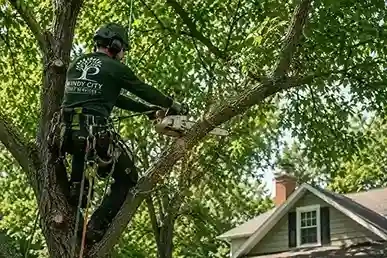
Every inspection and cut is led by a credentialed arborist, not a rotating subcontracted crew.
Decades-old boulevard oaks and maples require different judgment than young suburban plantings — we work on them regularly.
We know the access constraints on Western, Lincoln, and the residential side streets before we ever arrive on-site.
General liability and workers' comp coverage on every job, verifiable on request.
24/7 coverage for storm damage and hazardous leaning trees across the North Side.
Bucket trucks, aerial lifts, crane-assisted removal capability, and commercial stump grinders for every job type.
Lincoln Square sits at the crossroads of several North Side neighborhoods with similar mature canopy and streetscape characteristics — we serve all of them.
Yes. Prime Tree Care serves all of Lincoln Square, including the residential streets around Western, Lincoln, and Lawrence Avenues, as well as the boulevard corridors and side streets running toward Ravenswood and North Center.
Yes. Our crews are trained in utility vegetation management and safe clearance pruning near overhead service lines, common on Lincoln Square's older residential streets. For work directly on utility-owned equipment, we coordinate with the utility company as required.
Parkway trees — those planted between the sidewalk and the street — are owned and maintained by the City of Chicago's Bureau of Forestry. Trees anywhere else on your property are your responsibility as the homeowner.
We recommend a structural inspection every one to two years for large, mature boulevard trees, and sooner after any major storm event or if you notice deadwood, cracks, or canopy dieback.
Late winter through early spring, during the dormant season, is generally best for structural pruning on oaks and elms, since it reduces the risk of spreading oak wilt or Dutch elm disease compared to pruning during the growing season.
Yes. Lincoln Square's narrow lots, shared property lines, and limited alley access are common, and our crews plan removals around crane access, rigging, or sectional dismantling depending on the site.
If a tree or limb is threatening a structure, vehicle, or power line, keep people and pets away and call us for emergency response. For non-urgent damage, document it with photos for insurance purposes before scheduling cleanup.
Yes. An ISA-certified arborist can assess whether a declining or damaged tree can be treated and preserved, or whether removal is genuinely the safer, more cost-effective option.
Yes, Prime Tree Care offers 24/7 emergency tree service across Lincoln Square and the surrounding North Side neighborhoods for storm damage, fallen limbs, and hazardous leaning trees.
Cost depends on the tree's size, condition, and access. Small trees under 12 inches in diameter typically run a few hundred dollars, while large, mature boulevard-scale trees requiring crane access can run several thousand. We provide a written, itemized estimate after an on-site assessment. See our full Chicago tree removal cost guide.
Speak with an ISA-certified arborist who actually knows this neighborhood's canopy — same-day response for most requests.