 Prime Tree Care
Why Tree Removal Is More Dangerous Than Most Homeowners Realize
From the sidewalk, tree removal can look straightforward — cut it down, haul it away. In practice, it's one of the more hazardous trades a homeowner will ever hire for. A single job can involve:
- Falling limbs and sections — large pieces of wood, sometimes hundreds of pounds, being lowered or dropped in a controlled (or uncontrolled) manner
- Structural failures — decayed, storm-damaged, or diseased trees that can behave unpredictably under cutting stress
- Aerial lift and climbing work — technicians working 30, 60, sometimes 100+ feet above the ground
- Chainsaw hazards — one of the most injury-prone tools in any trade, especially at height
- Property damage exposure — roofs, fences, vehicles, and neighboring structures all within potential drop range
- Energized power lines — a hazard specific to tree work that few other home service trades encounter routinely
- Worker injuries — falls, struck-by incidents, and equipment-related injuries remain persistent risks industry-wide
Professional tree work isn't just cutting — it's a discipline that combines arboriculture (understanding how a specific tree species and condition will behave), rigging (controlling how and where cut sections fall or lower), heavy equipment operation, and active risk management, all happening simultaneously on a single job site.
Recognized industry safety data consistently identifies falls, struck-by incidents, aerial lift accidents, and contact with energized power lines among the leading hazard categories in tree-care operations — categories that OSHA specifically flags for the industry. This isn't meant to alarm homeowners; it's meant to explain why the qualifications of the crew standing in your yard matter as much as the price on the invoice.
The Biggest Reason Cheap Quotes Exist: Risk Is Being Priced Out
Tree companies don't operate on wildly different profit margins from each other — the raw cost of doing the job safely and correctly is fairly consistent across legitimate operators. When a quote comes in dramatically below the others, it's rarely because that company is simply more efficient. It's because something has been removed from the price:
- Insurance — general liability and workers' comp premiums are a real, ongoing cost that gets reflected in every quote
- Certified personnel — ISA-certified arborists and trained climbers cost more to employ than uncertified labor
- Specialized equipment — cranes, properly maintained bucket trucks, and rigging gear all carry ownership, rental, and maintenance costs
- Traffic control — cones, signage, and street coordination for jobs affecting sidewalks or parking
- Utility coordination — communicating with utility companies before work near power lines
- Crane access planning — assessing whether specialized equipment is genuinely needed rather than defaulting to whatever's cheapest
- Safety planning — a documented plan for how the specific tree will be dismantled safely
- Proper disposal — legal, responsible debris removal and disposal fees
Every item on that list is invisible on the day of the estimate — you can't see missing insurance or an uncertified crew just by looking at a business card. That's exactly why it's worth actively verifying these things rather than assuming they're included.
Crane Removal vs. "We'll Just Climb It"
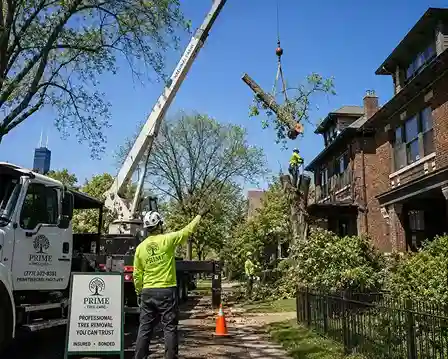
When a Crane Is Actually Necessary
- Trees over structures — where a controlled lift keeps sections from ever swinging toward a roof or wall
- Tight urban lots — common throughout Chicago, where there's simply no safe area to drop large sections
- Alley access issues — a frequent constraint on Chicago properties where equipment can't reach the backyard any other way
- Decayed trees — where the structural integrity needed for safe climbing and rigging can't be confirmed
- Storm-damaged trees — already compromised and unpredictable under additional cutting stress
- Limited drop zones — narrow side yards, close neighboring structures, or overhead utility lines that eliminate rigging options
Why Some Contractors Avoid Cranes
Crane rental and operator fees are a significant added cost — often a substantial portion of a job's total price on their own. A contractor trying to win the job on price alone has a direct financial incentive to avoid recommending one, even in situations where it's the safer choice.
⚠️ The Risk of Forcing a Non-Crane Removal
When a tree that genuinely calls for crane assistance is instead climbed and rigged down piece by piece to save cost, the risk profile changes substantially: increased chance of uncontrolled limb or section movement, greater property damage exposure to roofs, fences, and structures below, more worker exposure at height without the controlled lowering a crane provides, and elevated risk when the tree is anywhere near power lines, since rigging failures near energized conductors are especially dangerous.
In a dense Chicago neighborhood — narrow side yards, alley-only backyard access, mature trees overhanging garages and parkways — the margin for error on a rigged, non-crane removal is often much smaller than it would be on a spacious suburban lot. That's exactly the situation where cutting the crane out of the quote creates the most risk.
The Insurance Question Almost Nobody Asks
A legitimate tree service should carry several distinct types of coverage:
General Liability Insurance
Covers property damage caused during the job — a limb through a roof, a rigging failure that damages a fence, or a dropped section that hits a vehicle.
Workers' Compensation
Covers medical costs and lost wages if a worker is injured on your property. Without it, an injured worker (or their attorney) may look to the homeowner for compensation.
Commercial Auto Coverage
Covers company vehicles and trailered equipment — relevant if a truck or chipper causes damage while parked or maneuvering on your street.
Umbrella Policies
Additional liability coverage above standard policy limits, often carried by more established companies for higher-value or higher-risk jobs.
Why This Matters: Real Scenarios
- A limb damages your roof — general liability coverage is what pays for the repair, not your homeowner's policy by default
- A worker is injured — without workers' comp on the contractor's side, medical costs and liability can potentially extend to the property owner
- A neighbor's property is damaged — a rigging failure or misjudged drop zone can affect adjacent properties, not just your own
- A vehicle is damaged — parked cars near the work zone, including your own or a neighbor's, are exposed during removal work
How to Verify Tree Service Insurance
- Request a certificate of insurance (COI) — a legitimate company can produce this immediately, often by email, before the job starts
- Verify the dates — confirm the policy is currently active, not expired
- Verify the coverage limits — make sure the liability limits are reasonable for tree work, not a bare-minimum policy
- Confirm the business name matches — the insured name on the certificate should match the company you're actually hiring
- Call the carrier if needed — insurance certificates can be verified directly with the issuing carrier if you want extra confidence before a large job
✅ Quick Verification Checklist
Certificate provided without hesitation · Policy dates are current · Coverage limits look adequate for tree work · Business name matches exactly · Carrier contact info is legitimate and verifiable
Aerial Lifts, Bucket Trucks, and Power-Line Risks
Why Aerial Lift Work Is High Risk
Bucket trucks and aerial lifts position workers at height in a fixed, sometimes awkward position — different from climbing, where a technician can reposition more freely. Equipment malfunction, ground instability, or contact with overhead obstructions all carry serious consequences when a worker is elevated in a bucket.
Why Utility Clearance Work Is Different
Trees growing into or near power lines fall into a distinct category of tree work often called utility vegetation management or line-clearance work. This isn't standard tree trimming — it requires understanding minimum approach distances from energized conductors and specialized procedures most general tree crews aren't trained or equipped to handle safely.
Why Untrained Workers Should Never Work Near Energized Lines
Recognized safety guidance specifically identifies electrocution risk when limbs, branches, cranes, or aerial equipment contact live electrical conductors. Workers can be electrocuted not just through direct contact, but through equipment — a metal ladder, a wet rope, or an aluminum-handled tool — that conducts electricity from a line to the person holding it. Line-clearance tree work requires specialized training and strict separation distances from energized conductors, with significant additional precautions required whenever work occurs near power lines. This is precisely the kind of job where cutting corners to save money creates the most severe possible consequences.
In Chicago's older neighborhoods, dense overhead utility lines running through nearly every parkway make this a routine consideration, not an edge case — which is exactly why utility-aware procedures should be a standard part of any Chicago tree company's process, not an upsell.
Real Safety Incident Patterns Seen Across the Industry
Power Line Contact
Limbs, rigging lines, or equipment making contact with energized conductors during removal or trimming operations.
Falling Limbs
Sections or limbs falling outside the intended drop zone, often due to inadequate rigging or misjudged weight and balance.
Improper Rigging
Rope, hardware, or technique failures during the controlled lowering of cut sections.
Crane Misuse
Overloading, improper rigging attachment, or inadequate ground stabilization during crane-assisted removals.
Bucket Truck Incidents
Equipment tip-overs, boom failures, or contact with overhead obstructions during aerial lift operations.
Lack of Hazard Assessments
Jobs started without a documented review of tree condition, surrounding structures, and utility proximity before cutting begins.
Recognized safety investigations into fatal tree-care incidents have repeatedly documented cases involving falling tree sections, crane operations, aerial lifts, and contact with energized overhead lines during removal work. These patterns aren't presented to alarm homeowners — they're presented because nearly every one of them traces back to a preventable gap: missing training, skipped hazard assessment, inadequate equipment, or a decision to work faster and cheaper than the job safely allowed.
Red Flags Hidden Inside Cheap Estimates
- Cash-only pricing, with reluctance to provide any written documentation
- No written estimate at all — verbal pricing only
- No insurance documentation provided, or hesitation when asked
- No mention of arborist credentials or certifications
- No discussion of safety procedures, especially near structures or power lines
- An unusually fast timeline that doesn't allow for proper planning or permitting
- Refusal to provide references or past job examples
- Vague cleanup scope — unclear whether debris, chips, and logs are actually included
- Stump grinding not mentioned or excluded without explanation
- Disposal not clearly included in the price
Questions Every Homeowner Should Ask Before Hiring
- Are you insured?
- Can I see proof of insurance?
- Who supervises the job on-site?
- Is an ISA Certified Arborist involved in the assessment or work?
- Will a crane be used, and if not, why not?
- How do you protect nearby structures during the job?
- How do you handle proximity to power lines?
- Is cleanup included in the price?
- Is stump grinding included, or priced separately?
- Do you pull required permits for parkway or protected trees?
Why Professional Tree Work Sometimes Costs More
What that higher line item is actually paying for:
- Training — ongoing technical and safety training for climbers, ground crew, and equipment operators
- Insurance — general liability, workers' comp, and auto coverage that protects both the crew and your property
- Equipment — properly maintained chainsaws, rigging gear, chippers, and access to cranes and aerial lifts when needed
- Certified arborists — ISA-certified evaluation of tree condition and risk, not just a cutting estimate
- Risk reduction — planning that actively reduces the chance of property damage or injury, rather than hoping nothing goes wrong
- Documentation — written estimates, insurance certificates, and risk assessments you can reference later
- Compliance — permits and coordination with the Bureau of Forestry where parkway or protected trees are involved
- Proper disposal — legal, responsible handling of debris rather than an informal dump
Cheapest vs Best Value
| Question | Cheapest Quote | Best Value Quote |
|---|---|---|
| Lowest Price | Yes | Not always |
| Fully Insured | Maybe | Usually |
| Certified Arborist | Maybe | Often |
| Proper Equipment | Maybe | Yes |
| Safety Planning | Minimal | Comprehensive |
| Property Protection | Limited | High |
| Long-Term Risk | Higher | Lower |
How Prime Tree Care Approaches Tree Removal
ISA-Certified Evaluation
A certified arborist evaluates the tree's species, condition, and structural risk on-site.
Documented Risk Assessment
We formally assess proximity to structures, power lines, and access constraints before quoting.
Crane Evaluation
We determine honestly whether crane assistance is the safer approach — not just the cheaper one.
Utility Awareness
Power-line proximity is factored into planning from the start, not addressed as an afterthought.
Property Protection
Drop zones, ground protection, and structure safeguarding are planned before any cutting begins.
Insurance Verification
We provide documentation upfront — you shouldn't have to ask twice.
Transparent Proposal
Written estimates that clearly state what's included: cleanup, stump grinding, and disposal.
Documented Completion
A clear record of the work performed, useful for your own records or future reference.
Frequently Asked Questions
Why are tree removal quotes so different?
Why would one company be thousands cheaper?
Do I really need an insured tree company?
When is a crane necessary for tree removal?
What should a tree removal estimate include?
Are cheap tree services more dangerous?
Can I be liable if a contractor is uninsured?
How do I compare tree removal estimates fairly?
💡 Related Reading
Planning tree work? See our Tree Removal Cost Chicago guide, Do I Need a Permit to Remove a Tree in Chicago?, and What to Do About a Hazardous City Tree.