 Prime Tree Care
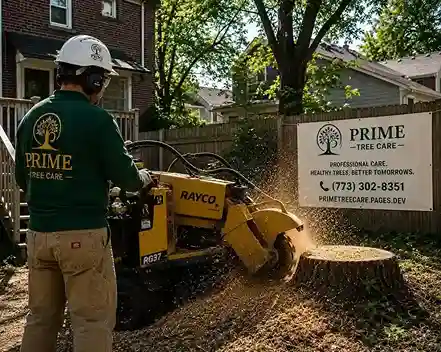
Introduction: The Confusion Almost Every Homeowner Runs Into
Most homeowners assume that once a tree is removed, the stump disappears with it. It's a completely reasonable assumption — the tree is gone, so why would a chunk of it still be sitting in the yard? But in reality, tree removal, stump grinding, and full stump removal are usually three separate services, each with different equipment, different labor requirements, and different pricing structures.
This disconnect is exactly why so many Chicago homeowners end up frustrated after a tree removal — the crew packs up, the tree is gone, and there's a stump sitting in the middle of the yard that wasn't part of the quote. Understanding the difference upfront — and knowing what fair Chicago pricing actually looks like — can save you from an unpleasant surprise, and in some cases save you hundreds of dollars by avoiding unnecessary services you don't actually need.
1. Stump Grinding vs Stump Removal: What's the Difference?
These two terms get used interchangeably by homeowners constantly, but they describe genuinely different jobs:
| Service | What Happens | Typical Cost | Most Common Choice |
|---|---|---|---|
| Tree Removal | Tree removed above ground | Varies by tree size | Yes |
| Stump Grinding | Stump ground below grade | Lower cost | Most common |
| Full Stump Removal | Entire root ball excavated | Highest cost | Rare |
Stump Grinding
- Grinds the stump 8–12 inches below grade using a specialized grinding wheel
- Roots remain underground and gradually decompose over time
- Faster to complete — usually under an hour for an accessible stump
- Causes significantly less lawn and soil disturbance
Full Stump Removal
- Entire root system is physically excavated from the ground
- Requires a large excavation pit, often several feet wide and deep
- Needs heavier equipment — sometimes an excavator rather than a stump grinder
- Leaves significant restoration work: backfilling, grading, and often reseeding or sod
Because of the extra equipment, labor, and restoration involved, full stump removal often costs two to three times more than grinding. For the vast majority of homeowners — unless you're planning new construction, a pool, or extensive hardscaping directly over the old root zone — grinding is the more practical and cost-effective choice.
2. Why Isn't Stump Grinding Included in Tree Removal?
This is the piece most competitor pricing pages gloss over. The short answer: tree removal and stump grinding require different equipment and different crews, which makes bundling them by default impractical for most tree companies.
🪓 Tree Removal Equipment
Bucket trucks, aerial lifts, rigging systems, chainsaws, and sometimes cranes for larger or hazardous trees — all focused on taking the tree down safely, in pieces, from the top down.
⚙️ Stump Grinding Equipment
A dedicated stump grinder — a completely different machine that has to be trailered in separately, often requiring its own mobilization trip and sometimes a different technician or crew altogether.
Because stump grinding is essentially a second job with its own setup cost, most companies separate it into its own line item rather than folding it into the tree removal price. This isn't necessarily a hidden fee or a bait-and-switch — it's usually just an accurate reflection of the extra time, equipment, and labor involved. The problem is that many companies don't explain this clearly upfront, which is exactly what leaves homeowners confused when the stump is still sitting there after the tree is gone.
3. Average Stump Grinding Costs in Chicago
Here are realistic Chicago-area planning ranges based on stump diameter, measured at the widest point:
| Stump Size | Typical Price Range |
|---|---|
| Under 12" | $150–$200 |
| 12–24" | $200–$300 |
| 24–36" | $300–$400 |
| 36"+ | $400–$600+ |
ℹ️ These Are Planning Ranges, Not Guaranteed Quotes
Actual pricing depends on species, root spread, access, and add-ons discussed below. Use these ranges to sanity-check quotes you receive — not as a substitute for an actual on-site estimate.
4. What Actually Determines Stump Grinding Cost?
Stump Diameter
This is the single largest pricing factor. Many companies price per diameter inch (for example, $2–$4 per inch with a minimum job charge), which is why the size tables above scale the way they do — a 30-inch oak stump simply takes a lot more grinding time and wheel wear than an 8-inch ornamental tree stump.
Root Spread
Surface roots extending well beyond the visible stump increase grinding time significantly, since a thorough job typically involves grinding out major surface roots radiating from the base, not just the stump itself.
Tree Species
Wood density varies enormously by species. Dense hardwoods like oak and hickory take substantially longer to grind than softer woods, while species like maple and ash fall in the middle, and pine grinds comparatively quickly.
Access
Stump grinders are heavy, wheeled machines that need a path to the stump. Backyard gates, fenced yards, narrow Chicago alley access, and sloped or hillside terrain can all add time — or in some cases require a smaller, specialized machine that costs more to operate per hour.
Depth Requirements
Standard grinding depth is 8–12 inches below grade, which is sufficient for lawns and most general landscaping. Additional depth is often requested — and priced as an add-on — near patios, driveways, foundations, or anywhere a new tree will be planted in roughly the same spot.
5. Chicago-Specific Cost Factors
Chicago's dense, older housing stock creates cost factors you simply won't see in a suburban or rural pricing guide.
🏙️ Dense Urban Lots
In neighborhoods like Lincoln Square, Lakeview, and Wicker Park, tight side-yard access and small lot sizes can require smaller equipment or manual supplemental work, adding to labor time.
🌳 Boulevard & Parkway Trees
Parkway-adjacent stumps can involve sidewalk proximity and public right-of-way access considerations that affect how equipment gets staged and maneuvered.
🚗 Alley Access
A distinctly Chicago issue — many backyards are only reachable via narrow alleys, which can determine whether a full-size grinder fits or a smaller machine is required.
🏛️ Historic Neighborhoods
In areas like Oak Park, Hyde Park, and Evanston, mature legacy stumps tend to be larger in diameter, and property owners often want extra care taken around landscaping and hardscaping.
⚡ Utility Conflicts
Older Chicago blocks can have gas, electric, water, and fiber lines running closer to the surface near parkway and yard stumps, sometimes requiring utility locating before grinding can begin safely.
6. Stump Grinding Cost by Tree Type
Wood density directly affects how long a stump takes to grind — and therefore what it costs:
| Tree Species | Typical Difficulty |
|---|---|
| Ash | Moderate |
| Maple | Moderate |
| Honey Locust | Moderate |
| Oak | High |
| Hickory | Very High |
| Pine | Low |
As a general rule, denser hardwoods dull grinding wheels faster and take longer per inch of diameter, which is why an oak or hickory stump of the same size as a pine stump will typically cost more to grind.
7. Multi-Stump Discounts
Many companies — including Prime Tree Care — offer per-stump discounts when grinding 2 or 3 stumps in the same visit, or when handling a full property cleanup with several stumps at once. This isn't just a sales tactic: mobilization is one of the larger fixed costs in a stump grinding job, since getting the grinder trailered in, staged, and set up takes real time regardless of how many stumps get ground once it's there. Spreading that fixed cost across multiple stumps genuinely lowers the effective price per stump, so it's always worth asking about a bundled rate if you have more than one to deal with.
8. Additional Charges Homeowners Often Miss
This is where quote comparisons get tricky — two quotes for the "same job" can vary by hundreds of dollars simply because they include different things:
| Possible Add-On | Why It Matters |
|---|---|
| Wood Chip Removal | Grinding produces a large pile of chips — hauling them away is often a separate charge |
| Root Grinding | Grinding out surface roots beyond the main stump adds time and cost |
| Soil Backfill | Filling the ground depression with topsoil rather than leaving loose grindings |
| Sod Installation | Restoring lawn coverage over the ground area after backfilling |
| Regrading | Leveling the area, especially important for larger stumps |
| Utility Marking | Required in some situations before grinding near underground lines |
| Tight Access Equipment | Smaller specialized grinders for gated yards or alley-only access |
| Weekend Service | Some companies add a premium for scheduling outside normal weekday hours |
Comparing quotes fairly means understanding exactly which of these are included in the base price — a cheaper quote that excludes cleanup and backfill can easily end up costing more once you add those services back in separately.
9. Can You Plant a New Tree After Stump Grinding?
Yes — but with some preparation. A ground stump leaves behind wood chips and old root material that can temporarily tie up soil nitrogen as they decompose, along with remnants of the old root system that may still be in the way of a new planting hole.
- Remaining roots: Large structural roots may still be present below the grinding depth and can interfere with digging a new planting hole in the exact same spot
- Soil quality: Amending the area with fresh topsoil helps offset the nitrogen drawdown from decomposing wood chips and roots
- Placement considerations: Many arborists recommend offsetting a new tree slightly from the old stump's center, rather than planting in the exact same spot, to avoid old root conflicts and soil compaction issues
If replanting is the goal, it's worth mentioning that upfront — request to have the stump ground a bit deeper than standard, since deeper grinding gives a new tree's root system more clean soil to establish in. Our Tree Planting & Transplanting team can help plan species selection and placement for the new tree.
10. Is Stump Grinding Worth It?
For most Chicago homeowners, yes — and here's why people who initially skip it often come back to it years later:
- Safety: Stumps are a common tripping hazard, especially in yards used by kids, pets, or during mowing
- Appearance: A ground stump area can be reseeded or landscaped, while a raw stump remains a visible eyesore indefinitely
- Property value: A cleaned-up yard reads better to buyers and appraisers than a yard with visible old stumps
- Lawn maintenance: Mowing around a stump is a recurring annoyance that grinding eliminates entirely
- Pest prevention: Decaying stumps can attract termites, carpenter ants, and other wood-boring pests that may eventually move toward nearby structures
- Landscaping flexibility: Grinding opens the area back up for grass, garden beds, or a new tree, rather than leaving a permanent obstacle
11. Common Chicago Scenarios
Lincoln Square Backyard Oak
A large hardwood oak stump in a fenced Lincoln Square backyard requires narrow-gate equipment access, pushing the job toward the higher end of the large-stump price range due to both diameter and access constraints.
Hyde Park Historic Property
A homeowner near Hyde Park's historic district wants the surrounding landscaping carefully preserved during grinding, which calls for a more deliberate, lower-impact approach than a standard job.
Mount Greenwood Multiple Stumps
After storm cleanup leaves several downed trees on a Mount Greenwood property, grinding all the resulting stumps in a single visit qualifies for a multi-stump discount, lowering the effective cost per stump.
Evanston Mature Parkway Tree
A mature parkway tree stump near an Evanston sidewalk needs city coordination before grinding, plus deeper grinding if a replacement tree is planned for the same general location.
Schaumburg New Construction Lot
A Schaumburg homeowner preparing a lot for new landscaping opts for full stump removal rather than grinding, since the area will be excavated for hardscaping anyway.
12. How to Compare Stump Grinding Quotes
This is one of the most valuable things you can do before hiring anyone — the cheapest quote on paper often excludes key work that gets added back as a surprise charge later. Before comparing prices, confirm each company answers these the same way:
- Is cleanup of wood chips and debris included in the price?
- Is haul-away of the chips included, or will they be left on-site?
- How deep will they grind — standard 8–12 inches, or deeper?
- Are surface roots beyond the stump included in the grinding?
- Is soil backfill included, or will there be a depression left behind?
- Is the company's insurance verified, in case of property damage?
- Does the quote assume standard equipment access, or has the crew seen your actual access constraints?
⚠️ Why the Cheapest Quote Is Often Risky
A rock-bottom quote that excludes cleanup, haul-away, and backfill can end up costing more once those services are added back in — and by then you're negotiating from a weaker position with equipment already on-site. Ask for a written, itemized quote before work begins. Read more in our guide: Why the Cheapest Tree Quote Is Risky.
13. DIY Stump Grinding vs Professional Service
Rental stump grinders are available at most Chicago-area equipment rental yards, and for a very small, accessible stump, DIY can be a reasonable option. But it's worth weighing the full picture first:
🔧 DIY Stump Grinding
- Equipment rental typically runs $100–$200+ per day, which can approach professional pricing for a single stump
- Grinders are genuinely dangerous — thrown debris and kickback are real risks without proper training
- Hidden utilities (gas, electric, water, fiber) are a serious concern without professional utility locating
- Property damage risk to fences, siding, or hardscaping is higher without experience
- There's a real learning curve — inexperienced operators often take far longer than a professional crew
🌲 Professional Service
- ISA-certified arborists and trained crews bring experience with Chicago's specific soil and species conditions
- Proper insurance coverage protects your property if something goes wrong
- Right-sized equipment for your specific access situation, rather than a one-size-fits-all rental unit
- Cleanup, haul-away, and backfill can be bundled into one visit
- Faster completion — usually well under an hour for a standard stump
For a single small stump in an open, easily accessible area, DIY can make financial sense if you're comfortable with the equipment. For anything larger, near utilities, in a tight urban lot, or where you want cleanup and restoration handled in one visit, professional service is almost always the more practical choice once rental cost, time, and risk are factored in honestly.
14. Frequently Asked Questions
How much does stump grinding cost in Chicago?
Is stump grinding included with tree removal?
Is stump removal different from stump grinding?
How deep should a stump be ground?
Can I plant a tree where a stump was?
Do roots keep growing after grinding?
How long does stump grinding take?
Does stump grinding damage my lawn?
Is it cheaper to grind or remove a stump?
Should I remove every stump on my property?
💡 Related Reading
Planning a larger project? See our Tree Removal Cost Chicago guide, Tree Trimming Cost Chicago guide, and Why the Cheapest Tree Quote Is Risky.