
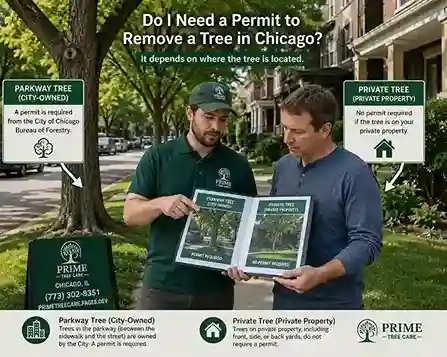
If you're asking this question, you're almost certainly staring at a real tree right now — maybe one that's dead, storm-damaged, growing into your foundation, or just in the way of a project — and you want a straight answer before you call anyone or spend any money. This guide gives you that answer, in plain English, with the Chicago-specific detail that generic tree-service content leaves out.
Chicago Tree Permit Quick Answer Table
Start here. Find your situation, and you'll have your answer in seconds.
| Situation | Permit Needed? | Who Owns Tree? | Who Handles Removal? |
|---|---|---|---|
| Tree entirely on private property | Usually No | Homeowner | Homeowner |
| Parkway tree | City authorization required | City of Chicago | Bureau of Forestry |
| Tree touching power lines | Utility coordination may be required | Depends | Utility + Arborist |
| Property-line tree | Depends | Shared ownership possible | Both parties |
| Emergency storm damage | Special circumstances | Depends | Emergency response |
Important Disclaimer
Tree ordinances, permitting thresholds, and municipal procedures can change, and specific suburbs outside Chicago proper may have entirely different rules (some require permits at 6" trunk diameter, others at 8", with different protected-species lists). This guide reflects general Chicago city practice; always confirm specifics with the Bureau of Forestry or your local municipality before proceeding, especially for anything beyond a small private tree.
The Most Important Question First: Is It a Parkway Tree or a Private Tree?
Before any question about permits, cost, or which company to hire, there's one distinction that determines everything else: does the tree belong to you, or does it belong to the City of Chicago? This single fact changes who's legally allowed to remove it, who pays, and what process applies.
This matters more than most homeowners expect, because the confusion runs in a very specific direction: residents almost always assume a tree in front of their house belongs to them, since it's on "their" side of the sidewalk and they've been the ones raking its leaves and mowing around it for years. In reality, a huge share of the trees homeowners consider "theirs" are actually parkway trees — city property sitting in the public right-of-way, simply located adjacent to a private lot.
Example: A homeowner in Avondale wants to remove a large, aging tree because it's dropping heavy branches near their front walk. They assume it's their tree since it's directly in front of their house and inside what looks like their yard. In reality, the tree sits in the parkway strip between the sidewalk and the street — meaning it's a City of Chicago tree, and removing it without authorization would mean removing public property without permission.
What Is a Parkway Tree?
A parkway tree is any tree planted in the strip of land — typically grass, sometimes just bare ground — that sits between the public sidewalk and the street curb. This strip is part of the public right-of-way, which means it's technically city land, even though it visually reads as part of a homeowner's frontage.
Parkway trees are managed by the City of Chicago's Bureau of Forestry, a division of the Department of Streets and Sanitation. Their responsibilities over parkway trees include:
- Planting new parkway trees, including species selection
- Routine pruning on a rotating maintenance cycle
- Removals when a parkway tree is dead, dying, diseased, or hazardous
✓ How to Tell If a Tree Is in the Parkway
- It's located between the public sidewalk and the street curb, not behind the sidewalk on your lot
- It's within the strip of grass or bare ground that the city, not you, is responsible for mowing edges of near the curb in many areas
- It lines up with other similarly-spaced trees along the block in a consistent row — a strong sign of a planned city planting
- Your property survey or plat (if you have one) shows the property line starting behind the sidewalk, not at the curb
- When in doubt, you can request a boundary check informally by comparing your lot survey to the tree's location, or ask the Bureau of Forestry directly via 311
Can I Remove a Tree on My Own Property?
If a tree is located entirely within your private property boundary — behind the sidewalk, within your fenced yard, or elsewhere on your lot — you generally do not need a city permit to remove it. As the property owner, you have the legal right to decide what happens to trees fully within your boundary lines.
That said, a few practical considerations still apply:
- Hire a licensed, insured contractor. Removal, especially of large trees, carries real safety risk and potential liability for property damage. A licensed and insured tree company protects you if something goes wrong during the job.
- Check your homeowners insurance if the removal is related to storm damage, since some policies cover tree removal costs when a tree has fallen or poses documented risk to a structure.
- Confirm your municipality if you're outside Chicago proper. Some suburbs require permits for private tree removal above a certain trunk diameter (often 6–8 inches), or have protected/heritage tree ordinances that don't exist within the city itself.
Regulations Can Change
This guide reflects Chicago's general practice as of publication. Ordinances are occasionally updated, and neighboring suburbs frequently have their own distinct rules. When in doubt on anything beyond a straightforward small private tree, a quick call to your municipality or the Bureau of Forestry costs nothing and prevents a costly mistake.
When Chicago Homeowners Commonly Get Confused
Beyond the basic parkway-versus-private distinction, several recurring situations trip people up:
The Tree Appears Inside the Property Line, But Isn't
Especially on older Chicago lots, the visual property line (fence, hedge, edge of lawn) doesn't always match the legal survey line. A tree that looks like it's on your side of an informal boundary may still fall within the public right-of-way once an actual survey is checked.
A Tree Planted by a Previous Owner
Ownership of a private tree transfers with the property — if a previous owner planted a tree entirely on the lot, it's now yours to manage, regardless of who planted it. This is different from a parkway tree, which was never privately owned regardless of who requested or planted it originally.
Trees Near the Alley
Chicago's alley system has its own right-of-way considerations. A tree near an alley may be on private property, but access constraints for equipment (crane placement, truck access) are often affected by the alley itself, which is separate from the ownership question.
Trees Near a Utility Easement
An easement grants a utility company certain rights to access or clear vegetation around their equipment, even on private property. A tree within a utility easement may be subject to utility vegetation management requirements distinct from standard city permitting.
Shared Ownership Trees
A tree trunk growing directly on or very close to a property line can create shared ownership between neighbors under general tree law principles, meaning removal decisions may require mutual agreement. See our full breakdown in Tree Law: Chicago Neighbor Disputes.
HOA Misunderstandings
If your property is part of an HOA, the association's covenants may impose additional restrictions on tree removal beyond city rules, even for a tree that is otherwise entirely private and unregulated by the city itself. Always check your HOA documents separately.
What Happens If a Parkway Tree Is Dead?
If you believe a parkway tree in front of your home is dead or dying, here's the realistic process:
- Report it through CHI311 — via the app, website, or by phone — describing the condition and including photos.
- Bureau of Forestry review — Staff assess your report and assign a priority level based on hazard indicators, not just general appearance.
- Inspection — A field inspector evaluates the tree's actual condition on-site.
- Replacement decision — If removal is warranted, the city typically schedules it, and may plan a replacement planting later, often as part of species-diversification efforts following losses to Emerald Ash Borer.
Realistic timelines vary considerably based on current priority queue and storm-related backlogs — read our full breakdown in the City of Chicago Tree Trimming Grid System guide for a detailed explanation of why routine requests can take considerable time.
Can I Hire My Own Tree Company To Remove A Parkway Tree?
This is one of the most frequently asked questions, and the direct answer is: not without city authorization.
Because parkway trees are city-owned public property, a private contractor removing one without proper authorization is, functionally, removing city property without permission — regardless of good intentions. This creates real exposure for both the homeowner and the contractor:
- Liability concerns: Unauthorized removal of city property can expose the homeowner to municipal fines or replacement-cost liability.
- Permitting confusion: Even reputable, licensed tree companies won't take on unauthorized parkway removal jobs, since it puts their own license and insurance at risk.
- Why authorization matters: The city's process exists in part to ensure a genuinely hazardous or dead tree is properly assessed (and potentially replaced) rather than removed based solely on a homeowner's private preference.
If you want a parkway tree gone — dead, hazardous, or simply inconvenient — the correct path is a 311 report requesting city assessment, not a private contractor showing up with a chainsaw.
What About Emergency Situations?
Emergencies change the calculus somewhat, though ownership still matters:
- Storm-damaged or fallen trees: If a parkway tree has already fallen or is actively failing, report it as an emergency through 311 immediately. City emergency response is generally fast for trees blocking roads or posing immediate danger.
- Leaning trees threatening a structure: Whether private or parkway, a leaning tree threatening your home warrants urgent attention — for a private tree, you can act immediately; for a parkway tree, report it as a hazard for expedited city response.
- Downed limbs and blocked roads: These are treated as public-safety emergencies and generally bypass the routine grid-rotation queue entirely.
- Trees near energized power lines: Treat this as an emergency regardless of ownership — see the dedicated section below.
In a genuine emergency involving a private tree on your own property, you can act immediately without waiting on anyone. For anything involving a parkway tree, even in an emergency, report through 311 first, since city crews and equipment are typically better positioned to safely handle work in the public right-of-way, particularly near roads and utility infrastructure.
Property-Line Trees and Neighbor Disputes
When a tree trunk straddles or sits directly on a property line, ownership can become genuinely shared between neighbors under general tree-law principles, which typically means removal decisions require mutual agreement rather than one owner acting unilaterally. Key considerations:
- Shared ownership: If both neighbors' land contributes to where the trunk actually stands, both may hold a legal interest in the tree.
- Liability: If a shared or neighbor's tree causes damage to your property, liability often depends on whether the tree's condition was reasonably known beforehand.
- Documentation: Photos, written correspondence with your neighbor, and a professional risk assessment all strengthen your position if a dispute arises.
- Professional assessments: An independent, ISA-certified arborist opinion can help resolve disagreements about a tree's health or hazard level before it becomes a legal dispute.
For a full breakdown of liability, cost-sharing, and documentation strategy, see our dedicated guide: Tree Law: Chicago Neighbor Disputes.
Trees Near Power Lines
⚠ Safety First
If a tree or limb is in contact with an energized power line, treat it as an emergency immediately. Keep people and pets well away from the tree, the ground beneath it, and any nearby metal objects, since electrical current can travel through a tree's trunk and root system. Do not attempt to cut, move, or touch any part of the tree yourself.
Overhead utility lines running through mature canopy are common throughout Chicago's older residential streets, and pruning near them requires specific utility vegetation management training and clearance protocols — this isn't standard homeowner or even general tree-service work.
Who to call:
- If a line is visibly down, sparking, or arcing — call 911 and ComEd immediately.
- For non-emergency line-clearance concerns around a healthy but encroaching tree, ComEd's vegetation management program typically handles clearance around their own equipment.
- For the tree itself (private property, non-utility-line portions), an ISA-certified arborist experienced in utility-adjacent pruning is the appropriate contact.
Common Chicago Scenarios (Direct Answers)
Chicago Tree Ownership Decision Flow
Use this simple flow to determine your situation:
1. Is the tree between the sidewalk and the street?
→ Yes: It is very likely a parkway tree, owned by the City of Chicago. City authorization is required for removal. Skip to step 4.
→ No: Continue to step 2.
2. Is the tree fully within your private property boundary?
→ Yes: It's a private tree. You generally do not need a city permit to remove it. Continue to step 3.
→ No (it straddles a property line): It may be a shared property-line tree. See the Property-Line Trees section above.
3. Is it located outside Chicago proper, in a suburb?
→ Yes: Check your specific municipality's ordinance, since permit thresholds and protected-species rules vary by suburb.
→ No: Proceed with a licensed, insured contractor. No city permit is typically required.
4. Is the situation an emergency (fallen, hazardous, blocking a road)?
→ Yes: Report immediately through 311 as an emergency hazard.
→ No: Submit a standard 311 request describing the tree's condition, and expect standard grid-rotation timelines.
Why Homeowners Request Private Arborist Inspections Before Contacting The City
Even when a tree is clearly a parkway tree that only the city can ultimately remove, many Chicago homeowners choose to get an independent inspection first. This isn't about bypassing the city — it's about being prepared:
- Documentation: A written, professional assessment creates a clear, timestamped record of the tree's condition, useful if the situation worsens before the city responds.
- Hazard and risk assessment: An ISA-certified arborist can identify structural defects, decay, or root issues that aren't obvious to an untrained eye, helping you accurately describe the urgency in your 311 report.
- Insurance records: If a tree does cause damage before the city acts, having a prior professional assessment on file can matter significantly for an insurance claim.
- Supporting evidence for escalation: A documented risk assessment gives you something concrete to reference if you need to follow up with 311 or your alderman's office about a stalled request.
Why Homeowners Call Prime Tree Care First
We're not able to remove a parkway tree without city authorization, and we'll always tell you honestly when that's the case. What we can do is give you a clear, ISA-certified assessment of whether a tree is genuinely hazardous, help you understand whether you're even dealing with a parkway or private tree in the first place, and provide the documentation that makes your 311 report — or your insurance claim, if it comes to that — far stronger than a homeowner's own description alone.
Frequently Asked Questions
Do I need a permit to remove a tree in Chicago?
In most cases, no permit is required to remove a tree located entirely on your private property. Parkway trees, however, are owned by the City of Chicago and cannot be removed by a homeowner or private contractor without authorization from the Bureau of Forestry.
Who owns parkway trees in Chicago?
The City of Chicago owns parkway trees — those planted in the strip between the sidewalk and the street — and manages them through the Bureau of Forestry, even though they sit directly in front of a private residence.
Can I hire a private company to remove a city tree?
No, not without city authorization. A private tree company cannot legally remove a parkway tree on a homeowner's request alone, since the tree is city property. Removal requires going through the Bureau of Forestry's process.
Can I remove a dead tree from my property?
If the dead tree is entirely on your private property, you can typically have it removed without a city permit, though hiring a licensed, insured tree service is strongly recommended. If it's a parkway tree, it must go through the city instead.
What if a city tree is dangerous?
Report it immediately through CHI311 as a hazard. Genuinely dangerous parkway trees — split trunks, visible uprooting, limbs threatening a structure — are prioritized ahead of routine city requests.
How long does city tree removal take?
It depends heavily on priority level. Genuine emergencies are typically addressed quickly, while routine parkway tree removal requests can take months, since they compete with the Bureau of Forestry's broader grid-based workload and any recent storm backlog.
Can a homeowner trim a parkway tree?
Generally, no. Parkway trees are city property, and pruning or trimming them without authorization isn't permitted, even though the tree sits directly in front of a private home.
What happens if roots damage my sidewalk?
If the damage is caused by a parkway tree's roots, it typically falls under the city's sidewalk repair and forestry coordination process, since the tree itself is public infrastructure. Document the damage with photos and report it through 311.