Southwest Side Chicago · Service Area
Professional Tree Care for Brighton Park Homes, Yards, and Property Improvement Projects
Prime Tree Care's ISA-certified arborists serve Brighton Park's residential blocks, from Archer Avenue to the neighborhood's quieter side streets. We handle tree trimming, removal, health inspections, stump grinding, and emergency storm response — sized for the tight lots, alley access, and mature shade trees that define this neighborhood.
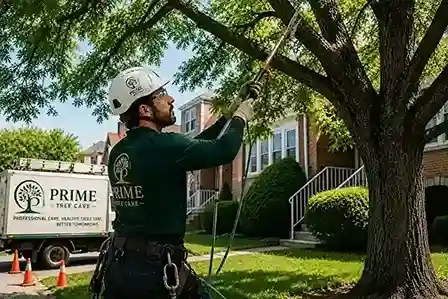
Prime Tree Care provides tree removal, trimming, health inspections, stump grinding, and emergency storm response throughout Brighton Park on Chicago's Southwest Side. Brighton Park's mix of mature shade trees, tight urban lots, and active home-improvement projects means tree work here has to account for close property lines, alley access, and parkway trees — not just cut and go. Call today for a property consultation with an ISA-certified arborist.
Section 1
Tree service demand in Brighton Park looks different from the rest of the city. Between its bungalow-lined blocks, ongoing home improvement, and mature parkway canopy, most calls we get here fall into three categories.
Homeowners typically bring us in when they're:
Professional tree care ahead of these projects protects usable yard space, improves safety around work crews, and supports long-term tree health once construction wraps up.
Brighton Park's older blocks carry decades-old shade trees — many planted before the homes around them were remodeled. Overgrown canopies, aging limb structure, and root systems pushing against foundations or sidewalks are common. Regular inspections catch structural defects and decay before they become an expensive emergency.
Close property lines, neighboring garages, alleys, and fences are the rule on Brighton Park lots, not the exception. That changes how a tree gets pruned or removed — access planning, rigging, and drop-zone control matter more here than on a wide-open suburban yard.
Section 2
These are the issues our crews encounter most often on Brighton Park service calls.
Limbs crowding the roofline, garage, walkway, or driveway are the most common safety call in the neighborhood. Watch for branches scraping the roof in wind, limbs blocking vehicle access, or cracking sounds during storms.
Summer thunderstorms, straight-line winds, and heavy snow loads regularly break limbs across Brighton Park's older canopy. Broken but still-attached limbs (hangers) are an emergency priority — they can fall without warning.
Ash trees on Brighton Park parkways and private lots continue to decline from EAB. We evaluate whether treatment or removal makes sense, and plan replacement species that won't repeat the problem. Full EAB guide →
Internal decay, structural defects, and canopy thinning are common in Brighton Park's mature trees. A visual and structural risk assessment tells you whether a tree needs pruning, cabling, or removal.
Sidewalk lifting, foundation cracking near garages, and lawn damage from surface roots show up often on Brighton Park's smaller lots. Root management — pruning, barriers, or in some cases removal — protects the structure without necessarily losing the tree.
Section 3
Diagnosis
Risk assessments, disease diagnosis, canopy evaluations.
View service →
Structure
Structural pruning, clearance pruning, curb appeal improvements.
View service →
Removal
Hazardous removal, tight-access removal, renovation prep.
View service →
Storm Response
Storm cleanup, fallen trees, emergency response.
View service →
Growth
Replacement planting, species diversification.
View service →
Nutrition
Root-zone improvement, nutrient management.
View service →
Protection
Cabling, bracing, storm resilience planning.
View service →
Restoration
Yard restoration, renovation prep, hazard elimination.
View service →
Section 4
Tree work in Brighton Park rarely happens in isolation — it's usually tied to a bigger property goal. Here's how it connects.
Pruning opens sightlines to the front of the house, cleans up visual clutter from deadwood and crossing limbs, and lets landscaping underneath actually get sunlight — small changes that read immediately from the sidewalk.
Buyers and inspectors notice overgrown or hazardous trees. A pre-listing inspection, hazard removal, and cleaned-up exterior presentation remove a common objection before it comes up in negotiations.
Before crews and equipment arrive, we help identify which trees are worth protecting, clear what's in the way of the work area, and handle stump removal and site prep so the project starts on schedule.
Routine tree maintenance protects the things a Brighton Park property owner has already paid for — the garage, the sidewalk, the landscaping, and the home's resale value — by catching problems while they're still cheap to fix.
Section 5
Reliable shade and fall color; watch for included bark at branch unions and surface roots on small lots.
Long-lived and structurally strong; needs dormant-season pruning to limit oak wilt transmission risk.
Widely planted historically, now under heavy EAB pressure; treatment vs. removal is a case-by-case call.
Common street and yard tree; light canopy is easy to live under but still needs structural pruning as it matures.
Tough and adaptable to urban soil; prone to witches'-broom growth and occasional limb drop with age.
Some surviving mature elms remain on older blocks; Dutch elm disease monitoring is important for these.
Crabapple and similar species common in front yards; benefit from light structural pruning and disease watch.
Spruce and arborvitae used for privacy screening; need different pruning timing than deciduous shade trees.
Section 6
Removal planning in Brighton Park has to account for conditions a generic city-wide crew often misses.
Safe removal planning starts with a tree risk assessment. Depending on access, we use bucket trucks, aerial lifts, or crane-assisted removal when a tight lot leaves no safe rigging path.
Section 7
We walk the property and talk through your goals, whether it's safety, curb appeal, or a renovation timeline.
A full assessment of canopy, structure, and root condition for every tree in question.
We identify structural defects and rank hazard priority using ISA-based risk assessment methods.
A clear plan covering preservation, pruning, or removal, with root management notes where relevant.
Canopy management, pruning, or removal carried out with equipment matched to your lot's access constraints.
Full site cleanup, plus a maintenance timeline for the trees that remain.
Section 8
Every assessment is led by a certified arborist, not a sales estimator.
We work Brighton Park's tight lots and alley access every week.
We plan tree work around your renovation, sale, or landscaping timeline.
Liability and workers' comp coverage on every job.
Fast response for fallen limbs and storm-damaged trees.
Bucket trucks, aerial lifts, stump grinders, and crane-assisted removal when needed.
Section 9
Prime Tree Care covers Brighton Park and the surrounding Southwest Side and city-wide area.
See the full list of neighborhoods and suburbs on our Chicago service areas hub →
FAQ
Yes. We regularly service Brighton Park's residential blocks, including tight-lot properties, alley-access yards, and parkway trees along the neighborhood's main corridors.
Yes. Clearing dead wood, raising the canopy off the roofline, and opening sightlines to the front of the house are some of the fastest, most affordable improvements to a Brighton Park property's curb appeal.
Warning signs include large dead limbs, fungus at the base, a leaning trunk that's new or worsening, cracks in the trunk or major limbs, and root damage near a foundation or garage. An ISA-certified arborist can assess whether the tree is a removal or a treatment case.
Yes, and we recommend it. A pre-renovation inspection identifies which trees are worth protecting during construction, which are in the way of planned work, and what root protection is needed before equipment moves onto the lot.
Stay clear of any limb or tree in contact with power lines and call ComEd or 911 immediately. For everything else, call us for emergency assessment and cleanup; broken limbs and split unions should be addressed quickly to prevent further failure.
Yes. We respond to storm damage, fallen limbs, and hazardous leaning trees on Brighton Park's residential streets and alleys.
Yes, particularly on Brighton Park's smaller lots where mature trees sit close to sidewalks, garages, and foundations. Root management and, in some cases, root pruning or barrier installation can reduce the risk.
We recommend a professional inspection every 1–2 years for mature shade trees, and sooner after any major storm or nearby construction.
It's not required, but it's strongly recommended on small urban lots like those common in Brighton Park, where a leftover stump limits usable yard space and complicates any landscaping or renovation plans.
Cost depends on trunk diameter, height, and access, since many Brighton Park lots require careful alley or tight-space removal. See our full Chicago tree removal cost guide for current ranges.
ISA-certified arborists who know the neighborhood's lots, access points, and parkway trees.
