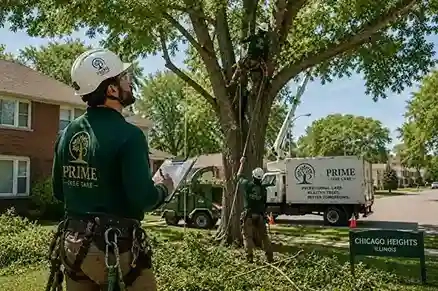
Certified Arborists Handling Hazardous Tree Removal, Risk Assessments & Storm Damage Prevention on the South Side's Industrial-Residential Corridor
Chicago Heights isn't a leafy North Shore suburb — it's a mix of aging shade-tree canopy on Hungry Hill and the East Side, active rail and industrial corridors along Route 1, and older housing stock where a failing limb can just as easily land on a garage, a fence line, or a live utility drop. Our ISA-certified arborists build every recommendation around that reality: tree risk assessment first, hazardous tree removal when a tree is genuinely past saving, and utility-aware pruning everywhere else.
The most common tree services requested in Chicago Heights are hazardous tree removal, storm-damage cleanup, and clearance pruning around structures and overhead utility lines — driven by the city's aging silver maple and ash canopy. Tree health inspections, stump grinding, and emergency 24/7 response round out the top requests, especially after high-wind events along the Route 30 corridor.
Chicago Heights sits at the intersection of three very different property types, and each one changes what "good tree care" actually means here.
Hungry Hill, the East Side, and the Country Club neighborhood carry mature shade trees planted in the mid-1900s. Decades of deferred maintenance mean many of these canopies now need structural pruning, not just a light trim, to stay safe.
The stretch along East Lincoln Highway and the rail-adjacent industrial parks near the old steel and stamping plants means large open lots where sightlines, safety compliance, and tree clearance for equipment and truck traffic take priority over ornamental shaping.
US‑30 (Lincoln Highway), US‑1 (Dixie Highway/Chicago Road), and the Metra Electric line all cut through the city, which means more trees growing close to easements and overhead power lines. Our crews plan utility-aware pruning and coordinate around energized lines by default here — not as an afterthought.
These are the four issues our arborists get called out for most across Chicago Heights' older lots and commercial frontages.
Trees planted in the 1950s–70s boom years are now 50–70+ years old, with decay pockets, included bark, and limb failure risk that a visual-only glance easily misses. A proper tree risk assessment checks trunk soundness, canopy balance, and root-flare condition before anything gets cut.
Straight-line winds, severe summer thunderstorms, and heavy wet snow or ice loading in winter regularly snap weak unions across the Chicago Heights canopy. Preventive pruning and cabling and bracing before storm season head off the failures that cause the most property damage.
Silver maples are one of the most common older shade trees on Chicago Heights lots, and they're also one of the most storm-prone. Weak wood structure and narrow branch unions mean frequent limb drop, especially over garages and driveways. See our full breakdown on silver maple problems in Chicago.
Ash tree decline from Emerald Ash Borer is still working through South Suburban Cook County. We help owners decide between trunk-injection treatment for lightly infested trees and planned removal before a dead ash becomes a falling hazard near a home or roadway.
Every service below is performed by ISA-certified arborists, fully insured, with equipment suited to Chicago Heights' mix of tight residential lots and large commercial parcels.
Structural pruning, canopy management, deadwood removal, and utility clearance pruning, timed to Chicago's dormant season to limit disease spread.
Learn More →Removal of hazardous, dead, and storm-damaged trees, including crane-assisted removals, aerial lift access, and rigging for large-diameter takedowns.
Learn More →Downed trees, fallen limbs, split trunks, and emergency stabilization — our crews respond around the clock across Chicago Heights and the Southland.
Learn More →On-site diagnosis for Emerald Ash Borer, Dutch Elm Disease, root stress, and canopy decline, with a written treatment plan.
Learn More →Cabling, bracing, and structural support installed before severe weather hits, reducing limb failure risk on mature or storm-exposed trees.
Learn More →Full below-grade stump removal that clears safety hazards and preps the site for replanting, sod, or hardscaping.
Learn More →Root-zone correction for Chicago Heights' compacted clay soils, built to support long-term canopy recovery after storm or pest stress.
Learn More →Species diversification and proper site selection to replace declining ash and silver maples with stronger, longer-lived trees.
Learn More →A written, ISA-based evaluation of failure likelihood and consequence — the foundation of every hazardous tree decision we make.
Request an Assessment →Understanding what's actually growing on your property is step one of any tree risk assessment.
Long-lived and worth preserving. Needs structural pruning timed outside oak wilt season.
Fast growth, weak wood. The city's leading cause of storm-related limb failure.
Under sustained pressure from Emerald Ash Borer across South Suburban Cook County.
Monitored closely for Dutch Elm Disease, especially older street plantings.
Urban-tolerant and common on newer plantings, but needs regular maintenance pruning.
If your Chicago Heights property shows any of the following, it's worth a tree risk assessment before the next storm rolls through.
A certified arborist walks the property and inspects the tree(s) in person.
Species, structure, decay, and target exposure are evaluated and documented.
You receive a clear, itemized estimate and recommendation — no pressure.
Our crew performs the work safely, using the right equipment for the job.
Full site cleanup, plus long-term management guidance for what's left standing.
Educational estimates only — every quote is confirmed on-site and in writing. See our full Chicago tree removal cost breakdown for more detail.
| Service | Typical Range |
|---|---|
| Tree Trimming | $300 – $1,500+ |
| Small Tree Removal | $300 – $900 |
| Medium Tree Removal | $1,500 – $3,500 |
| Large Tree Removal | $4,000 – $10,000+ |
| Emergency Removal | Variable, quoted on-site |
| Stump Grinding | $150 – $1,200+ |
Pricing factors include trunk diameter, height, site accessibility, proximity to structures or overhead utility lines, whether a crane is required, and total debris volume. Industrial and commercial sites near the Route 1 corridor often need larger equipment access, which can shift pricing versus a standard residential backyard removal.
We plan every removal and pruning job around the actual streets, easements, and landmarks our crews navigate on a Chicago Heights job — not a generic city map.
Chicago Heights earned its "Crossroads of the Nation" nickname where the historic Lincoln Highway (US-30) meets the old Dixie Highway (US-1/Chicago Road) downtown — a heavily traveled commercial corridor lined with mature parkway trees needing regular clearance pruning.
The National Register-listed Bloom High School campus anchors the city's civic core. Surrounding blocks carry some of Chicago Heights' most mature, oldest street trees.
A 1920s-era Chicago Heights Park District landmark set along Lincoln Highway, surrounded by the kind of mature shade canopy that benefits from routine structural inspection.
The community college campus sits along the Halsted Street corridor, near several of the industrial and commercial properties where we handle large-lot tree clearance and risk mitigation.
These waterways run through Chicago Heights, including the Country Club neighborhood, where creek-adjacent trees face added root-zone moisture stress — a factor we account for in every risk assessment near the water.
Chicago Heights' Metra Electric stop connects to Millennium Station downtown, and the rail right-of-way runs close to residential backyards on the city's east side, adding another utility-adjacent pruning consideration.
Chicago Heights sits in the same derecho-prone, heavy-snow-load corridor as the rest of Chicagoland, with its own local wrinkle: open industrial lots and rail corridors that funnel wind differently than a dense city block.
Every inspection and cut is led by a credentialed arborist, not a rotating day-labor crew.
We specialize in the risk assessments and removals Chicago Heights' aging canopy actually needs.
Verified coverage protects your property, your neighbors', and our crews on every job.
Utility-aware procedures as standard practice near Chicago Heights' overhead lines and rail corridors.
Crane, bucket truck, and aerial lift access for large-diameter and tight-access removals alike.
Clear, itemized pricing before work starts — no surprise disposal or permit fees.
Michael has spent more than 15 years working on trees across Chicagoland, with concentrated experience in the South Suburban communities that ring Chicago Heights. His work centers on hazardous tree assessment, storm damage mitigation, and tree preservation planning — deciding when a stressed or storm-damaged tree can genuinely be saved versus when removal is the safer, more honest recommendation. He regularly coordinates utility conflict management on properties near overhead lines and rail easements, and trains Prime's field crews on Chicago Heights-specific risk factors, from silver maple limb failure to root stress along Thorn Creek.
Why older canopies need routine inspections. A large share of Chicago Heights' shade trees were planted 50 to 70 years ago. Wood decays from the inside out, so a tree can look healthy from the curb while carrying serious internal decay. An annual walk-around from a certified arborist catches what a homeowner's glance won't.
Why industrial-adjacent properties face unique risk. Trees bordering Chicago Heights' rail yards, warehouses, and open commercial lots often grow with less competition and more wind exposure than a tree tucked between two houses, which changes how it needs to be pruned and supported.
Why proactive assessments save money. A $300–$600 risk assessment and preventive prune is consistently cheaper than emergency removal after a limb comes down on a roof, fence, or parked vehicle — and it avoids the insurance headache that follows.
When removal becomes safer than preservation. Once a tree shows major trunk cavities, more than 50% canopy dieback, or root-plate lifting, preservation stops being the responsible option. Our arborists will always tell you plainly when that line has been crossed.
Large mature trees near garages and detached structures on Hungry Hill and the East Side are one of our most common removal and structural-pruning calls.
Storm-damaged limbs need a real assessment, not just a chainsaw cleanup — the remaining structure may still be compromised.
Aging silver maples across the city are a leading cause of repeat storm calls. We talk through cabling and bracing versus phased removal.
Utility-aware pruning near overhead lines along the Route 1 and rail corridors is routine work for our crews.
We document damage with photos and a written assessment that supports your claim — we're not adjusters, but we make sure you're not missing anything.
We give a straight answer based on species, decay extent, and location, not an upsell toward the bigger job.
"A silver maple in our Hungry Hill backyard split during a summer storm and was hanging over the garage. Prime had a crew out fast, took it down safely, and explained exactly why the rest of the tree needed to come down too."
"They inspected an old ash tree near our fence line by the Lincoln Highway corridor, confirmed EAB, and gave us a straight answer on removal timing before it became a hazard. No pressure, just facts."
"Called about a leaning tree near our warehouse lot off Route 1 and they handled the whole risk assessment and clearance pruning around our fence and power drop. Professional and on schedule."
Most removals fall between $300 for a small tree and $10,000+ for a large-diameter removal requiring a crane. Mid-size trees typically run $1,500–$3,500. Price depends on diameter, height, accessibility, proximity to structures or utility lines, and debris volume.
Older residential blocks carry a mix of mature oaks, silver maples, honey locusts, and remaining ash and elm trees. Many silver maples and ash trees were planted mid-century and now need closer structural and pest monitoring.
Mature silver maples are fast-growing but structurally weak, with narrow branch unions that make them prone to limb failure. Aging silver maples are one of the leading causes of storm-related property damage in Chicago Heights' older neighborhoods.
Ash trees with less than roughly 30% canopy loss can often be saved with trunk injection treatment. Trees with significant dieback, bark splitting, or trunk decay are usually better candidates for planned removal.
Stay clear of any limb or tree in contact with power lines and contact ComEd before touching anything electrical. Photograph the damage for insurance, avoid standing under hung-up limbs, and call a certified arborist for emergency stabilization or removal.
At least once a year, with additional checks after major storms. Trees near structures, driveways, or overhead utility lines benefit from more frequent risk assessments.
A structured, ISA-based evaluation of a tree's likelihood of failure and the consequences if it fails, resulting in a written recommendation: monitor, prune, support, or remove.
Stump grinding is typically a separate line item from removal. We can grind the stump the same day as removal or schedule it separately.
Book a tree risk assessment, plan a hazardous removal, or get ahead of a leaning silver maple before it becomes an emergency. Same-day response for most Chicago Heights requests.