Home/ Service Areas/ Westmont, IL
Prime Tree Care provides ISA-certified tree trimming, removal, health inspections, and Emerald Ash Borer evaluations for Westmont homeowners. Local arborists help residents in established neighborhoods off Cass Avenue, Ogden Avenue, and Route 83 catch disease and structural issues early — before a mature tree becomes a costly emergency. 24/7 storm response is available.
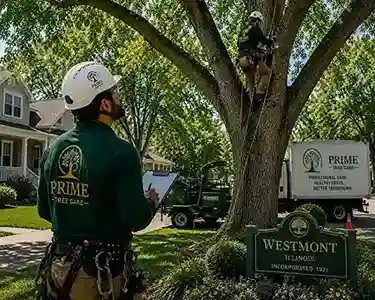
Walk through neighborhoods off Cass Avenue, Blackhawk Drive, or the streets surrounding Ty Warner Park and James M. Long Park, and you'll see decades-old oaks, maples, and ash trees shading ranch homes and bungalows built during Westmont's mid-century growth. That maturity is part of what makes the village desirable — but it also means a large share of Westmont's private trees are entering the stage of life where structural pruning becomes important, root issues become more common, and disease pressure, particularly from Emerald Ash Borer, becomes a real concern rather than a hypothetical one.
We see the same pattern on almost every block: a homeowner waits until a tree visibly declines — thinning canopy, dead limbs, bark splitting — before calling an arborist. By that point, treatment options are often more limited and more expensive than they would have been with an inspection a year or two earlier. A proactive tree health inspection catches EAB, oak wilt exposure, and root stress while a tree still has a real chance at recovery, and it's almost always cheaper than an emergency removal after a limb comes down on a driveway or garage.
Westmont's tree-lined residential streets and older subdivisions carry a specific set of maintenance needs that newer developments simply don't have yet.
Decades-old parkway and yard trees line most of Westmont's older blocks, creating shade but also crowding driveways, sidewalks, and utility lines as canopies mature.
Postwar capes, ranches, and bungalows on smaller lots mean trees are often planted close to homes, garages, and foundations — raising the stakes when a large limb fails.
Mature shade trees in Westmont backyards are a major part of property character, but many haven't had structural pruning in years.
Long-established oaks throughout the village need careful, dormant-season-timed pruning to avoid oak wilt exposure.
Like most of DuPage County, Westmont's ash population has been hit hard by Emerald Ash Borer — many are still treatable if caught early.
Silver and Norway maples planted during Westmont's development boom are now reaching the age where weak branch unions and decay become common.
The pattern we see most often: homeowners wait until a tree's decline is visible — sparse leaves, dead branches, bark loss — before scheduling an inspection. By then, treatment options are frequently narrower and removal becomes the more likely outcome.
Westmont sits in the path of the same severe-weather patterns that move through the rest of Chicagoland — and mature trees bear the brunt of it.
Severe summer storms bring damaging wind gusts and heavy rain that stress weak limbs and saturated root zones.
DuPage County has seen a rise in derecho-style straight-line wind events capable of snapping large limbs or toppling shallow-rooted trees.
Wet, heavy snow accumulation adds significant weight to branches, especially on trees with poor structure or included bark.
Ice storms coat limbs in added weight, a leading cause of winter limb failure on mature Westmont trees.
Structural pruning, tree cabling and bracing, deadwood removal, and annual tree risk assessments all reduce the odds of storm-related failure. Preventative maintenance before storm season is almost always less disruptive — and less expensive — than emergency cleanup after.
EAB has had a widespread regional impact across DuPage County, and Westmont's ash trees are no exception. Early warning signs include D-shaped exit holes, canopy thinning starting at the top, and increased woodpecker activity. Whether treatment or removal makes sense depends on how much canopy has already been lost — which is why an ISA-certified inspection matters before deciding either way.
Learn more about tree health inspection & treatment →Elm trees remain some of the most valuable, long-established shade trees in Westmont's older neighborhoods. Early symptom recognition — wilting or yellowing in a single section of canopy — is critical, since the disease can spread quickly. We recommend ongoing monitoring programs for mature elms and prompt disease management the moment symptoms appear.
See our disease diagnosis process →Thinning foliage and dead branches are usually symptoms of a problem below ground: root stress, soil compaction from decades of foot and vehicle traffic, or construction impacts from a recent driveway, patio, or addition project nearby.
After a wind or ice event, split trunks, hanging limbs, and leaning trees need prompt evaluation — some of the most dangerous defects, like hidden internal decay, aren't visible from the ground.
A full arborist evaluation covering disease diagnosis, EAB assessment, canopy analysis, and risk identification — the starting point for any treat-or-remove decision.
Structural pruning timed to Chicago's dormant season, reducing disease transmission while improving safety and long-term form.
Safe removal of hazardous, dead, or diseased trees, including difficult-access backyards common in Westmont's older subdivisions.
Around-the-clock response for storm damage, fallen limbs, and leaning trees that threaten a home, garage, or driveway.
Complete below-grade stump removal that restores the landscape and clears trip hazards, ready for replanting or hardscaping.
Cabling and bracing installed on mature or storm-prone trees before severe weather hits, reinforcing weak unions and reducing failure risk.
| Species | What We Watch For |
|---|---|
| Ash Trees | Emerald Ash Borer concerns, treatment eligibility based on canopy loss, removal considerations once decline is advanced |
| Oaks | Structural pruning needs, oak wilt awareness during growing-season pruning, long-term preservation planning |
| Maples | Storm damage potential, co-dominant stem issues that create weak branch unions |
| Elm Trees | Dutch Elm Disease monitoring, especially in mature specimens near older homes |
| Honey Locust | Common suburban shade tree with routine maintenance needs and generally good storm resilience |
Thinning canopy
Dead branches
Cracks in trunk
Leaning tree
Root damage
Woodpecker activity
Fungus at base
Bark loss
Hanging limbs
Storm damage
Every Westmont inspection follows a consistent, six-step, science-based process led by an ISA-certified arborist with a preservation-first approach.
We assess the tree in the context of your property — proximity to structures, utility lines, driveways, and neighboring trees.
Confirming species tells us which diseases and pests to specifically screen for.
Canopy, bark, trunk, and visible root flare are all evaluated for signs of stress or disease.
We evaluate structural defects and failure potential, factoring in Westmont's storm exposure and the tree's location relative to your home.
You receive a clear, written report explaining exactly what we found and why.
A specific next-steps plan — treatment, pruning, monitoring, or removal — grounded in ISA certification standards and science-based recommendations.
Every property is different, so we don't quote fixed prices online. These are the main factors that shape your estimate.
Every inspection led by a credentialed professional.
We recommend treatment when a tree can genuinely be saved.
Written reports, not vague verbal opinions.
Verified coverage protects your property and ours.
Trained to work near structures and utility lines.
Clear, itemized estimates before any work starts.
Bucket trucks and aerial lifts for tall or tight-access jobs.
Familiar with Westmont's neighborhoods, soil, and species.
We also provide tree health inspections, removal, and trimming throughout these nearby communities.
Early disease detection, Emerald Ash Borer monitoring, and proactive tree preservation protect both your trees and your property value. Don't wait until a problem becomes an emergency — get an ISA-certified inspection today.
 Prime Tree Care