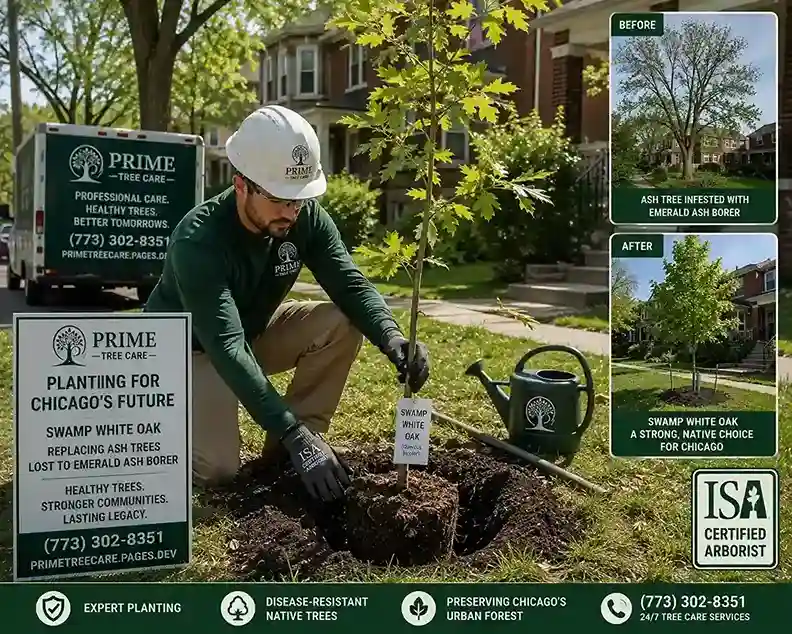
What should you plant instead of an ash tree in Chicago? Chicago homeowners replacing ash trees should avoid planting large numbers of any single species. ISA-certified arborists generally recommend a diverse mix of trees such as swamp white oak, Kentucky coffeetree, ginkgo, disease-resistant elm cultivars, hackberry, bald cypress, and certain lindens, depending on soil conditions, available space, and sun exposure.
Emerald Ash Borer arrived in the Chicago region in the mid-2000s and, within a decade, had killed the overwhelming majority of untreated ash trees across Cook County and the surrounding suburbs. Millions of ash trees across northeastern Illinois were affected, and entire blocks in some North Side and South Side neighborhoods lost their parkway canopy within just a few years.
The scale of the loss traces back to a decision made decades earlier. After Dutch Elm Disease devastated Chicago's American elm population in the mid-20th century, cities and homeowners across the region replanted heavily with ash. It grew fast, tolerated compacted urban soils, and filled bare parkways quickly, so it became one of the most commonly planted replacement trees throughout Chicagoland. In some neighborhoods, ash eventually made up 20 percent or more of the total tree canopy.
That concentration is exactly what made Emerald Ash Borer so devastating. A specialist pest that only attacks ash found an enormous, densely planted host population with almost no natural resistance. The lesson from both Dutch Elm Disease and EAB is the same: planting too much of any single species creates a long-term vulnerability that eventually gets exploited, whether by an insect, a fungus, or a future pest nobody has identified yet.
Most homeowners ask the same question after losing an ash tree: "What's the best replacement tree?" It's a natural question, but it's the wrong one. The better question is, "What's the right tree for this specific site?" A single "best" tree doesn't exist, and treating any one species as a universal answer is how Chicago ended up over-planted with ash in the first place.
Urban forestry experts generally point to a species diversity target known as the 10-20-30 rule: no more than 10 percent of a community's tree canopy from any single species, no more than 20 percent from any single genus, and no more than 30 percent from any single family. The Chicago Region Trees Initiative has used similar diversity benchmarks in its regional canopy planning, precisely because monoculture plantings are what turned EAB from a manageable pest into a canopy-wide crisis.
Replacing every removed ash with the same replacement species, even a good one, just rebuilds the same vulnerability with a different tree. Diversity, matched to the specific site, is the actual goal.
Before picking a species, walk through the site itself. Four factors determine which trees will actually thrive in a given spot.
Matching these four factors to a species is more useful than any generic "top 10 trees" list, because the right tree for a Hyde Park backyard is rarely the right tree for a narrow Lincoln Square parkway strip.
These species consistently perform well across Chicago's clay soils, temperature swings, and urban growing conditions, based on guidance from the Chicago Botanic Garden and Illinois urban forestry research, and on what we see succeed in the field.
| Tree Species | Mature Size | Parkway Friendly | Salt Tolerance | Disease Resistance | Notes |
|---|---|---|---|---|---|
| Swamp White Oak | 50-60 ft | Yes | Moderate | High | Excellent clay soil tolerance, long-lived |
| Bur Oak | 60-80 ft | Limited (large) | Moderate | High | Best for large lots, exceptional longevity |
| Kentucky Coffeetree | 50-70 ft | Yes | Good | Very high | Few pest problems, tough urban performer |
| Hackberry | 50-60 ft | Yes | Good | High | Highly adaptable, good wildlife value |
| Bald Cypress | 50-70 ft | Limited | Moderate | High | Ideal for wet or poorly drained sites |
| Disease-Resistant Elm Cultivars | 50-60 ft | Yes | Good | High (bred resistance) | Restores classic elm form safely |
| Ginkgo (male selections) | 40-60 ft | Yes | Excellent | Very high | Male only, avoids messy fruit drop |
| London Planetree | 60-80 ft | Limited (large) | Good | High | Tolerates poor soil and pollution well |
| Honeylocust | 40-60 ft | Yes | Good | Moderate | Light shade, thornless cultivars preferred |
| American Linden | 50-70 ft | Where space allows | Moderate | Moderate | Fragrant bloom, good pollinator value |
City parkways are the toughest planting environment Chicago has to offer: restricted root zones, compacted soil, heavy winter salt exposure, and constant utility conflicts. Species that thrive in a backyard often struggle badly in this strip between the sidewalk and the street.
Swamp white oak handles parkway conditions well thanks to its clay soil tolerance and moderate salt resistance. Ginkgo, specifically male cultivars that avoid the odor and mess of female fruit, tolerates salt, pollution, and compacted soil about as well as any tree available in this climate. Kentucky coffeetree and hackberry both shrug off poor soil and urban stress with minimal maintenance. Disease-resistant elm cultivars bring back some of Chicago's classic elm-lined street character without the vulnerability that doomed the originals.
Species like bur oak and London planetree, while excellent trees, generally outgrow the space and root volume most Chicago parkways can offer, and are better suited to yards or larger boulevard medians.
Backyards and larger front yards can support genuinely large, long-lived shade trees that a parkway strip simply cannot accommodate. White oak and bur oak are the gold standard for long-term canopy, both capable of living well over a century and providing storm-resistant structure once established. Swamp white oak splits the difference nicely, offering strong shade with better tolerance for imperfect soil than a true white oak.
Bald cypress is worth considering for any low, wet spot in the yard where other species struggle, and it provides excellent long-term canopy despite its unusual reputation as a wetland tree. Kentucky coffeetree rounds out the list with strong storm resistance, minimal pest pressure, and real wildlife and climate resilience value as Chicago's weather patterns continue shifting.
Chicago's climate is shifting in ways that matter directly for tree selection. Summers are trending hotter and more humid, rainfall is arriving in more intense, concentrated events rather than steady patterns, drought periods are becoming less predictable, and new pests and diseases continue moving into the region as winters grow milder.
Species diversification isn't just about avoiding another EAB-style crisis, it's also about resilience to a climate that will look noticeably different in twenty or thirty years than it does today. The Chicago Botanic Garden has explored this directly through its "Trees for 2050" research, testing species and cultivars for their ability to handle the hotter, more variable conditions Chicago is expected to face by mid-century. A genuinely diverse planting, mixing native and well-adapted non-native species across a range of families, gives a neighborhood's canopy the best chance of weathering whatever comes next, whether that's a new pest, a harsher drought, or a wetter spring.
There's no single universally best replacement tree, but certain species consistently make sense for certain situations. Here's how we typically approach it in the field.
The right answer always depends on the specific site conditions, not a fixed favorite. That's why our tree planting visits start with a site walk-through before any species recommendation.
Chicago-area planting generally works well in either spring or fall, and both windows have real advantages. Spring planting, once the ground has thawed and before summer heat sets in, gives a new tree a full growing season to establish roots before its first winter. Fall planting, typically September through mid-November, lets a tree establish root growth in cooler soil without the stress of summer heat, often resulting in stronger growth the following spring.
Illinois Extension planting guidance generally favors fall for most container and balled-and-burlapped trees in this climate, provided there's enough time before hard frost for initial root establishment. Whichever season you choose, proper site preparation, adequate watering through the first one to two growing seasons, and correct planting depth matter more to long-term survival than the specific month you plant.
Not always right away, and rushing the replant can set a new tree up for problems. Stump grinding should generally happen first, both to remove a trip hazard and to clear space for a new root system. If the stump is left in place, or only partially ground, a new tree's roots often have to compete with decaying ash roots and stump wood for years.
Root competition, soil restoration, grade correction, and utility marking are all worth addressing before the new tree goes in the ground. Compacted or depleted soil left behind after a large tree removal often benefits from amendment before replanting. Many sites also need minor grade correction where root flare disturbance or old stump grinding left uneven ground. A quick utility marking call before digging is standard practice and avoids costly, dangerous surprises.
Our stump grinding service is typically the first step we recommend before any replanting project, followed by soil assessment and site prep through our tree planting and transplanting service.
Replacing a single ash tree is a small decision with a bigger opportunity attached to it. Species diversity, matched carefully to the specific site, is the foundation of a healthier long-term canopy. Proper planting practices, correct depth, adequate root spread, and appropriate mulching, give a new tree the best possible start. Ongoing care, particularly consistent watering through the first two growing seasons, determines whether that good start actually turns into a mature, healthy tree decades from now.
Every homeowner across Chicago, Cook County, the North Side, the South Side, Hyde Park, Lincoln Square, Oak Park, Evanston, and Elmhurst who replaces an ash tree with a thoughtfully chosen, well-sited species is contributing, in a small way, to a more resilient regional canopy. That's a better outcome than simply filling the empty spot as quickly as possible.
Our ISA-certified arborists have planted and evaluated replacement trees across Chicago's parkways, yards, and commercial properties for years, matching species to soil, space, and utility conditions site by site rather than defaulting to a single go-to tree. If you removed an ash tree and aren't sure what belongs in its place, we're glad to walk the site with you.
There isn't one universal best tree. Swamp white oak, Kentucky coffeetree, ginkgo, hackberry, bald cypress, and disease-resistant elm cultivars are all strong options, and the right choice depends on the specific site's space, soil, and sun exposure.
EAB only attacks true ash species (Fraxinus), so any non-ash tree is inherently resistant. Species outside the ash genus entirely, such as oak, elm, hackberry, or ginkgo, are not affected by this specific pest.
It's generally not recommended. EAB remains established throughout the Chicago region, and a newly planted ash tree faces the same long-term infestation risk without ongoing preventive treatment.
Hackberry and honeylocust are among the faster-growing options on this list, though fast growth often trades off against wood density and longevity, so growth rate shouldn't be the only factor in the decision.
Swamp white oak, male ginkgo cultivars, Kentucky coffeetree, hackberry, and disease-resistant elm cultivars all perform well in parkway conditions, thanks to their tolerance for compacted soil, restricted root zones, and road salt exposure.
Generally, yes, once the stump is ground and the soil is assessed. Root competition from remaining ash stump wood and any soil compaction from the removal process are the main issues worth addressing first.
Yes. Stump grinding clears space for the new tree's root system and removes a trip hazard, and it's the step we recommend completing before any replanting begins.
White oak and bur oak offer the best long-term shade canopy for large lots, while swamp white oak is a strong choice where soil conditions are less ideal for a true white oak.
Prime Tree Care can walk your property, assess soil and space conditions, and recommend species that will actually thrive where your ash tree used to stand, no generic nursery list required.
 Prime Tree Care Chicago Arborists