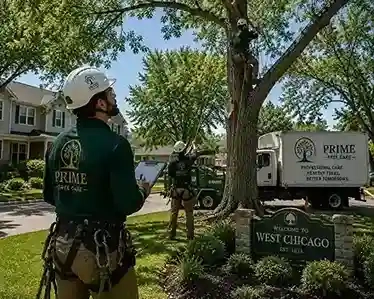
West Chicago is a city of contrasts when it comes to trees. Established neighborhoods near downtown and Reed-Keppler Park carry decades-old maples, oaks, and honey locusts, while newer subdivisions off Fabyan Parkway, Hawthorne Lane, and Bell Graham Farm are still filling in with young trees that haven't yet developed their permanent structure. Both situations call for different expertise — and both directly affect property value, storm preparedness, and long-term canopy health.
Whether you're protecting a mature oak that's shaded a Reed-Keppler Park neighborhood yard for fifty years or training a newly planted swamp white oak in a Prince Crossing front yard to grow with strong branch architecture, Prime Tree Care approaches each property with the same preservation-first, science-based philosophy.
West Chicago, incorporated in 1906 around one of Illinois' first railroad junctions, has grown from a small rail town into a DuPage County city of more than 25,000 residents. That growth shows up clearly in its tree canopy, which falls into two distinct categories that require two distinct approaches.
Older sections of the city — around downtown Main Street, the Reed-Keppler Park area, and neighborhoods near the Illinois Prairie Path — carry mature maples, oaks, and honey locusts planted decades ago. Many of these trees are now dealing with the effects of age: included bark, deadwood, root stress from nearby driveways and foundations, and, in some cases, ongoing decline from emerald ash borer if ash was ever part of the planting mix.
Newer subdivisions throughout West Chicago, including areas off Fabyan Parkway, Hawthorne Lane, and Timber Ridge, are still in the early years of tree growth. These young trees are actively forming their permanent structure right now — which means proper species selection, early pruning, and long-term canopy goals matter enormously more here than they will once the trees mature and those decisions become permanent.
Proactive care today — a structural pruning cycle on a five-year-old maple, a species-diversification plan for a new cul-de-sac, a risk assessment on a leaning parkway oak — is dramatically less expensive than the alternative: an emergency removal decades from now after decay, storm damage, or poor structure finally catches up with a neglected tree.
Emerald Ash Borer (EAB) reshaped tree canopies across the Chicago region, and West Chicago was no exception. Ash trees were once planted heavily along parkways and in residential yards throughout DuPage County because they grew quickly and tolerated urban conditions well. That overreliance on a single species turned into a regional liability once EAB arrived — entire blocks lost their shade canopy within a few years, and many communities are still replanting to fill the gaps.
West Chicago is in a genuinely different position than older, more built-out Chicago suburbs. Because so much of the city's residential development is recent, there's a real opportunity to plant and train a diverse canopy from the start, rather than repeating the same single-species mistake with a different tree.
That's why ISA-certified arborists and municipal foresters throughout the region now emphasize:
A resilient urban forest isn't an accident — it's the result of hundreds of individual planting and pruning decisions made correctly, block by block, over years. West Chicago's newer neighborhoods have a genuine head start on getting this right.
This is where Prime Tree Care spends the most time in West Chicago, and it's the single biggest factor in whether a tree grows into a safe, long-lived asset or a future liability.
A tree's permanent branch structure is largely set within its first 10 to 15 years. Early, light structural pruning during that window — removing competing leaders, correcting co-dominant stems, and spacing scaffold branches properly — costs very little and takes very little time. Skipping it doesn't save the tree that work; it just defers it, and by the time a structural flaw is obvious on a mature tree, correcting it usually isn't possible without significant risk or removal altogether.
Specifically, early structural training addresses:
Consider a young silver maple planted in a new West Chicago subdivision. Left unpruned, it's likely to develop multiple competing leaders and weak, narrow-angle branch unions — exactly the structural pattern that fails during a straight-line wind event twenty years later. A few rounds of structural pruning in its first decade largely eliminates that risk. The same principle applies to young oaks establishing their central leader, elm replacement cultivars being trained for a strong branch scaffold, and ornamental trees like serviceberry or redbud that benefit from early shaping to avoid included bark at the crotch.
Many of the tree failures we're called out to clean up after a storm could have been prevented with a single round of structural pruning fifteen or twenty years earlier. That's the case we make to every West Chicago homeowner with a young tree: the best time to invest in a tree's structure is long before it needs it.
DuPage County sits squarely in the path of the severe weather patterns that have become more frequent across northern Illinois in recent years, and West Chicago's mix of mature and young trees each face different risks from it.
Spring and summer storms roll through DuPage County regularly, bringing heavy rain, lightning, and gusty outflow winds that test weak branch unions.
Illinois has seen a real rise in high-wind derecho events in recent years — sudden, widespread wind damage that can down mature limbs with little warning.
Early and late-season wet snow loads West Chicago's canopy quickly, putting the most stress on trees with poor branch spacing or included bark.
Occasional ice events coat limbs in dense weight, and trees with prior structural issues are far more likely to lose major limbs.
Extended hot, dry stretches stress root systems, especially in West Chicago's newer developments where trees haven't yet established deep root networks.
Saturated clay soil in spring can loosen root anchorage right before storm season, a combination that increases whole-tree failure risk on compromised trees.
Our approach to storm risk isn't just cleanup after the fact. Regular tree risk assessments, structural pruning, and cabling and bracing on mature, storm-prone trees are all preventative measures we recommend before severe weather season, not after a limb is already on the ground.
Structural pruning, young-tree training, clearance pruning around structures and driveways, deadwood removal, and ongoing canopy management timed to the dormant season when possible.
Learn More →Disease diagnosis, emerald ash borer monitoring, canopy decline evaluation, and root stress assessment, with treatment plans built around West Chicago's soil and species mix.
Learn More →Species diversification planning, proper site selection, replacement planning for declining ash trees, and long-term canopy goals mapped out before the first shovel goes in the ground.
Learn More →Safe removal of hazardous, dead, storm-damaged, or diseased trees, including tight-access backyards and properties near structures or power lines.
Learn More →24/7 response for fallen trees, split limbs, and storm cleanup across West Chicago and DuPage County — including hazard mitigation when a tree threatens a structure.
Learn More →Complete below-grade stump removal that prepares the site for replanting, sod, or hardscaping, and eliminates hazards and pest habitat left behind by an old stump.
Learn More →Cabling, bracing, and preventative structural reinforcement installed on mature or storm-prone trees before severe weather season arrives, not after.
Learn More →Long-lived and structurally strong when trained early, West Chicago's oaks — from downtown's mature specimens to young swamp white oaks in new developments — benefit from structural pruning and awareness of oak wilt risk, which spreads faster during active growing-season pruning cuts.
Fast-growing and common throughout the city, maples like silver and Norway maple are prone to weak branch unions and storm-related limb failure without early structural training to correct competing leaders.
A popular choice for West Chicago's urban and parkway plantings thanks to its tolerance for compacted soil and road salt, honey locust still needs routine maintenance pruning to manage its spreading branch habit.
Modern disease-resistant elm cultivars are increasingly planted throughout DuPage County as a Dutch elm disease-resistant alternative that still delivers the classic vase-shaped canopy older elms once provided.
Remaining ash trees in West Chicago's older neighborhoods still face ongoing EAB pressure. Some can be preserved with regular treatment if caught early; others are past the point where treatment is a realistic option.
We walk the full property, noting every tree's location, size, condition, and proximity to structures, driveways, and utility lines.
Accurate species ID drives every recommendation that follows, from pruning timing to disease risk to long-term canopy planning.
We evaluate canopy density, deadwood, signs of pest or disease activity, and root zone condition.
Structural defects, lean, decay, and storm vulnerability are assessed to determine whether a tree can be preserved safely or needs more active intervention.
You receive clear, written findings and options — no vague verbal opinions, and no pressure toward removal when preservation is a realistic path.
ISA-certified arborists carry out the agreed work using proper equipment and safety practices, whether that's a single pruning visit or a multi-year canopy plan.
Every step of this process is grounded in ISA-certified expertise and a preservation-first philosophy — science-based recommendations rather than a reflexive push toward removal.
Every property is different, so we don't publish fixed pricing — but these are the main factors that shape a quote:
| Factor | Why It Affects Cost |
|---|---|
| Tree size | Larger trees require more time, more equipment, and more careful rigging |
| Tree species | Wood density and branch structure affect how a tree is safely cut and removed |
| Accessibility | Tight backyards or fenced-in lots common in newer subdivisions can limit equipment access |
| Equipment requirements | Aerial lifts and bucket trucks add capability but also cost for taller or harder-to-reach trees |
| Crane usage | Necessary for some large removals near structures, adding to overall cost |
| Emergency conditions | After-hours or storm-emergency response typically carries a premium over scheduled work |
| Disposal needs | Hauling and processing large volumes of wood and debris adds to the total scope |
For a general sense of regional pricing, see our guide to tree removal cost in the Chicago area. Every West Chicago estimate is written, itemized, and provided before any work begins.
Prime Tree Care is based in Hickory Hills and regularly serves properties throughout West Chicago, about 30 miles northwest of our office via I-294 North and I-88 West — typically a 40 to 45 minute drive for a scheduled visit, with priority dispatch for storm emergencies.
We're also familiar with West Chicago landmarks that put our crews' work in context day to day — Cantigny Park and the First Division Museum just southeast of the city, Cosley Zoo and the Kruse House Museum nearby in Wheaton, Lincoln Marsh Natural Area, and the West Chicago Prairie Forest Preserve, one of DuPage County's most significant native prairie remnants.
Tree care timing matters, and we plan our West Chicago work around both the seasons and the city's calendar.
Structural pruning and oak trimming are best scheduled while trees are dormant, reducing disease transmission risk and making branch structure easier to see and correct.
April through June bring West Chicago's most active severe thunderstorm activity — the ideal window to have already completed risk assessments and cabling on vulnerable trees.
Held nearby each summer, the fair draws heavy local traffic — a good marker for scheduling routine maintenance before or after peak season congestion.
The Forest Preserve District's living-history programming at Kline Creek Farm runs year-round, a reminder of how much of West Chicago's identity is tied to its natural landscape and tree canopy.
October and November bring heavy leaf drop from the city's mature maples and oaks — also a good time for a post-summer health inspection before winter.
Heavy wet snow and occasional ice events call for rapid emergency response; our crews are on call 24/7 throughout the winter months.
Schedule a risk assessment now — cabling, bracing, and structural pruning are far less expensive as prevention than as cleanup.
Call (773) 302-8351Every inspection and pruning plan is led by a credentialed arborist, not a rotating landscaping crew.
We specialize in structural training for the newly planted trees filling West Chicago's growing subdivisions.
Planting and treatment recommendations informed directly by the region's EAB experience.
Removal is a last resort, not a default recommendation.
Licensed, bonded, and insured on every West Chicago job, protecting your property and ours.
Aerial lifts, bucket trucks, and crane access when a job genuinely requires it.
Written, itemized estimates and clear explanations — no pressure, no surprise fees.
Young-tree pruning establishes a strong central structure while branches are still small and easy to correct. It prevents co-dominant stems, weak branch unions, and lopsided canopies that become expensive or impossible to fix once a tree matures.
Structural pruning is the selective removal of specific branches to develop a tree's permanent framework, correcting competing leaders and weak unions early so the mature tree grows with strong, well-spaced scaffold branches.
We generally recommend diversifying rather than replacing one dominant species with another. Strong options for West Chicago yards include swamp white oak, hackberry, disease-resistant elm cultivars, ironwood, and Kentucky coffeetree, chosen based on soil, space, and sun exposure.
Regular risk assessments, structural pruning to remove weak or crossing limbs, and cabling or bracing on mature trees with included bark or heavy horizontal limbs are the most effective ways to reduce storm-related failures.
Structural training typically begins within the first few years after planting and continues on a regular cycle, often every 2 to 3 years, through the first decade.
Most residential trees benefit from a health and structure inspection every 1 to 2 years, with more frequent checks for mature ash trees or any tree with a history of stress or damage.
Yes. Surviving and newly planted ash trees remain at risk, and DuPage County communities continue to see active infestations. Any untreated ash tree should be evaluated.
Yes. Prime Tree Care provides 24/7 emergency response across West Chicago and DuPage County for fallen trees, split limbs, and storm damage threatening a structure or power line.
Long-term canopy planning, young-tree development, disease prevention, and tree preservation start with one inspection. Get ahead of expensive removals — schedule your West Chicago arborist visit today.
 Prime Tree Care