Prime Tree Care provides tree trimming, tree removal, tree health inspections, storm-damage response, cabling & bracing, stump grinding, and tree planting throughout the Cottage Grove and Jackson Park corridor. Our ISA-certified arborists specialize in the large, mature canopy trees that surround Jackson Park, the Midway Plaisance, and Woodlawn — and know how to prepare park-adjacent properties for Chicago's toughest storm seasons.
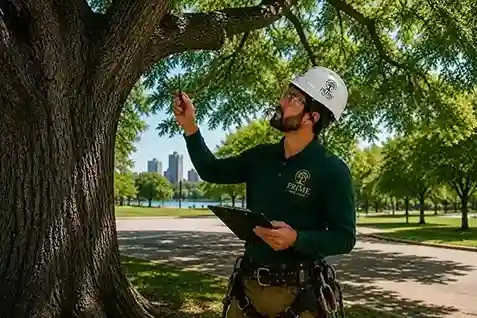
Our crews are on the South Side often enough to know this stretch of the city by its trees, not just its street grid. Jackson Park, the 500-acre Frederick Law Olmsted-designed park bordering Lake Michigan, anchors the corridor on its east side, with the Midway Plaisance running a mile west from Stony Island Avenue to Cottage Grove Avenue, dividing Hyde Park to the north from Woodlawn to the south. Cottage Grove Avenue itself is one of the South Side's oldest arterial roads, lined in places with century-old parkway trees planted long before modern utility and sidewalk infrastructure existed alongside them.
Nearby landmarks give this area a distinct tree-canopy profile: the Museum of Science and Industry and the Wooded Isle sit inside Jackson Park itself; the University of Chicago campus and Rockefeller Chapel border the Midway; and the South Shore Cultural Center anchors the lakefront a few minutes northeast. The Metra Electric Line's 59th Street/University of Chicago and Jackson Park stations, along with CTA bus routes 4, 6, 28, and 55, run straight through the neighborhoods we service — which means we're regularly working near heavy foot traffic, transit infrastructure, and dense residential blocks that demand extra care on every job.
Prime Tree Care is based at 8811 W 87th St in Hickory Hills. Here's what that means for response times if you're calling from the Cottage Grove or Jackson Park area.
Crews typically route in via I-90/94 to Stony Island Avenue or via 87th Street and Cottage Grove Avenue directly, depending on the job site and current traffic — giving us flexible access to Woodlawn, South Shore, Hyde Park, and the Jackson Park perimeter.
Trees around Jackson Park face lake-effect weather patterns that differ from Chicago's inland suburbs — stronger sustained winds off Lake Michigan, heavier lakefront humidity, and exposure to sudden summer squalls moving in off the water.
These are the issues our crews encounter most often on South Side properties near Jackson Park — not generic citywide talking points, but the specific problems this canopy actually develops.
Straight-line winds, severe thunderstorms, and occasional derecho events moving in off Lake Michigan cause limb failures and split leaders in exposed, older trees throughout the corridor.
Ash tree decline remains widespread on the South Side. We evaluate whether treatment can still save a tree or whether removal is the safer, more cost-effective path.
Emerald Ash Borer in Chicago →Oak Wilt awareness, structural pruning, and canopy management are critical for the large oaks common around Jackson Park and Woodlawn.
Tree Trimming & Pruning →Canopy thinning, dead branches, fungal growth, trunk defects, and root damage are common in trees planted decades ago along dense residential blocks.
On-site diagnosis of disease, pest pressure, and structural defects in mature South Side trees, with a clear written treatment plan.
Learn More →Structural pruning and canopy management timed to protect large, older trees around Jackson Park and reduce storm failure risk.
Learn More →Safe, code-compliant removal of hazardous or declining trees, including tight-access lots and jobs near structures, alleys, and easements.
Learn More →24/7 response for storm-damaged limbs and hazardous trees threatening a structure, power line, or right-of-way.
Learn More →Cabling and bracing installed on mature or storm-exposed trees before Chicago's high-wind season arrives.
Learn More →Complete below-grade stump removal, ready for new sod, planting, or hardscaping right away.
Learn More →Species selection and planting suited to Chicago's clay soil and this corridor's historic canopy character.
Learn More →A certified arborist's tree risk assessment can catch structural defects long before they become a hazard. Watch for these warning signs.
A certified arborist walks the property and evaluates every tree in question, in person.
We identify species-specific risks common to this corridor's oaks, elms, and maples.
Structural defects, decay, and hazard potential are evaluated and documented.
You receive a clear, itemized plan and pricing before any work begins.
Aerial lift, bucket truck, and rigging systems deployed with full utility awareness near power lines and structures.
Debris removed, site cleaned, and a follow-up plan provided for future monitoring.
Educational pricing ranges for South Side tree work. Every quote depends on tree size, species, access, and site conditions — request a free on-site estimate for an exact number.
| Service | Typical Range | Key Cost Factors |
|---|---|---|
| Tree Trimming | $300 – $1,500+ | Tree size, species, access |
| Tree Removal | $500 – $9,000+ | Size, crane requirements, proximity to structures |
| Stump Grinding | $150 – $1,000+ | Stump diameter, root spread, site access |
| Cabling & Bracing | $500 – $3,500+ | Number of support points, canopy height, hardware type |
Larger cost factors on Cottage Grove and Jackson Park jobs specifically include utility conflicts along older alleys, tight-access backyards common to South Side lots, and crane staging near busy streets like Cottage Grove Avenue and Stony Island Avenue. See our full tree removal cost guide for a citywide breakdown.
Michael holds ISA certification and has spent years working Chicago's urban canopy, with particular focus on South Side tree preservation around Jackson Park, Woodlawn, and Hyde Park. He specializes in storm-damage assessment for large, exposed trees and understands the jurisdictional details of park-adjacent tree management — from Bureau of Forestry parkway responsibilities to Chicago Park District boundary questions — that come up constantly in this corridor.
It depends on location. Trees inside Jackson Park itself are managed by the Chicago Park District. Parkway trees between the sidewalk and street are the City of Chicago's Bureau of Forestry's responsibility. Trees entirely on private property are the homeowner's responsibility.
Generally, if a tree sits in the parkway strip between the sidewalk and the street, it belongs to the city. If it's inside your property line, it's yours. When boundaries are unclear near an easement or right-of-way, our arborists can help you confirm, and you can also contact 311 or CHI311 to check city records.
Mature oaks, elms, maples, hackberries, and sycamores are especially common throughout the Jackson Park, Midway Plaisance, and Woodlawn corridor, many of them significantly older and larger than trees found in newer Chicago developments.
Often, yes. Structural pruning, cabling, and Oak Wilt-aware maintenance can preserve a mature oak for years. Removal is typically recommended only when decay, root failure, or Oak Wilt has progressed too far to correct safely.
Large, older canopy trees near Jackson Park should generally be inspected every 1–2 years, and after any major storm event, given their size and the higher failure risk that comes with age and structural history.
Keep people and pets away from the affected area, avoid touching any limb near a power line, and call for an emergency tree assessment. Prime Tree Care offers 24/7 storm-damage response across the Cottage Grove and Jackson Park corridor.
Private property trees generally don't require a city permit to remove. Parkway trees are managed by the Bureau of Forestry and typically require city involvement before removal. We help confirm which category your tree falls into before work begins.
Yes. Cabling and bracing redistribute structural load across weak branch unions and co-dominant stems, reducing the likelihood of limb failure during high-wind events common to the lakefront-adjacent Jackson Park area.
Our Cottage Grove and Jackson Park coverage connects directly with these nearby South Side service areas — reach out if your property sits closer to one of these neighborhoods.
From a single mature oak near the Midway to a full-property canopy plan along Cottage Grove Avenue, our ISA-certified arborists are ready to help.
On-site evaluation from a certified arborist, no obligation.
Documented structural review for large or aging canopy trees.
24/7 dispatch for fallen limbs and hazardous trees.
Clear, written pricing before any work is scheduled.
 Prime Tree Care Chicago Arborists