Prime Tree Care provides tree trimming, tree removal, emergency storm response, parkway tree guidance, tree health inspections, storm preparation, and stump grinding throughout Chicago's North Side — Lakeview, Lincoln Park, Uptown, Ravenswood, North Center, Edgewater, Roscoe Village, Andersonville, Avondale, and Irving Park. Our ISA-certified arborists are trained for the tight lot spacing, alley access, and overhead utility lines that define tree work in these dense, mature-canopy neighborhoods.
Chicago's North Side sits roughly 18–22 miles northeast of our Hickory Hills headquarters, typically a 30–40 minute dispatch depending on traffic on the Kennedy or Stevenson corridors. Here's what's currently relevant for North Side tree owners.
45% chance of rain today, with a wetter pattern moving in through the weekend. Saturated soil after heavy rain raises root-plate movement risk on already-leaning trees — a good week to have a hazard tree checked.
Hickory Hills to Lakeview/Lincoln Park via I-55 and the Kennedy Expressway (I-90/94) or via Cicero Ave and Western Ave for tighter neighborhood access.
Straight-line wind events and sudden downbursts off Lake Michigan peak in summer; heavy wet snow and ice loading are the main risk from December through February.
Tree work in Lakeview or Lincoln Park is not the same job as a wide suburban lot in the southwest suburbs. Narrow lots, alley access, mature parkway canopy, and constant pedestrian and vehicle traffic all change how a removal or pruning job has to be planned.
Mature street trees along blocks in Roscoe Village, North Center, and Ravenswood tower over rowhouses, two-flats, and busy sidewalks. Heavy pedestrian activity, parked cars along the curb, and tightly spaced homes mean there's often no wide-open landing zone for cut limbs — every job needs a real work-zone plan, not just a crew with saws.
Overhead utility infrastructure runs along alleys and streets throughout Uptown, Edgewater, and Andersonville. Clearance pruning near these lines follows strict utility vegetation management protocols, and our crews coordinate with the utility when a line needs to be addressed before we can safely work.
The Chicago Bureau of Forestry owns and maintains parkway trees across every North Side neighborhood. Knowing where public responsibility ends and private responsibility begins — and how to coordinate with the city when needed — is core to doing this work correctly here.
The same certified-arborist standard applies to every North Side job, from a single parkway tree inspection to a full storm-emergency response.
Full Tree Risk Assessment, Emerald Ash Borer detection, Dutch Elm Disease monitoring, canopy decline diagnosis, and root stress evaluation for trees stressed by compacted urban soil.
Tree Health Inspection & Treatment →Structural pruning, utility clearance pruning, deadwood removal, dormant-season pruning, and pedestrian clearance pruning over sidewalks and parked cars.
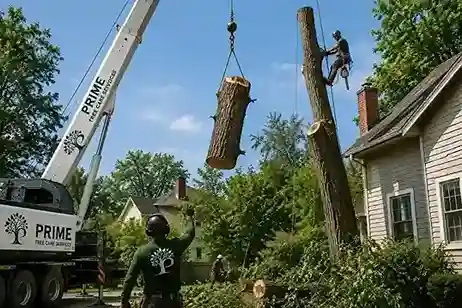
Tree Trimming & Pruning →Hazardous, dead, and storm-damaged tree removal, including tight-access removals in confined urban work sites where a bucket truck or crane may be the only safe option.
Tree Removal →24/7 response for downed limbs, split trunks, trees blocking North Side streets and alleys, and utility hazards after severe weather.
Emergency Tree Service →Tree cabling, structural bracing, preventative inspections, and wind-load reduction for mature trees before the next high-wind event moves through.
Storm Prep & Tree Support Systems →Hazard removal, landscape restoration, and sidewalk and yard improvements to prepare small North Side lots for replanting or hardscaping.
Stump Grinding →This is the single most common point of confusion for North Side homeowners, and getting it wrong can mean an unnecessary permit request or an unauthorized removal of a tree the city owns.
A parkway tree is planted in the strip of land between the sidewalk and the street — the "parkway." On tree-lined North Side blocks in Lincoln Park and Ravenswood, these are often the largest, most mature trees on the block.
The City of Chicago owns every parkway tree. This holds true whether the block is in Lakeview, Andersonville, Irving Park, or anywhere else in the city — the adjacent homeowner does not own the tree in front of their house.
The Chicago Bureau of Forestry handles routine maintenance, pruning cycles, and removal decisions for parkway trees. Residents can request service but cannot authorize private removal or major pruning themselves.
Any time a parkway tree needs pruning, has visible hazard signs, or requires removal, the request routes through the Bureau of Forestry — typically initiated via CHI311.
For anything on private property — your own yard, side lot, or a tree overhanging from a shared property line — an arborist inspection is the right first step, and can also help document a parkway hazard to support a city request.
For example, a leaning parkway oak on a Ravenswood block or a storm-damaged elm along the curb in North Center goes through the Bureau of Forestry, while a backyard silver maple threatening a garage in Roscoe Village is entirely the homeowner's call. Read the full breakdown in our Parkway Trees vs. Private Trees in Chicago guide.
Overhead utility infrastructure runs through nearly every alley and many streets across the North Side, and pruning near it wrong causes problems that outlast the job by years.
Power lines running along alleys behind Lakeview two-flats, communication lines strung between poles in Uptown, and service drops connecting individual homes throughout Edgewater all create points where tree limbs and infrastructure compete for the same space.
Our crews use aerial lifts and bucket trucks to reach clearance zones safely, follow utility clearance requirements for each line type, and coordinate directly with the utility when a line needs to be flagged or de-energized before work begins.
Topping or hacking a tree back from a line without proper technique triggers weak, densely clustered regrowth that grows back into the clearance zone faster than a properly pruned cut would. Over years, this pattern causes structural defects, accelerates tree decline, and increases future failure risk — exactly the outcome utility-aware pruning is designed to prevent.
| Conflict Type | Typical Location | Approach |
|---|---|---|
| Overhead Power Lines | Alleys, rear yards | Utility coordination + clearance pruning |
| Communication Lines | Pole-to-pole runs | Aerial lift, careful rigging |
| Service Drops | House to pole connections | Hand-pruning, close clearance work |
| Streetlight Sightlines | Parkway trees | Bureau of Forestry coordination |
Every North Side neighborhood has its own canopy character, lot layout, and landmark reference points our crews use to plan access and work zones.
Dense two-flat and courtyard-building blocks near Wrigley Field and Southport Corridor, with mature parkway trees lining residential side streets off Lincoln, Belmont, and Ashland.
Heavy tree canopy around Lincoln Park Zoo and DePaul's campus, tight historic-block spacing, and mature trees along Clark Street and the lakefront path.
Historic courtyard buildings near the Aragon Ballroom and Green Mill, with older parkway trees and alley-adjacent utility lines throughout the neighborhood's residential core.
Quiet, tree-heavy residential streets near the Metra corridor, with mature oaks and maples on larger lots than much of the surrounding North Side.
Family residential blocks near Welles Park and Lane Tech, known for well-established parkway trees and consistent canopy coverage street to street.
Lakefront high-rises transition into tree-lined residential blocks around Andersonville's northern edge, with mature canopy near Foster Beach and Bryn Mawr Historic District.
Tight bungalow-lined streets near the Roscoe Village retail strip, where narrow side yards and alley access shape nearly every tree job we take on here.
Historic Swedish-American commercial corridor on Clark Street surrounded by dense residential blocks with well-established, mature parkway trees.
Working-class residential blocks near the Kennedy Expressway with a mix of older mature trees and newer parkway plantings replacing lost ash trees.
Larger lots and wider parkways than much of the North Side, near Independence Park, with a mature, varied canopy of oak, maple, and honey locust.
Knowing the species on a block tells our arborists what to look for before we even reach the tree.
Long-lived and structurally strong, but oak wilt is a real concern in Chicago — pruning is best scheduled outside the high-risk spring window, and structural pruning helps these trees age safely on tight urban lots.
Fast-growing and common throughout North Center and Roscoe Village, but that same fast growth produces weaker wood, making mature maples more susceptible to storm-related limb failure.
Chicago's remaining mature elms require ongoing Dutch Elm Disease monitoring, since the disease still moves through root grafts and bark beetle activity on established blocks.
A common newer parkway planting thanks to strong urban tolerance for compacted soil and pollution, though structural maintenance in early years shapes a stronger, safer canopy long-term.
Remaining ash trees across the North Side continue to face Emerald Ash Borer pressure — early detection is the difference between a treatable tree and a removal.
Brittle, bark-stripped limbs with no live growth are a fall risk in any wind.
A new or worsening lean, especially near a home or sidewalk, needs prompt evaluation.
Vertical or horizontal trunk cracks signal internal stress close to failure.
Open cavities reduce the structural wood available to bear weight and wind load.
Lifted sidewalk slabs or soil near the base often point to root or anchoring issues.
Missing or peeling bark exposes the tree to decay and pest entry points.
A crown that's visibly sparser than neighboring trees can signal root or disease stress.
Any branch touching a power or service line needs immediate professional attention.
Broken limbs or a cracked leader after a wind event should be checked before the next storm.
Conks or mushrooms at the base are one of the clearest visible signs of internal decay.
Dense North Side lots demand a tighter, more deliberate process than a wide-open suburban yard.
An ISA-certified arborist walks the property, evaluates the tree, and checks for access constraints unique to the lot and block.
Structural condition, decay, lean, and proximity to targets like homes, sidewalks, and lines are formally evaluated.
Equipment, rigging, work zones, and any utility or Bureau of Forestry coordination are planned before a crew arrives.
Climbing, rigging, aerial lift, or crane work is carried out with property protection and pedestrian safety zones in place.
Debris is fully cleared from the tight lot, alley, or parkway, with follow-up monitoring recommendations for the tree and its neighbors.
Lake Michigan's proximity means North Side storm patterns can shift fast — from straight-line wind gusts in summer to heavy wet snow and ice loading in winter.
Schedule a Tree Risk Assessment for any leaning, dead-limbed, or storm-exposed tree, and install cabling or bracing on high-value mature trees before wind season peaks.
Stay clear of trees and downed limbs, keep vehicles out from under large canopy where possible, and never approach a limb resting on or near a power line.
Photograph damage for insurance, avoid the area under hanging limbs, and call for emergency response if a tree threatens a structure, vehicle, or pedestrian path.
For a deeper look at Chicago's rising derecho and high-wind risk, see Chicago Derecho Storm Damage to Trees, and for dormant-season timing on oak and elm pruning, see Oak Wilt, Dutch Elm Disease & Dormant Pruning Season.
Every inspection and job is led by a credentialed arborist, not a general labor crew.
Built specifically for dense-lot, alley-access, mature-canopy neighborhood work.
Verified coverage protects your property, your neighbors', and our crews on every job.
Trained and equipped to work safely near energized lines throughout the North Side.
Real work-zone planning for sidewalks, parked cars, and pedestrian-heavy blocks.
Years of hands-on work across North Side neighborhoods and their specific canopy issues.
24/7 storm response dispatched to the North Side, every day of the year.
We know Chicago's parkway-tree rules and Bureau of Forestry process before your project starts.
The City of Chicago's Bureau of Forestry owns and is responsible for parkway trees — the trees planted in the strip between the sidewalk and the street. On the North Side, this covers the mature street trees lining blocks throughout Lakeview, Lincoln Park, Ravenswood, and similar neighborhoods. Homeowners are not responsible for pruning, treating, or removing a parkway tree, though they can and should report hazards through CHI311.
No. Because parkway trees are City of Chicago property, residents should not cut, prune, or remove them without going through the Bureau of Forestry. Unauthorized pruning can damage the tree, violate city ordinance, and create liability. Requests go through CHI311, and a licensed arborist can help document the issue to support that request.
Private trees on your own North Side property generally don't require a city permit to remove. Parkway trees are different — they belong to the city and go through the Bureau of Forestry rather than a private removal permit. Trees near a property line or shared fence often benefit from arborist documentation before removal.
North Side removal costs follow the same size factors as the rest of Chicago — roughly $300–$800 for small trees, $1,500–$3,000 for medium trees, and $6,000–$9,000+ for large mature trees — but dense lot spacing, alley access, and proximity to garages and power lines can add to the total. See our full Tree Removal Cost in Chicago guide for a detailed breakdown.
Stay away from the tree and the branch, keep others and pets clear, and don't attempt to cut or move it yourself. Contact ComEd to report the hazard and call a licensed, utility-aware arborist. Never assume a line is de-energized.
Most mature North Side street and yard trees benefit from structural pruning every 3–5 years, with more frequent deadwood and hazard checks for older or storm-exposed trees. Utility clearance pruning follows a separate cycle set by the utility.
The canopy includes a mix of oak, maple, elm, honey locust, and remaining ash trees. Honey locust and select oak and elm cultivars are common newer parkway plantings, while older blocks still carry mature silver maple and green ash.
Ash trees caught early can often be saved with systemic insecticide treatment on a recurring schedule. Once infestation causes significant canopy dieback — generally more than 30–50% crown loss — removal becomes the safer, more cost-effective option.
A structured evaluation by a certified arborist examining a tree's structural condition, decay, lean, root stability, and proximity to targets like homes, sidewalks, or power lines to determine the appropriate next step.
Call immediately if a tree or large limb has fallen on a structure, vehicle, or power line, if a trunk has split, if a limb is hanging over a sidewalk or parked car, or after any severe storm that leaves visible cracking or lean.
Prime Tree Care also serves the neighborhoods and suburbs bordering the North Side and across Chicagoland.
See our full Chicago service area coverage, or explore nearby location pages: Chicago, IL, Lincoln Square, Hyde Park, Dunning, and Evanston.
Whether it's a hazardous parkway tree in Lakeview, storm damage in Lincoln Park, or a routine trim in Ravenswood, Prime Tree Care brings certified, utility-aware expertise to every North Side job.
 Prime Tree Care Chicago Arborists