 Prime Tree Care | McHenry Arborists Prime Tree Care | McHenry Arborists
ISA-Certified Arborists helping McHenry property owners manage mature trees, protect wooded lots, and reduce storm-damage risk along the Fox River and Chain O'Lakes.
McHenry isn't a dense Chicago suburb — it's a mix of lakefront neighborhoods, semi-rural acreage, and heavily wooded lots stretching from Pistakee Bay to Moraine Hills. That means bigger canopies, longer sightlines to hidden defects, and real wind exposure off the water. Our certified arborists build every tree risk assessment, canopy management plan, and storm-preparedness recommendation around those exact conditions — not a generic city playbook.
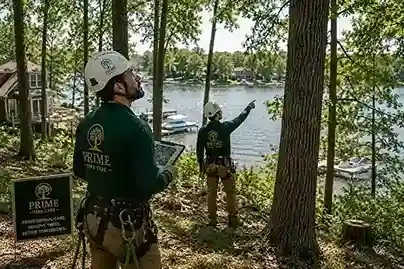
McHenry property owners most often need hazardous tree removal, storm-damage prevention pruning, and tree health inspections for mature oaks and remaining ash trees. Because so many McHenry lots are wooded or semi-rural, land/lot clearing, selective thinning, and stump grinding are also common — along with 24/7 emergency response after wind events off the Chain O'Lakes and Fox River.
McHenry sits where Chicago's inner-ring suburban forestry rules stop applying. Larger lots, denser tree populations, and real wind exposure off the water change what "routine maintenance" actually needs to look like.
Half-acre to multi-acre lots throughout McHenry carry far greater tree density than a standard Chicago city parcel. Mature canopies often go years between inspections, which is exactly how hidden defects — cracked unions, root plate movement, deadwood — turn into emergencies.
Naturalized tree stands along Boone Creek, the Fox River corridor, and near Moraine Hills need selective thinning and risk management, not blanket clearing. Dense, tight-access wooded lots also change how we stage equipment and rigging.
Open acreage and lakefront lots near Pistakee Bay and McCullom Lake catch wind that a tight city block never sees. That exposure, combined with taller, older trees, drives our emphasis on cabling, bracing, and long-term forest health management here.
Knowing the ground helps us plan access, rigging, and risk. Here's the McHenry geography that shapes almost every job we do in town.
The Fox River runs the length of McHenry, with riverside parks and the Riverwalk promenade lined by mature cottonwoods, silver maples, and willows prone to storm and root damage near the water's edge.
Just south of downtown off River Road, this ~2,200-acre park's wetlands and glacial terrain border many private wooded lots we service, sharing similar oak, hickory, and native woodland composition.
Lakefront properties along Pistakee Bay and the Chain O'Lakes see the most direct open-water wind exposure in our McHenry coverage area — a top factor in our cabling and bracing recommendations.
These McCullom Lake and riverside parks anchor much of McHenry's outdoor life — and give us a good visual benchmark for canopy health and storm damage patterns we also see on nearby private lots.
McHenry's three close-together commercial districts — Main Street, Green Street, and Riverside Drive — sit near older, established shade trees that require utility-aware pruning near storefronts and parking.
These three state routes carry the bulk of McHenry traffic and cross several wooded residential subdivisions where we regularly handle clearance pruning and hazardous roadside-tree removal.
Storm-prep timing and crew scheduling around town often line up with McHenry's community calendar.
An 11-day, decades-running festival at Petersen Park, Veterans Memorial Park, and downtown — we make sure storm-vulnerable trees near parade and event routes are inspected beforehand.
A multi-day concert event at Petersen Park. Large gathering areas near mature shoreline trees are a common pre-event inspection request from event organizers and neighboring homeowners.
Peak growing season across McHenry County brings the highest volume of storm-damage calls, tied to summer thunderstorms and straight-line wind events.
Heavy, wet lake-effect snow around the holidays is our top winter storm-prep driver for McHenry's older shade trees near downtown and residential streets.
These are the issues our arborists diagnose most often on McHenry's wooded, lakefront, and semi-rural properties.
Straight-line winds off the Chain O'Lakes, summer thunderstorms, heavy snow loads, and periodic ice storms drive most of our McHenry emergency calls. We install cabling and bracing on high-risk trees before storm season, not just after.
Decades-old oaks and silver maples common to McHenry's older neighborhoods develop structural defects — codominant stems, included bark, large limb failures — that need proactive structural pruning to manage.
Remaining ash stock throughout McHenry continues to decline from EAB. We evaluate each tree individually for treatment viability versus scheduled removal before it becomes a hazard.
Naturalized wooded lots near Boone Creek and the Fox River benefit from selective removals and forest thinning that improve safety and property value without stripping the lot bare.
Every service performed by ISA-certified arborists, scaled for McHenry's larger lots and wooded terrain.
Structural pruning, deadwood removal, canopy reduction, and clearance pruning — timed to dormant season for McHenry's mature oaks and maples.
Dead, hazardous, and storm-damaged tree removal, including large-diameter takedowns with crane-assisted rigging where wooded-lot access requires it.
24/7 response for downed trees, split trunks, and storm emergencies across McHenry, including utility-hazard coordination.
On-site diagnosis for Emerald Ash Borer, Dutch Elm Disease, root-zone stress, and canopy decline specific to McHenry's tree population.
Selective clearing for new construction, additions, or overgrown wooded lots — preserving healthy specimen trees while removing hazards and invasive growth.
Complete below-grade stump removal, clearing mowing hazards and preparing the site for replanting or hardscaping.
Cabling, bracing, and preventive inspections for McHenry's wind- and storm-exposed mature trees ahead of severe weather season.
Species diversification and site-specific planting plans that reduce future EAB-style monoculture risk on McHenry properties.
Root-zone nutrition and soil correction built for McHenry's mix of river-bottom, glacial, and residential soils.
McHenry's canopy reflects its river-and-lake geography — here's what we manage most.
Long-lived bur, red, and white oaks anchor many mature McHenry lots. Structural pruning and long-term preservation are usually the priority over removal.
Silver and sugar maples are common but storm-vulnerable, especially near open water — regular limb management reduces failure risk.
Remaining ash throughout McHenry require ongoing EAB monitoring to decide between treatment and scheduled removal.
Scattered elms still carry Dutch Elm Disease risk, particularly on older residential streets near downtown.
Common on semi-rural, wooded lots near Moraine Hills and Boone Creek — factored into our broader forest management recommendations.
Frequent along the Fox River and lakefront properties — fast-growing, weak-wooded species that need proactive risk assessment near water.
An on-site visit to assess the full lot, not just the tree in question.
Species, structure, wind exposure, and disease signs evaluated by a certified arborist.
Clear, written guidance on treatment, pruning, or removal — no upselling.
Work performed with the right equipment for McHenry's lot sizes and access conditions.
Full debris cleanup plus a long-term canopy health plan for the property.
Educational, realistic ranges based on typical McHenry lot sizes and tree populations. Every job gets a written, itemized estimate before work begins.
| Service | Typical Range |
|---|---|
| Tree Trimming | $300 – $2,000+ |
| Small Tree Removal | $300 – $900 |
| Medium Tree Removal | $1,500 – $4,000 |
| Large Tree Removal | $4,000 – $12,000+ |
| Emergency Removal | Variable — call for same-day quote |
| Stump Grinding | $150 – $1,500+ |
| Lot Clearing | Project-based |
Cost drivers include trunk diameter, tree height, property access (a major factor on wooded and semi-rural McHenry lots), equipment needs, disposal volume, and whether crane assistance is required. See our full Chicagoland tree removal cost guide for more detail.
Every inspection and treatment plan is backed by ISA-Certified Arborist training.
Real experience managing naturalized, wooded, and semi-rural lots — not just city parkway trees.
Verified insurance coverage on every job, protecting your property and ours.
Crane-assisted removals, aerial lifts, and stump grinders sized for McHenry's larger trees.
Written, itemized estimates — no pressure toward removal when treatment is the better call.
We know McHenry's terrain, wind exposure, and canopy composition firsthand.
Michael has spent 15+ years providing tree care across Chicagoland, with hands-on experience managing wooded and semi-rural properties throughout McHenry County. His work focuses on tree risk assessment, storm-mitigation planning, and long-term forest and canopy health strategy — from single-lot oak preservation to full-property woodland management. He has led large-tree removal and crane-assisted operations on some of McHenry's most heavily wooded acreage properties.
Most tree companies apply the same city-lot playbook everywhere they go. McHenry doesn't work that way. Between the Fox River corridor, the Chain O'Lakes, and the semi-rural acreage stretching toward Wonder Lake and Johnsburg, McHenry properties routinely carry dozens of mature trees rather than three or four — and that changes everything about how tree management should be approached.
We assess the whole lot's tree population, not just the one tree someone called about — because on wooded acreage, risk is rarely isolated to a single specimen.
Selective thinning and species diversification protect long-term canopy health on naturalized lots, instead of a clear-cut-or-nothing approach.
Multi-year recommendations for wooded and lakefront properties, factoring in wind exposure, soil, and the specific species mix found in McHenry.
Based in Hickory Hills, Prime Tree Care travels to McHenry and surrounding McHenry County communities — including Johnsburg, Wonder Lake, Ringwood, Lakemoor, and Pistakee Highlands — for both residential and acreage-property tree work.
We serve all of McHenry, IL and neighboring McHenry County communities.
Typical drive time from our Hickory Hills office is 60–75 minutes via I-90 to IL-31 or IL-120, depending on traffic through Elgin and Crystal Lake.
"We have almost two acres of wooded lot near Boone Creek and Prime Tree Care was the first company that actually walked the whole property instead of just looking at the one leaning oak we called about."
"After a windstorm off the lake took down a big limb near our dock on Pistakee Bay, they had a crew out fast and handled it safely around the water."
"They cleared brush and a few dead trees on our acreage for a new addition, but kept the mature oaks we wanted to save. Exactly the balance we asked for."
Small tree removal typically runs $300–$900, medium trees $1,500–$4,000, and large trees common on wooded McHenry lots run $4,000–$12,000+ depending on diameter, height, access, and whether crane assistance is required.
Yes. Naturalized, wooded lots near the Fox River, Boone Creek, and the Chain O'Lakes carry more hidden structural defects than open suburban yards. We recommend a full walkthrough every 1–2 years, and after any major storm.
McHenry's canopy is dominated by mature oak, silver and sugar maple, cottonwood, and remaining ash, with native hickory and woodland species common on semi-rural and lakefront lots.
It depends on infestation stage. Trees with under 30% canopy dieback are often still viable for treatment; trees beyond 50% canopy loss are usually best scheduled for removal before they become unsafe.
Often, yes. A tree with a single broken limb or minor crown damage can usually be pruned and supported with cabling. A split trunk or exposed root plate typically means removal is the safer option.
Selective lot clearing removes hazardous, invasive, or poor-structure trees and brush while preserving healthy specimen trees — the approach we use instead of clear-cutting for construction or landscaping projects.
At least every two years, and immediately after any straight-line wind event, ice storm, or heavy snow load — all common around McHenry.
It's typically quoted as a separate line item, though many McHenry customers bundle both to prepare the site for replanting or lawn restoration in one visit.
Request a tree risk assessment, schedule a pruning consultation, evaluate a storm-prone tree, plan a lot-clearing project, or book emergency service — same-day response for most McHenry requests.